
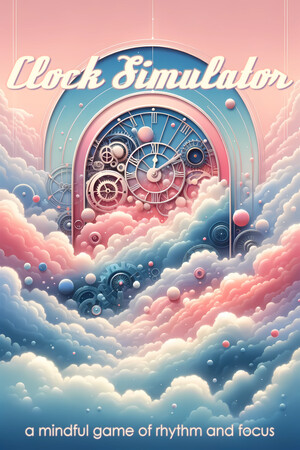
Compare Clock Simulator prices across 50+ stores and find the best deal. Developed by Kool2Play. Published by Kool2Play. Released on 7/20/2016. Available on PC, Mac, Linux. Genres: Indie, Simulation.

Harder than it has any right to be: clicking once per second sounds trivial until your brain starts second-guessing every tick and you unravel completely. A micro-commitment for mindfulness seekers or score-chasers with two spare minutes.

I spent more time mentally arguing with a mouse click than I care to admit, and that is the entire point of Clock Simulator. The core mechanic is stripped to something almost satirically minimal: press a button precisely once per second, every second, for as long as you can sustain it. No build orders, no tech trees, no resource loops. Just you, an analog clock face, and the quiet horror of realising that your internal rhythm is a complete mess. What Kool2Play pulled off is genuinely tricky to explain without sounding dismissive. The game wraps that single mechanic across a selection of modes, ranging from straightforward marathon runs where you try to maintain a streak without drifting early or late, to a digital clock variant that strips out the visual reference and forces pure feel, to a mode where a rope-jumping pig provides a secondary timing cue you have to sync with. The visual design is clean block-colour minimalism, and the audio is sparse ticking that becomes oddly meditative once you lock in. Critics on the Switch version noted the hypnotic quality of the colour and sound manipulation, and Steam user reception on PC has sat at Very Positive across nearly 450 reviews, which is a strange but real signal that something here resonates with people. Who is this actually for? Not strategy players looking for decision depth, and I say that as someone who colour-codes Paradox patch notes for fun. There is no decision tree here. What this game offers instead is a specific kind of single-tasking focus that is genuinely hard to find in modern releases. If you use breathing exercises, play ambient games to decompress, or just want something that will sharpen your sense of a second for no practical reason, Clock Simulator delivers that in short, efficient sessions. The average playtime on record hovers around two hours total, which is an honest ceiling to set expectations against. The honest downside is longevity. Reviewers across multiple outlets converged on the same ceiling: interest typically holds for around half an hour before the novelty plateaus, and without new mechanical hooks, there is little reason to return once the initial challenge of internalising the rhythm has been met. The eight Steam achievements give completionists a mild checklist, and the trading cards mean bundle hunters have a reason to fire it up, but do not expect a game that evolves. What you buy is what you get, and what you get is a focused, peculiar, surprisingly difficult proof of concept with zero ambition to be anything else. Diego, Scout Team

Clock Simulator
IndieSimulation

Clock Simulator

Jul 20, 2016Kool2Play
GamerScout Says

Harder than it has any right to be: clicking once per second sounds trivial until your brain starts second-guessing every tick and you unravel completely. A micro-commitment for mindfulness seekers or score-chasers with two spare minutes.

PCMacLinux
Best Price Available
0.00
at N/A
Historical low: $2.99

Compare Prices(0 stores)

Loading prices...

We may earn a commission when you buy games through links on this page — at no extra cost to you. It never affects our rankings or verdicts.

Screenshots & Media

Screenshot

About Clock Simulator

I spent more time mentally arguing with a mouse click than I care to admit, and that is the entire point of Clock Simulator. The core mechanic is stripped to something almost satirically minimal: press a button precisely once per second, every second, for as long as you can sustain it. No build orders, no tech trees, no resource loops. Just you, an analog clock face, and the quiet horror of realising that your internal rhythm is a complete mess. What Kool2Play pulled off is genuinely tricky to explain without sounding dismissive. The game wraps that single mechanic across a selection of modes, ranging from straightforward marathon runs where you try to maintain a streak without drifting early or late, to a digital clock variant that strips out the visual reference and forces pure feel, to a mode where a rope-jumping pig provides a secondary timing cue you have to sync with. The visual design is clean block-colour minimalism, and the audio is sparse ticking that becomes oddly meditative once you lock in. Critics on the Switch version noted the hypnotic quality of the colour and sound manipulation, and Steam user reception on PC has sat at Very Positive across nearly 450 reviews, which is a strange but real signal that something here resonates with people. Who is this actually for? Not strategy players looking for decision depth, and I say that as someone who colour-codes Paradox patch notes for fun. There is no decision tree here. What this game offers instead is a specific kind of single-tasking focus that is genuinely hard to find in modern releases. If you use breathing exercises, play ambient games to decompress, or just want something that will sharpen your sense of a second for no practical reason, Clock Simulator delivers that in short, efficient sessions. The average playtime on record hovers around two hours total, which is an honest ceiling to set expectations against. The honest downside is longevity. Reviewers across multiple outlets converged on the same ceiling: interest typically holds for around half an hour before the novelty plateaus, and without new mechanical hooks, there is little reason to return once the initial challenge of internalising the rhythm has been met. The eight Steam achievements give completionists a mild checklist, and the trading cards mean bundle hunters have a reason to fire it up, but do not expect a game that evolves. What you buy is what you get, and what you get is a focused, peculiar, surprisingly difficult proof of concept with zero ambition to be anything else. Diego, Scout Team

Tags

singleplayerachievementstrading-cardstier:sub-5MinimalistRhythm-PrecisionMicro-SessionScore-AttackMindfulnessSteam-Deck-Playable

Steam Deck & Linux

Steam Deck PlayableProtonDB Platinum

Valve rates this game Steam Deck Playable. Runs flawlessly on Linux out of the box. Based on 3 ProtonDB community reports.

System Requirements

Minimum

OS
Windows 7
Memory
1 GB RAM
DirectX
Version 9.0c
Storage
100 MB available space
Graphics
Intel HD Graphics 5000
Processor
Intel Core i5 1,4 GHz
Sound Card
Why not
Additional Notes
Resistance to time relativity can be helpful

Community Discussion

Be the first to comment on Clock Simulator.

Reviews & Ratings

No ratings available

Game Info

Developer
Kool2Play
Publisher
Kool2Play
Release Date
Jul 20, 2016

Price Alert

Get notified when the price drops below your target!

Create Alert

Price History

2026-06-102.99(lowest)

More from Kool2Play

Buy smarter: helpful guides

Looking for more? See games like Clock Simulator

Frequently asked questions about Clock Simulator

How much does Clock Simulator cost?

Clock Simulator pricing changes often and varies by store, edition and region. The live price table on this page compares the cheapest in-stock key and store offers across 50+ verified shops, so you always see the current lowest price before you buy.

Where can I buy Clock Simulator cheapest?

Compare Clock Simulator prices across every verified store in the price table on this page. We list the cheapest in-stock key and store offers, updated regularly, so you always see the best current deal before you buy.

What platforms is Clock Simulator available on?

Clock Simulator is available on PC, Mac, Linux.

When was Clock Simulator released?

Clock Simulator was released on 20 July 2016.

Who developed Clock Simulator?

Clock Simulator was developed by Kool2Play.