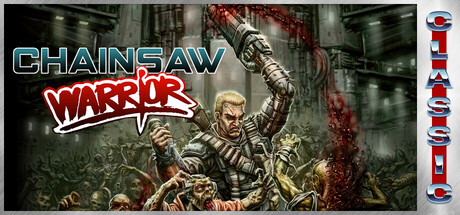
Chainsaw Warrior (Classic)
A faithful port of Games Workshop's notoriously cruel 1987 solo board game, where dice rule everything and even a great run can end on a single bad card flip.
GamerScout Verdict
Worth owning for fans of pure dice-and-card tension and Games Workshop history; a hard sell for anyone expecting meaningful build depth.
Compare Prices(0 stores)
Loading prices...
We may earn a commission when you buy games through links on this page — at no extra cost to you. It never affects our rankings or verdicts.
Price History
Screenshots & Media
About Chainsaw Warrior (Classic)
My first instinct, coming from a spreadsheet-and-systems background, was to look for the decision tree. Where are the branching build paths? Where is the optimization ceiling? Chainsaw Warrior answers with a shrug and a six-sided die. This is Auroch Digital's direct digital translation of the 1987 Games Workshop solo board game, and the word "translation" is doing real work there. The studio left the core mechanics almost completely intact: you roll to generate five character stats (endurance, wounds, hand-to-hand, reflexes, and marksmanship), spend rolled points on a loadout from a catalogue that includes body armor, a submachine gun, a laser lance, an implosion vest, a heat detector, and yes, a chainsaw, and then you flip your way through 108 house cards split across two 54-card decks. Each card costs 30 seconds off your 60-minute clock. Zombies, mutants, chaos agents, radiation traps, and empty rooms are all in there. Darkness is shuffled somewhere into the second deck. You find it, you kill it, or you lose. For a strategy-oriented player, the honest assessment is that genuine decision space here is narrow. Your equipment choices at the start are the closest thing to a build, and on Easy and Medium difficulties you can select specific items rather than take random allocations. On Hard, item selection is removed entirely, which means the dice are even more in control. The combat loop itself is binary: shoot (testing marksmanship) or go hand-to-hand (testing your HTH stat), with the outcome resolved by a roll against the relevant attribute. There is no positioning, no resource juggling mid-run, no branching card outcomes to read and exploit. What you get instead is pure probability tension, the kind that made the original board game a cult object despite its mechanical thinness. Where this lands for a modern PC player depends heavily on tolerance for that kind of randomness. Critics have pointed out that character generation offers no re-roll option, so a bad opening sequence can feel like a run over before it starts. The UI carries over some of the board game's procedural clutter: switching to hand-to-hand, for instance, still routes you through a weapon selection screen even when you only carry one melee weapon. There is no in-game rulebook, so newcomers may feel under-informed about how enemy types interact with specific stats or what certain equipment actually does in practice. The art style, pulled largely from the original 1987 cards with some digital polish, holds up in a grimy, pulpy way, and the audio ramps tension as you dig deeper into the second deck. The replayability argument is real, even if it is not a strategic one. Each run reshuffles the deck and re-rolls the stats, so no two playthroughs share the same opening position or card sequence. Sessions clock in at roughly 15 to 20 minutes on Easy or Medium, longer on Hard, which makes it a decent palette cleanser between longer strategy sessions rather than a main event. There is also a known technical note worth flagging: the game was pulled from active sale after Auroch Digital's publishing rights expired in 2021, meaning if you own a copy already you can still play it, but new purchases come through secondary markets. That context matters when evaluating it as a current purchase. For the board game archaeology crowd, or anyone who wants a low-overhead randomness gauntlet that respects the original design's cruelty, this hits that specific note cleanly. For players expecting depth of decision-making to match the grim sci-fi atmosphere, the gap between the premise and the mechanics will feel wider than the dimensional rift tearing Manhattan apart.

Strategy & simulation
Tags
System Requirements
Minimum
- OS
- Windows XP SP3
- Memory
- 1 GB RAM
- Storage
- 300 MB available space
- Processor
- Intel 1.6GHz Processor or equivalent
Recommended
- OS
- Windows 7
- Memory
- 2 GB RAM
- Storage
- 400 MB available space
- Graphics
- 512 MB Card or above.
- Processor
- Dual Core 2.0 or equivalent
DLC & Add-ons for Chainsaw Warrior (Classic)1
Expansions, DLC packs and add-on content for this game. Click any item to see store offers.
Keep exploring
Community Discussion
Be the first to comment on Chainsaw Warrior (Classic).
Reviews & Ratings
No ratings available
Game Info
- Developer
- Auroch Digital
- Publisher
- Auroch Digital
- Release Date
- Oct 7, 2013