
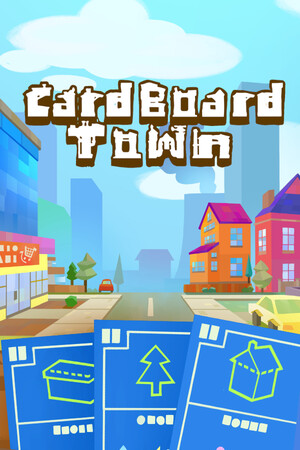
Cardboard Town
City-building meets roguelite card play in a package that pulls off the "one more run" trick better than its low-key profile suggests. Worth sizing up before the genre gets crowded.
GamerScout Verdict
Strong pick for city-builder fans who want a roguelite card loop they can learn in an hour and replay for dozens more.
Compare Prices(0 stores)
Loading prices...
We may earn a commission when you buy games through links on this page — at no extra cost to you. It never affects our rankings or verdicts.
Price History
Screenshots & Media
About Cardboard Town
I'll be straight with you: I came into Cardboard Town expecting a throwaway casual time-sink and walked out having lost a Saturday afternoon to it. The hook is deceptively simple. Each turn you draw from a shared pool of over 100 Building and Action cards, spend Money to place them on a Monopoly-board-style isometric grid, and try to keep four municipal stats balanced: Water, Electricity, Safety, and Environment. Population growth directly controls your Money income per turn, so the classic city-builder tension of "expand fast vs. build stable infrastructure" is baked right into the card economy. Let your Safety stat crater while you're busy stacking residential apartments, and you'll hit a Red Alert. Accumulate three Red Alerts and the run ends. That three-strike structure is merciful enough to let beginners learn, but punishing enough to keep veterans honest. The card system is where the strategy lives, and it rewards patient thinkers more than impulsive placers. Action Cards serve as emergency responses to random disasters and festivals, but holding too many clogs your hand when you need Building Cards to keep stats above water. Early runs suffer from deck bloat, and the developer has acknowledged this directly with post-launch updates that added card-removal tools including an Action Card that destroys other cards on demand and a Booster Pack Factory building. The result is that newer runs give you meaningful deck-shaping decisions from days four through seven, which changes the mid-game calculus considerably. It is still not a full-fat deckbuilder, and the developers are upfront about that; think of the cards as a constrained selection layer on top of a city-sim, not a Slay-the-Spire-style synergy engine. Run variety comes from the nine game modes, which range from a beginner-friendly Utopia mode (no Red Alerts, just pure city expression) to the Expert mode that strips your starting Officer and reduces starting resources. Democratic Town adds a strict 100-day time limit, while Quick Decision mode discards your unplayed hand at the end of each day, forcing faster, riskier calls. Rural Town quadruples natural terrain objects, making grid planning genuinely harder and rewarding spatial thinkers. The meta-progression loop has you earning Votes at the end of each run to unlock new building cards, festivals, and cosmetics, which keeps the early sessions feeling fresh even when you lose quickly. Community reception has settled around a Very Positive rating on Steam across roughly two thousand reviews, which for a sub-five-dollar indie is a meaningful signal. The rough edges are real and worth naming. The background music has been flagged by multiple reviewers as thin and repetitive, doing little to set atmosphere across longer sessions. Late-game quest cards can arrive in difficult clusters, and if you have not built the right Action Card buffer, a single bad draw sequence can end a run that felt well-managed up to that point. The difficulty spikes feel random rather than designed, which will frustrate players who want to feel punished for specific mistakes rather than RNG timing. There is no multiplayer, and mod tooling is absent from the Steam build, so the long-term ceiling is lower than it would be with community content. For a genre veteran accustomed to Paradox-depth simulations, Cardboard Town satisfies as a commute-length puzzle box, not a 200-hour campaign. For the right audience, specifically players who want a city-builder they can genuinely finish in a sitting and reset without guilt, this is a well-tuned loop. Newcomers to the genre should start in Classic mode, read the pop-up hints (they are actually useful), and prioritize balancing all four stats before chasing population growth. The hand-drawn cardboard aesthetic gives it a tactile charm that screenshots do not fully capture. Stratera Games have kept patching it well past what most small studios commit to, and that matters.

Strategy & simulation
Tags
System Requirements
Minimum
- OS
- Windows 7
- Memory
- 4 GB RAM
- DirectX
- Version 8.0
- Storage
- 1 GB available space
- Graphics
- NVIDIA GeForce 840M
- Processor
- Intel Pentium CPU G860
Keep exploring
Community Discussion
Be the first to comment on Cardboard Town.
Reviews & Ratings
No ratings available
Game Info
- Developer
- Stratera Games
- Publisher
- Rogue Duck Interactive
- Release Date
- Aug 18, 2023