Budget Cuts
One of the sharpest VR stealth games ever made, but its three-to-four hour runtime will leave you wanting a second act that the base game never quite delivers.
GamerScout Verdict
Ideal for PCVR players wanting a tight, mechanics-first stealth game, if you can accept a short campaign with an abrupt ending.
Compare Prices(3 stores)
Every store in this table quotes us in euros, so the EUR figure is the price the seller actually set, not our arithmetic — which is why EUR is also the currency we rank in. We only list an offer here when the store gives us its price in euros, so nothing in this table is a number we invented.
Pick USD, PLN, GBP, CAD or AUD in the header and we convert from EUR at the European Central Bank reference rate — converted amounts are prefixed with ~. Your bank or the store may apply a different rate at checkout. We never hide offers based on where you are: everyone sees this whole table.
We may earn a commission when you buy games through links on this page — at no extra cost to you. It never affects our rankings or verdicts.
Price History
Screenshots & Media
About Budget Cuts
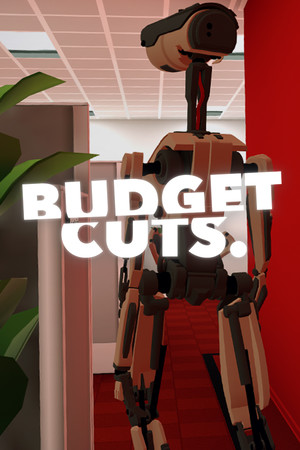
My first time firing the TransLocator into an unsuspecting corridor and watching a little scout-sphere bounce off a wall to reveal two armed robot guards, I felt something rare in VR: genuine tactical suspense. Neat Corporation, a small Stockholm studio, built their reputation on this one clever idea, and Budget Cuts earns it. You are the last human employee at TransCorp, a corporate dystopia populated entirely by robotic managers and security guards with very bad intentions. A mysterious ally named Winta feeds you breadcrumbs over the phone while you crawl through ventilation shafts, hide behind cubicle partitions, and decide whether to ghost every room or go loud with a fistful of thrown scissors. The TransLocator is the heart of everything here. It is not a simple teleport button. You fire it, watch the projectile arc and bounce through a space, and study the live preview of wherever it lands before committing to the jump. That scouting mechanic transforms VR teleportation from a concession to motion sickness into a genuine stealth tool. Neat Corporation also built an anti-cheating layer into the physics: peek your head through a door or a grate and your view blacks out until your whole body crosses the threshold. It forces you to physically crouch, lean, and commit to each move in a way that feels beautifully intentional. Knife and scissors throwing is the other pillar, with the physics tuned so that a missed throw sends a guard spinning toward you with a gun raised, turning a clean execution into a white-knuckle scramble. The world itself carries a quiet, sardonic charm. Office noticeboards hold dry jokes about automation policy and Taco Tuesday. The environments are deliberately plain in palette, all beige cubicles and grey vents, which suits the corporate satire and keeps the visual noise low enough that you focus on threat tracking rather than scenery. The ambient audio does real work here: the hum of a patrol bot, the faint click of its footsteps on tile, the alarm shriek that hits like a defibrillator when a guard spots your elbow around a corner. Sound design this attentive in a small indie VR title deserves a mention. Where the game pulls back from greatness is length and polish. A focused run lands somewhere between three and four hours, and the campaign ends in a way that feels less like a conclusion than a chapter break. Enemy AI is exploitable once you learn its rhythms, and some players will clear every guard in a room and then spend equal time being lost, unsure which unmarked panel opens the next path. There is also one genuinely tense cat-and-mouse sequence with a larger, unkillable enemy that the game does not do enough with. Bugs, historically, have caused occasional frustration, from erratic guard pathing to geometry snags. The Arcade mode, unlocked post-campaign, adds four score-attack levels and multiple difficulty tiers, which extends the life a little, but replay motivation stays low once the story beats are known. For VR newcomers wanting a proof-of-concept that the medium can support real game design, Budget Cuts still works well as that argument. For veterans who lived through the 2016 demo hype, the full game pays that promise off, mostly. It knows what it is, it commits to its single central idea with care, and when the mechanics click, the feeling of teleporting behind a guard and drawing back a letter opener is quietly exhilarating in a way that is hard to replicate outside a headset.

Indie & narrative
Tags
System Requirements
Minimum
- OS
- Windows 7 SP1 or newer
- Memory
- 6 GB RAM
- Graphics
- GeForce GTX 970/1060 or Radeon RX 480
- Processor
- Intel i5-4590 / AMD Ryzen 1500X
- VR Support
- SteamVR. Standing or Room Scale
Keep exploring
Community Discussion
Be the first to comment on Budget Cuts.
Reviews & Ratings
Game Info
- Developer
- Neat Corporation
- Publisher
- Neat Corporation
- Release Date
- Jun 14, 2018