
Bloomtown: A Different Story
Persona's cozy, creepier little sibling: a 15-20 hour JRPG set in 1960s smalltown America where demon-collecting and dice-roll skill checks live alongside fishing, gardening, and a soundtrack that hits harder than it has any right to.
GamerScout Verdict
Best for Persona-curious players who want the vibe and demon-collecting in a focused 15-20 hour package without the 100-hour commitment.
Compare Prices(9 stores)
Every store in this table quotes us in euros, so the EUR figure is the price the seller actually set, not our arithmetic — which is why EUR is also the currency we rank in. We only list an offer here when the store gives us its price in euros, so nothing in this table is a number we invented.
Pick USD, PLN, GBP, CAD or AUD in the header and we convert from EUR at the European Central Bank reference rate — converted amounts are prefixed with ~. Your bank or the store may apply a different rate at checkout. We never hide offers based on where you are: everyone sees this whole table.
We may earn a commission when you buy games through links on this page — at no extra cost to you. It never affects our rankings or verdicts.
Price History
Screenshots & Media
About Bloomtown: A Different Story
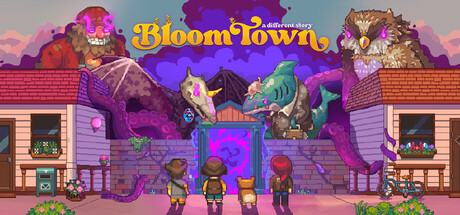
I spent a weekend with Bloomtown: A Different Story fully expecting a budget knockoff riding Persona's coattails, and walked away genuinely charmed in ways I did not predict. The pitch sells itself on atmosphere first: a sun-drenched 1960s American summer, kids on bikes, a crotchety grandfather, and the specific dread of children going missing that nobody wants to talk about. Lazy Bear Games, the Lithuanian studio behind Graveyard Keeper, clearly loves genre pastiche, and here they pair that sunlit surface with a demon underworld called the Underside, where Emily, her brother Chester, and their odd little party venture every night under a contract with Lucifer himself. It is a strange, sincere, slightly absurd setup, and it works. The structure borrows heavily from Persona's day-and-night rhythm. By day, Emily manages social stats (Guts, Proficiency, Charm, and Smart), does part-time shifts at the grocery store, works the garden, fishes, solves crossword puzzles in the newspaper, and builds relationships with party members and townsfolk whose side-quest arcs unlock new combat abilities. By night, she enters the Underside to fight through dungeon corridors, exploit elemental weaknesses to down enemies, and attempt demon captures via a dice-roll skill check. Subdued enemies can be added to your roster and fused with others to build out each party member's secondary spell set. Hugo, a centuries-old corgi who transforms into a muscle-bound gunslinger in the Underside, is the most unhinged party member in a game from the last few years, and I mean that as a compliment. Crucially, Bloomtown removes Persona's punishing calendar pressure almost entirely: there are no hard deadlines on dungeons, time moves slowly, and fast travel opens early, which makes the whole thing breathe at a gentler pace than its inspirations. The pixel art is where the craft shows most clearly. Both zones, the warm, almost over-saturated Bloomtown streets and the sickly, neon-tinged Underside, feel intentionally distinct rather than just cosmetically different. Enemy designs range from sword-wielding broccoli to cats in top hats, which should tell you something about the tone. And the soundtrack. I want to dwell on the soundtrack. Battle music here has fully sung vocals, and the game rotates between multiple tracks so repetition barely registers. Several critics and players flagged it independently as one of the best they heard in 2024, and I agree. The sound design alone elevates fights that might otherwise feel mechanical. That said, Bloomtown is not a seamless experience. The Persona comparison cuts both ways: combat is fun but lacks some of the tightness of its inspirations, the demon fusion system is underdeveloped enough that many players skip it after a few hours, and dialogue occasionally breaks the 1960s illusion with modern phrasing that is clearly a product of a non-Anglophone team working from cultural memory rather than lived experience. Character arcs are more interesting inside optional social link events than they are inside the main plot, where the writing moves quickly and leaves some threads feeling thin. The day-and-night structure also creates a mild disconnect: characters talk as though there is urgency, but mechanically nothing punishes patience, which dulls stakes without quite eliminating them. For narrative JRPG fans who find the Persona series intimidating in length, or who want something that prioritizes handcrafted mood over systems depth, Bloomtown lands well within the 15-to-20 hour window most players report, and it ends before it overstays its welcome. That discipline matters. A game that knows its scale and fills it rather than inflating it is a rarer thing than it should be, and this one pulls it off with enough warmth and genuine weirdness to stick with you after the credits roll.

Indie & narrative
Tags
System Requirements
Minimum
- OS
- Windows 7
- Memory
- 4 GB RAM
- DirectX
- Version 11
- Storage
- 1 GB available space
- Graphics
- Nvidia 450 GTS / Radeon HD 5750 or better
- Processor
- Dual Core 2.4 GHz
Recommended
- OS
- Windows 10
- Memory
- 8 GB RAM
- DirectX
- Version 12
- Storage
- 1 GB available space
- Graphics
- Nvidia GTX 460 / Radeon HD 7800 or better
- Processor
- Dual Core 2.8 GHz
Keep exploring
Community Discussion
Be the first to comment on Bloomtown: A Different Story.
Reviews & Ratings
No ratings available
Game Info
- Developer
- Lazy Bear Games
- Publisher
- Twin Sails Interactive
- Release Date
- Sep 24, 2024



![[18+] Social Sunday | We're just fiddling around and having fun today](https://static-cdn.jtvnw.net/previews-ttv/live_user_lunarinlynx-440x248.jpg)