Binaries
Control two balls with one brain simultaneously across 100+ devious levels - a BAFTA-nominated reflex-puzzle that will make you question your own motor skills.
GamerScout Verdict
Ideal for precision-platformer devotees who enjoy the Super Meat Boy loop, but a hard sell for anyone who needs narrative fuel to push through difficulty walls.
Compare Prices(5 stores)
Every store in this table quotes us in euros, so the EUR figure is the price the seller actually set, not our arithmetic — which is why EUR is also the currency we rank in. We only list an offer here when the store gives us its price in euros, so nothing in this table is a number we invented.
Pick USD, PLN, GBP, CAD or AUD in the header and we convert from EUR at the European Central Bank reference rate — converted amounts are prefixed with ~. Your bank or the store may apply a different rate at checkout. We never hide offers based on where you are: everyone sees this whole table.
We may earn a commission when you buy games through links on this page — at no extra cost to you. It never affects our rankings or verdicts.
Price History
Screenshots & Media
About Binaries
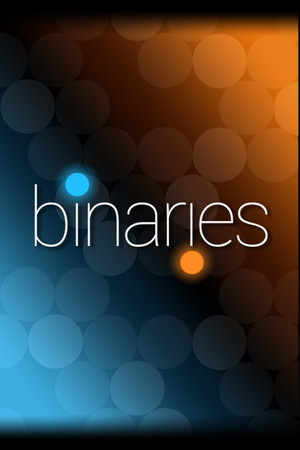
I'll be honest: the first six levels of Binaries lied to me. They felt gentle, almost kind. Two small coloured balls, a simple jump, a tidy little finish line. Then the spikes arrived, and the turrets, and the gravity manipulators, and I understood that Edinburgh's Ant Workshop had been quietly setting a trap the whole time. The core conceit is genuinely fresh. You control a blue ball and an orange ball simultaneously using a single set of inputs. Move left and they both move left. Jump and they both jump. The catch is that the two balls are never in the same position on screen, so any input that saves one will often doom the other. Reviewers who covered Binaries consistently landed on the same word: infuriating. But, crucially, infuriating in the way a good puzzle is infuriating rather than the way an unfair game is infuriating. When you fail, it is almost always because you watched the wrong ball for a split second. The controls are precise, the jump arc is trustworthy, and respawning is instant, so blame stays squarely with the player. The hazard design is one of the game's quietest strokes of craft. Spikes, turrets, and portals are colour-coded to match each ball, meaning the blue ball can walk clean over orange spikes, and vice versa. That rule, once it clicks, opens up a second layer of spatial reasoning on top of the already demanding split-attention challenge. Levels are laid out on a non-linear map, so if a particular stage bricks you completely you can detour and return later. Completion is graded on time, with S, A, B, and the gently shaming U rank for slower runs, which adds a replay hook for anyone who wants more than a single clear. The game also carries a dynamic soundtrack that shifts tempo and intensity in response to your performance - calmer when you are struggling, faster when you are rolling. Where Binaries shows its limits is with a narrow audience ceiling. If you are not already comfortable with the Super Meat Boy school of die-retry-die-again platforming, the middle third of the game's 100-plus levels will feel like a wall rather than a curve. There is no story to carry you through friction, no character arc, and the in-level text jokes, while genuinely funny at first, cannot substitute for mechanical variety across a long session. The visual style is clean and minimal, which suits the game's demands perfectly but will not move anyone who needs spectacle alongside challenge. For what it is - a two-person Edinburgh studio's first major release, BAFTA-nominated, built on a mechanic that nobody had quite tried before - Binaries earns real respect. It knows its shape, it respects the player's time per attempt, and it has the quiet confidence of something made by people who thought hard about exactly one problem and solved it well.

Indie & narrative
Tags
System Requirements
Minimum
- OS
- Windows 7/8/10
- Memory
- 2 GB RAM
- DirectX
- Version 11
- Storage
- 500 MB available space
- Graphics
- GeForce 8800 or equivalent
- Processor
- 2.0 GHz Dual Core Processor
Keep exploring
Community Discussion
Be the first to comment on Binaries.
Reviews & Ratings
No ratings available
Game Info
- Developer
- Ant Workshop Ltd
- Publisher
- Ant Workshop Ltd
- Release Date
- Apr 4, 2016