
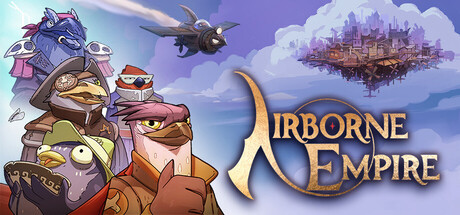
Airborne Empire
Managing lift, weight, and pirate attacks simultaneously is the kind of layered puzzle that will either hook you for 80 hours or send you back to flat ground. Worth knowing which side you're on before you buy.
GamerScout Verdict
Best for city-builder fans ready to swap grid optimization for lift physics and aerial pirate skirmishes.
Compare Prices(2 stores)
Every store in this table quotes us in euros, so the EUR figure is the price the seller actually set, not our arithmetic — which is why EUR is also the currency we rank in. We only list an offer here when the store gives us its price in euros, so nothing in this table is a number we invented.
Pick USD, PLN, GBP, CAD or AUD in the header and we convert from EUR at the European Central Bank reference rate — converted amounts are prefixed with ~. Your bank or the store may apply a different rate at checkout. We never hide offers based on where you are: everyone sees this whole table.
We may earn a commission when you buy games through links on this page — at no extra cost to you. It never affects our rankings or verdicts.
Screenshots & Media
About Airborne Empire
I have a colour-coded spreadsheet for most city builders I sink serious time into. Airborne Empire earned its own tab fast, because the decision-making here is genuinely three-dimensional. Every building you place shifts your city's weight distribution, and that tilt is not a cosmetic warning: let it creep past a threshold and your workers slow down, production chains stall, and your fuel economy collapses before a pirate raid even arrives. The core discipline of the game is not "grow as fast as possible" but rather "grow only as fast as your balance budget allows." That inversion of the usual city-builder instinct is where most of the interesting tension lives. The flight physics sit on top of a fairly orthodox resource loop. You assign workers to harvesting, manage fuel stocks (run dry and your city falls, literally), plan lighting infrastructure to prevent nighttime accidents and fires, and research new buildings through an Academy unlock tree. The tree is genuinely large, but not everything in it pulls its weight equally: vertical expansion tools that reduce drag are almost always the correct early investment, while defensive upgrades feel optional until they suddenly are not. Five biomes (the lush Aeyrie, the volcanic Blackspine, the frozen Kingsfell, and others) each apply regional rule changes. Frozen zones can stall your engines outright and require heat management; humid zones accelerate water production but degrade structures over time. The biome transitions do meaningful work in preventing mid-game stagnation. Combat, which was absent from predecessor Airborne Kingdom, is now a permanent part of the agenda. Sky pirates escalate across 20 stages in Survival Mode, and the correct counter-play is to use your city's mobility offensively: kite backwards while your defensive turrets and hangar-launched attack planes chip away at incoming threats. If you wait for pirates to reach your walls, you have already made a mistake. The Adventure Mode wraps a quest structure around this, asking you to liberate towns, trade with NPC kingdoms, and collect relics across the open world. Critic reception on that mode has been mixed: the RPG stitching is serviceable rather than deep, and players who want a proper narrative RPG will find the writing thin. Players who treat quests as a navigation reward system for exploring the map will get considerably more out of it. Pacifist Mode and Creative Mode exist for those who want to skip combat entirely or stress-test city layouts without resource pressure. The accessibility choices are genuinely thoughtful and worth naming if you are recommending this to a cautious newcomer: the game supports mouse-only input, adjustable difficulty sliders, a save-anywhere system, and a Pacifist Mode that removes combat entirely. That combination means a player who has never touched a city builder can set the difficulty low, ignore pirates, and learn the lift-and-balance puzzle at their own pace before dialling up the pressure. For genre veterans, Hard Mode with custom sliders offers a different contract entirely. The community in 2026 has largely converged on a "modular hub" layout philosophy because worker travel time directly affects fuel efficiency, and that kind of emergent meta is a good sign for decision depth. There is no mod ecosystem to speak of at this stage, which is the one gap that would make a longer-term investment feel more secure. Steam reviews sit at 88 percent positive across over 900 reviews, which for a niche hybrid like this reflects a player base that understood what they were buying.

Strategy & simulation
Tags
System Requirements
Minimum
- OS
- Windows 10
- Processor
- Intel Core i5-8400 / AMD Ryzen 5 1600
- Graphics
- NVIDIA GeForce GTX 660, 2 GB VRAM / AMD Radeon HD 7870, 2 GB VRAM
Recommended
- OS
- Windows 11
- Processor
- Intel Core i7-10700 / AMD Ryzen 7 3700x
- Graphics
- NVIDIA 2060 Super RTX 8 GB VRAM / AMD RX 5700 8 GB VRAM
Keep exploring
Community Discussion
Be the first to comment on Airborne Empire.
Reviews & Ratings
Game Info
- Developer
- The Wandering Band LLC
- Publisher
- Stray Fawn Publishing, The Wandering Band LLC
- Release Date
- Apr 17, 2026