80 Days
A steampunk Jules Verne adaptation where every route around the world tells a different story. Choice-heavy, replayable, and genuinely tense on a ticking clock.
GamerScout Verdict
Best for players who want Jules Verne with actual decisions to make and enough branching to justify five or more runs.
Compare Prices(6 stores)
Every store in this table quotes us in euros, so the EUR figure is the price the seller actually set, not our arithmetic — which is why EUR is also the currency we rank in. We only list an offer here when the store gives us its price in euros, so nothing in this table is a number we invented.
Pick USD, PLN, GBP, CAD or AUD in the header and we convert from EUR at the European Central Bank reference rate — converted amounts are prefixed with ~. Your bank or the store may apply a different rate at checkout. We never hide offers based on where you are: everyone sees this whole table.
We may earn a commission when you buy games through links on this page — at no extra cost to you. It never affects our rankings or verdicts.
Price History
Screenshots & Media
About 80 Days
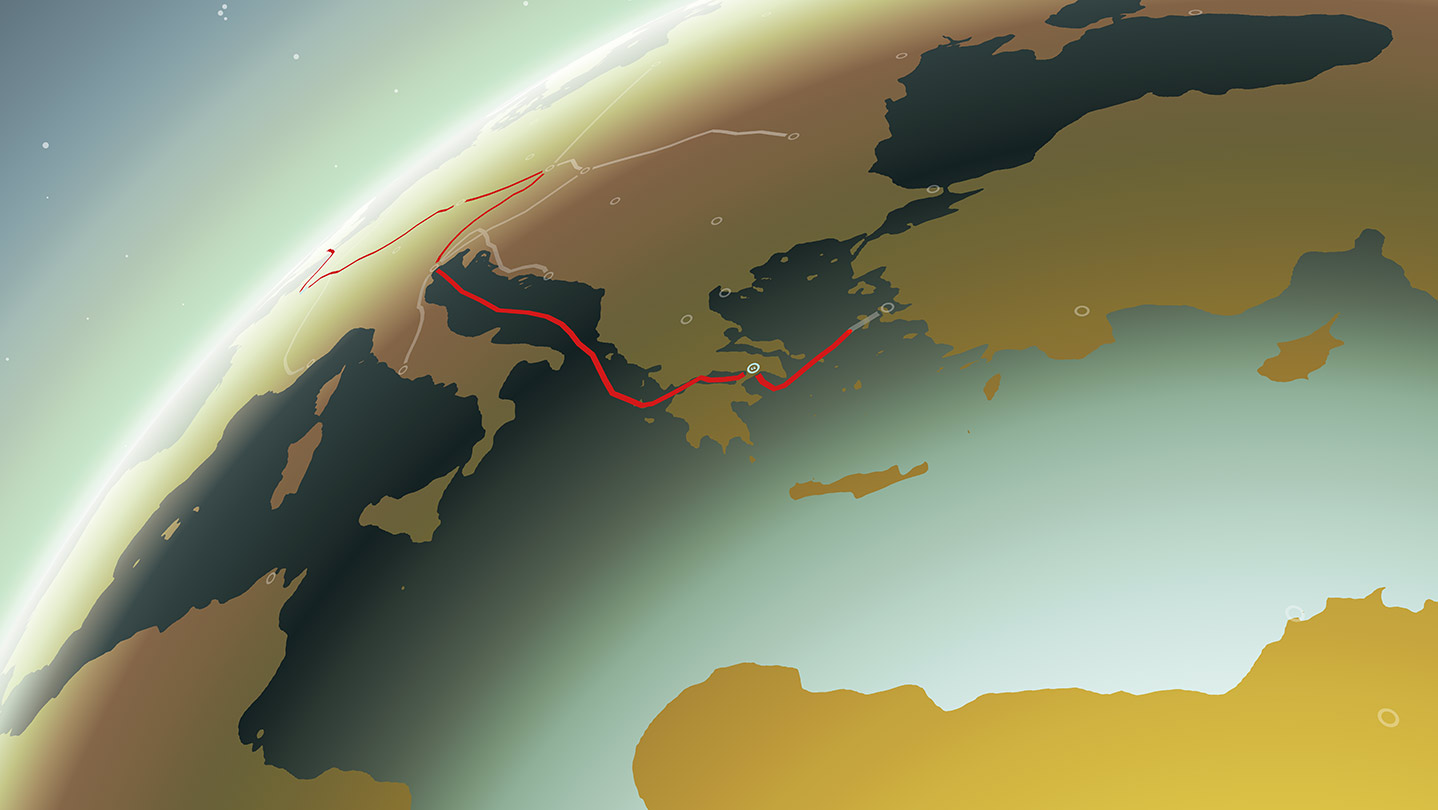
80 Days is a narrative strategy game built on one deceptively simple constraint: get Phileas Fogg around the world in 80 days or lose the bet. You play as Passepartout, his valet, managing money, health, luggage, and a branching web of travel routes across a steampunk-reimagined 1872 globe. Every city is a decision node. Do you take the faster airship that costs more and risks Fogg's fragile constitution, or the slower steam-train that leaves time to earn cash by trading goods along the way? Those decisions compound fast, and a route that looked clever on day 20 can strand you in Bombay with an empty wallet on day 50. For a strategy-minded player, the depth here is in route optimization and resource juggling. inkle built a world map with well over 150 cities, each connected by different transit options that vary in speed, cost, and risk. You are constantly solving a traveling-salesman problem with narrative chaos injected at every stop. Side conversations with characters can unlock faster routes, cheaper passages, or items that open entirely new branching paths on subsequent playthroughs. The game rewards players who treat the first run as reconnaissance and come back with a proper plan. Where 80 Days earns its Very Positive rating is in the writing. The prose is sharp, politically layered for a Victorian adventure, and avoids the sanitized globe-trotting fantasy you might expect. Cities feel distinct. A stop in Tehran plays nothing like one in Dakar or Yokohama, and the steampunk technology in each region is invented with internal consistency rather than slapped on for aesthetics. The branching is genuinely wide: inkle claims around 750,000 words of content, and after multiple runs you will still hit story fragments you have never seen. That is the honest replay value, not an inflated statistic. The strategy layer is light enough that pure narrative gamers will not bounce off it, but deep enough to give min-maxers something to optimize. There is no mod ecosystem to speak of, and the AI opponent element, racing other players' ghost routes via an asynchronous leaderboard, is a minor feature rather than a core loop. The tutorial is minimal by design, which actually works here because the game is legible from the first screen. New players should not be intimidated: the worst outcome is arriving late, which just means starting a new run with better knowledge. The game respects your time by keeping individual sessions short even if total hours accumulate quietly. The main criticism worth flagging is that the PC version, released in 2015, feels like a polished mobile port in its interface. Text is large, menus are tap-friendly, and there is no complexity in the UI that would make a spreadsheet person feel at home. The lack of a detailed stats screen or route history is a genuine omission for players who want to analyze decisions post-run. It is a game that trusts narrative memory over data logging, which is a deliberate choice but not everyone's preference. If you like the idea of a replayable choose-your-own-adventure where timing and money management actually matter, and where the writing is good enough to make you care about a mechanical camel race across the Sahara, 80 Days delivers that with unusual consistency across its 80-day runtime.

Strategy & simulation
Tags
System Requirements
Minimum
- Processor
- 2 Ghz with SSE2 instruction set support
- Memory
- 2 GB RAM
- Graphics
- Hardware support for shader model 3
- DirectX
- Version 9.0c Hard Drive: 2 GB available space
Recommended
- Processor
- 4 Ghz with SSE2 instruction set support
- Memory
- 4 GB RAM
- Graphics
- Intel Iris 6100 equivalent or better
- DirectX
- Version 9.0c
- Storage
- 2 GB available space
- Sound Card
- Pre…
Keep exploring
Community Discussion
Be the first to comment on 80 Days.
Reviews & Ratings
Game Info
- Developer
- inkle Ltd
- Publisher
- inkle Ltd
- Release Date
- Sep 28, 2015