
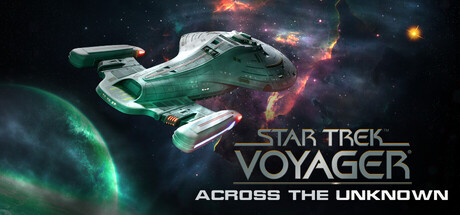
Star Trek: Voyager - Across the Unknown
FTL meets XCOM in the Delta Quadrant: a cycle-based ship-management roguelite where every deuterium tank, morale point, and research choice is a dominoes tile waiting to fall. Trekkies will be hooked; patient strategy fans should follow closely.
Veredicto de GamerScout
Best for strategy fans who want a resource-management puzzle wrapped in Voyager lore and are comfortable with autosave-enforced consequences.
Comparar precios(9 tiendas)
Todas las tiendas de esta tabla nos dan el precio en euros, así que la cifra en EUR es el precio que fijó el vendedor, no un cálculo nuestro, y por eso EUR es también la moneda en la que calculamos el ranking. Solo incluimos aquí una oferta cuando la tienda nos da su precio en euros, de modo que ninguna cifra de esta tabla es inventada por nosotros.
Elige USD, PLN, GBP, CAD o AUD en la cabecera y convertimos desde EUR con el tipo de cambio de referencia del Banco Central Europeo — los importes convertidos llevan el prefijo ~. Tu banco o la tienda pueden aplicar un tipo distinto al pagar. Nunca ocultamos ofertas según dónde estés: todo el mundo ve esta tabla completa.
We may earn a commission when you buy games through links on this page — at no extra cost to you. It never affects our rankings or verdicts.
Historial de precios
Capturas y multimedia
Acerca de Star Trek: Voyager - Across the Unknown
My spreadsheet instincts lit up within the first sector. The cycle-based progression framework here is tighter than it initially looks: every action, from node travel to tech research, burns time and deuterium simultaneously, and the two resources are in constant competition for your attention. Run low on fuel and you stall; linger too long scavenging and crew morale degrades toward mutiny. That knife-edge is the game's best design idea, and it stays sharp across all twelve randomly-ordered sectors of the journey home. The ship management layer is where Across the Unknown earns serious respect. Voyager is rendered as a side-view grid of rooms, each requiring resources to construct, power from the warp core to run, and often prior tech research to unlock. The tech tree splits across five branches: Engineering, Crew, Science, Combat, and Borg, and committing too early to one line leaves obvious gaps. Want phaser control stations and shield generators on every deck? Fine, but then you are skipping the holodeck and hydroponics bay that fight morale decay, which forces heavier use of power-hungry replicator stations to feed the crew. Every build path creates a cascading problem somewhere else. That is exactly the kind of systemic depth I look for. Comparisons to XCOM 2's base-building and FTL's scarcity loop are fair and not flattering by accident; this game was clearly built by people who studied both. Away missions and ship combat round out the loop. Away missions are text-and-percentage-chance affairs where the skills of your three chosen hero characters determine success odds, which can frustrate if RNG goes against you repeatedly. Ship combat puts you in the captain's chair issuing targeting orders, directing torpedo use, reallocating shield quadrants, and triggering hero abilities rather than flying manually. The autopilot positioning has a known weakness against large targets like Borg cubes, and several reviewers flagged the combat as the weakest pillar. That assessment is fair. The narrative and resource layers carry far more weight, and the combat functions adequately as a pressure release valve rather than a standalone draw. Voice acting coverage is thin outside the sector-opening logs voiced by original actors Tim Russ and Robert Duncan McNeill, and most story beats are delivered in text, which will suit fans of interactive fiction but may disappoint players expecting a voiced production. For non-Trekkies wondering if the license gates them out: it does not, but it does add a ceiling on how much you will get from the story. The game includes genuine franchise deep cuts, in-universe jokes, and branching decisions that break canon in meaningful ways, including named crew deaths and choices around Borg technology adoption. Modders on PC are already active post-launch, and the developer has shipped several patches quickly, including a substantial Delta Flyer update that adds a new Tom Paris questline in Sector 7, construction mechanics for the Shuttlebay, and combat ally functionality. The autosave-only structure remains divisive in community feedback, but it does enforce the rogue-lite tension the design clearly wants. Three difficulty levels exist, and the in-game tutorial respects newcomers without hand-holding experienced strategy players to death. The budget ceiling shows in animation quality and audio depth, and the RNG can pile bad luck in ways that feel unfair rather than challenging. But the systemic decision-making, the genuine "what if" branching across all seven seasons of the show, and a post-launch support cadence that suggests the developers are listening all point in the right direction. If your comfort zone is management-heavy strategy and you have any affinity for the source material, this is a better-built game than its modest production values initially suggest.

Strategy & simulation
Etiquetas
Requisitos del sistema
Mínimos
- OS
- WIn 11 64 Bit
- Memory
- 16 GB RAM
- DirectX
- Version 12
- Storage
- 11 GB available space
- Graphics
- NVIDIA GeForce GTX 1060 (6GB) or AMD Radeon RX 580 (8GB)
- Processor
- AMD Ryzen 5 2600 or Intel Core i5-8500
Recomendados
- OS
- WIn 11 64 Bit
- Memory
- 16 GB RAM
- DirectX
- Version 12
- Storage
- 11 GB available space
- Graphics
- NVIDIA GeForce RTX 3060 or AMD Radeon RX 5700 XT
- Processor
- AMD Ryzen 7 7800X3D or Intel Core i5-14600K
Sigue explorando
Community Discussion
Be the first to comment on Star Trek: Voyager - Across the Unknown.
Reseñas y valoraciones
Información del juego
- Desarrolladora
- Gamexcite
- Distribuidora
- Daedalic Entertainment
- Fecha de lanzamiento
- 18 feb 2026