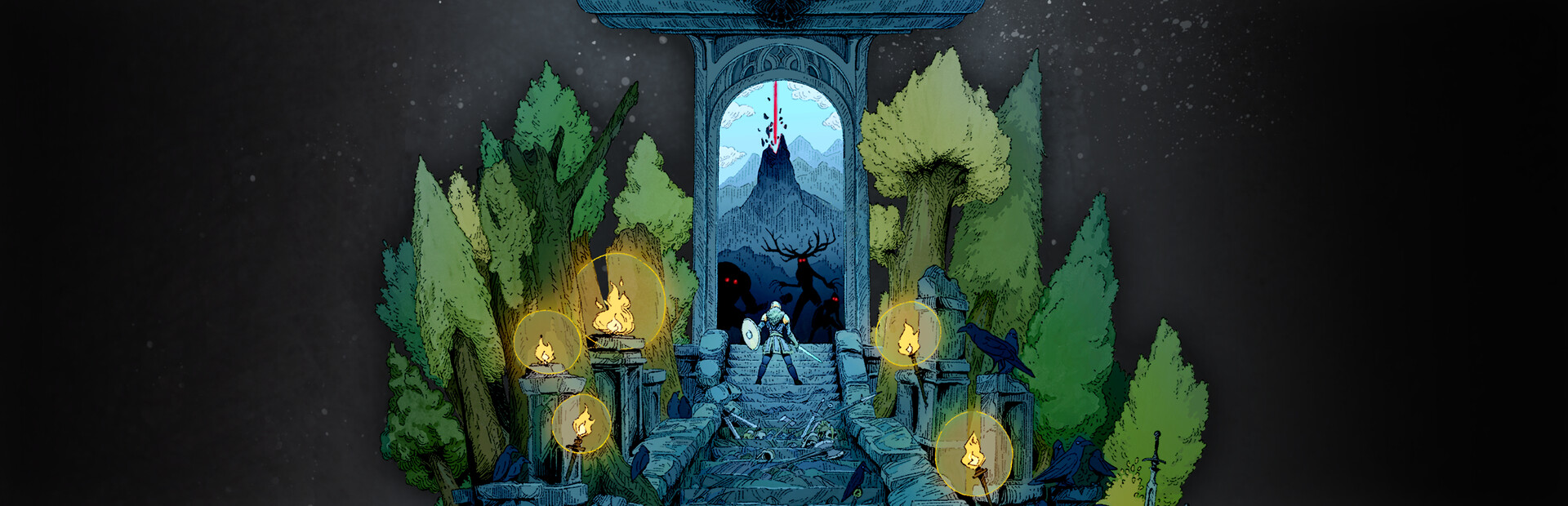

Ravenbound
A gorgeous Scandinavian folklore setting glued onto a roguelite skeleton that never quite fills out its bones. Worth a look at a deep discount if the card-driven, permadeath loop appeals to you more than the open world does.
Veredicto de GamerScout
Best for roguelite die-hards who can overlook a hollow open world in exchange for tight card-build tinkering at a steep discount.
Comparar precios(7 tiendas)
Todas las tiendas de esta tabla nos dan el precio en euros, así que la cifra en EUR es el precio que fijó el vendedor, no un cálculo nuestro, y por eso EUR es también la moneda en la que calculamos el ranking. Solo incluimos aquí una oferta cuando la tienda nos da su precio en euros, de modo que ninguna cifra de esta tabla es inventada por nosotros.
Elige USD, PLN, GBP, CAD o AUD en la cabecera y convertimos desde EUR con el tipo de cambio de referencia del Banco Central Europeo — los importes convertidos llevan el prefijo ~. Tu banco o la tienda pueden aplicar un tipo distinto al pagar. Nunca ocultamos ofertas según dónde estés: todo el mundo ve esta tabla completa.
We may earn a commission when you buy games through links on this page — at no extra cost to you. It never affects our rankings or verdicts.
Historial de precios
Capturas y multimedia
Acerca de Ravenbound
My first few minutes with Ravenbound were genuinely exciting. You drop into the island of Ávalt as a Vessel, a disposable warrior bound to a magical raven, and the world looks striking enough to make you want to fly across every mountain ridge and fog-draped ruin. The raven traversal mechanic is the game's single sharpest idea: you shift into bird form and soar at speed across a wide open landscape before swooping down to land directly in an enemy camp and start swinging. That transition from flight to ground combat has real flair, and for about an hour it feels like the start of something special. Under the hood, Ravenbound is a roguelite built around a card system. Clear camps, collect fragments, empower them at shrines, and you draw cards that slot in weapons, armor, and passive Relics. The Hatred mechanic layers on top of this: every hateful chest or fragment you absorb buffs the region's enemies and bosses, so every upgrade decision carries a risk calculation. On paper that tension between greed and survival is clever. In practice, it mostly just discourages you from exploring the large world the developers clearly spent a lot of time building, which is a self-defeating design choice. The card pool itself is RNG-dependent enough that some runs feel dead on arrival because no weapon or armor cards appear, and there's no way to cull weak duplicates from your pool mid-run. Combat has a rhythmic structure that rewards well-timed dodges and blocks. A perfect dodge triggers a Frenzy state for bonus damage, while a timed guard grants brief invulnerability. That cadence feels satisfying against single targets and the game's Guardian-type bosses, which are distinct and worth fighting. The trouble is enemy camps throw six to ten foes at you simultaneously, the AI attacks in overlapping waves that leave very little breathing room, and the Vessel's moveset cannot expand during a run, so the same light-heavy-dodge rhythm gets old fast. Post-launch patches did address some of the worst damage-sponge behavior and mandatory always-online requirements that caused controversy at launch, but the core loop repetition is a structural problem patches can't fully fix. The world of Ávalt has the atmosphere of a Scandinavian folklore primer brought to life, with trolls, Hulders, and undead Draugr roaming well-crafted biomes. Ruins look interesting from the air. On the ground most of them are either empty or occupied by a group of enemies ready to wipe your current run. Towns exist but feel like set dressing, populated by static NPCs with nothing interesting to say and serving mainly as heal-for-gold stops. There's lore buried in menus if you dig for it, but the world rarely communicates that history through its design. The permanent-progression side of things, where completing challenges gradually unlocks more cards for future runs and a Legacy system lets you buy vessel traits between attempts, does provide enough forward momentum to keep patient players pushing through the early awkwardness. Ravenbound sits in a frustrating middle ground. It has more going on than most genre crossover experiments, and the fundamentals of its card-driven build system and raven traversal are genuinely interesting. The finished product, though, is thin on content outside of combat, and combat alone can't carry a full open-world roguelite for very long. If you can get it at a significant discount and you specifically enjoy grinding out card synergies and permadeath runs without caring much about a living world around you, there's real value here. Everyone else should temper expectations sharply or wait for a sale that makes the risk easy to swallow.

Catch-all
Etiquetas
Requisitos del sistema
Mínimos
- OS
- 64 bit OS - Windows 10
- Memory
- 8 GB RAM
- DirectX
- Version 12
- Network
- Broadband Internet connection
- Storage
- 25 GB available space
- Graphics
- NVIDIA GeForce GTX 1050 4GB, AMD Radeon RX 5500 XT 4GB or equivalent
- Processor
- Intel i5-6400 (4C / 4T) (Q3 ‘15), AMD Ryzen 5 1600
Recomendados
- OS
- 64 bit OS - Windows 10/11
- Memory
- 16 GB RAM
- DirectX
- Version 12
- Network
- Broadband Internet connection
- Storage
- 25 GB available space
- Graphics
- Nvidia GTX 1070 8 GB, AMD Vega 56 8GB
- Processor
- Intel Core i7-4770, AMD Ryzen 5 1600X
Sigue explorando
Community Discussion
Be the first to comment on Ravenbound.
Reseñas y valoraciones
No hay valoraciones disponibles
Información del juego
- Desarrolladora
- Systemic Reaction™
- Distribuidora
- Avalanche Studios
- Fecha de lanzamiento
- 30 mar 2023