
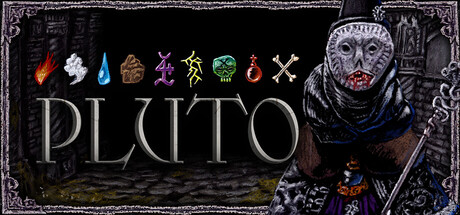
Compara los precios de Pluto en tiendas de claves de confianza y encuentra la mejor oferta. Desarrollado por Siege Wizard Interactive. Publicado por indie.io. Lanzado el 9/3/2026. Disponible en PC, Mac, Linux. Géneros: Indie, Strategy.

Forget saving the world. Pluto gives you eight distinct wizard builds, a gesture-driven combat system nobody else is doing, and the most relatable motivation in deckbuilder history: making it to a birthday party.

I track complexity budgets in strategy games the way other people track calories, so when a deckbuilder ships a combat system I genuinely have to sit down and diagram, that gets my attention fast. Pluto's core mechanic assigns elemental sigils to individual fingers on your wizard's hand, and spells are constructed by matching and overlapping those finger-pattern recipes. When two spells share an identical segment of that pattern, you can stack them in the same turn, chaining buffs, damage, and blocks into a single volatile combo. The result is that every combat turn reads less like "which card do I play" and more like a spatial logic puzzle where timing and overlap determine whether you chain-activate a devastating synergy or misfire into a catastrophic mess. A built-in outcome preview (the game calls it Wizard Vision) calculates the result of your intended actions before you commit, which is a small design decision that earns enormous goodwill. It communicates that this game respects your time rather than burying you in mental arithmetic. The spell categories add another layer to track. Cantrips discard immediately after casting, Chants stay in hand, Rituals fire once per battle, and Echoes can repeat but still discard like Cantrips. Stacking Inscriptions on top of those - temporary modifiers that alter a spell's recipe or effect for one turn - is where the build depth starts to genuinely compound. The launch roster carries eight spellcasters, each bending the gesture system in a distinct direction. The Apprentice is the clearest entry point. The Necromancer and Pyromancer operate on entirely different tempo curves, and Flame Knight rewards aggressive overlap stacking in a way that feels almost broken until the difficulty catches up. Runs are structured for roughly one-hour sessions, which for a strategy-inclined player means you get a complete decision arc in a single sitting rather than an open-ended commitment. That is a legitimate design virtue. Post-launch updates have already added the Crescent Moon mode (a tuned-down difficulty for newcomers learning new characters) and Blood Moon mode for players who want the system tested at full pressure. A new Inscribe mechanic arrived in the same patch wave, and the developers have confirmed that Steam Workshop mod support is in progress. A two-person studio shipping that kind of post-release velocity is worth noting. Community sentiment on Steam sits at 93% positive across over 400 reviews, which for a deckbuilder in a crowded genre signals genuine word-of-mouth rather than launch-window enthusiasm alone. The hand-drawn art by DitchWitch is doing serious work here too - grotesque, detailed, and tonally consistent with the dry black humor that runs through the whole game. The legitimate criticism is complexity density. One reviewer noted that the tooltip system eventually produces tooltips that have their own tooltips, which is a real signal that the jargon load can outpace the onboarding, especially in the mid-game when new mechanics stack fast. The absence of persistent meta-progression between runs will also frustrate players conditioned by the modern roguelite standard of unlocking permanent buffs to soften repeated attempts. Pluto leans closer to pure roguelike structure, which means early runs can feel punishing before the finger-pattern logic becomes intuitive. If you hit that wall, switch to Crescent Moon, clear two or three runs with a character you like, and the systems will click. The game is not trying to trick you. It is asking you to learn a specific spatial grammar, and once you do, the depth is real. For strategy players who have already exhausted Slay the Spire's ascension ladder and want something that reframes how deckbuilding combat actually works, Pluto is the most mechanically original argument for the genre I have seen in this release cycle. Just give the tutorial the patience it asks for. Diego, Scout Team

Pluto

Pluto

9 mar 2026Siege Wizard Interactiveindie.io
GamerScout opina

Forget saving the world. Pluto gives you eight distinct wizard builds, a gesture-driven combat system nobody else is doing, and the most relatable motivation in deckbuilder history: making it to a birthday party.

PCMacLinux
Steam Deck Playable
Mejor precio disponible
7,28 €-57%
en Eneba
Mínimo registrado: 7,28 €
Sigue este precio

Veredicto de GamerScout

Best for Slay the Spire veterans who want a spatial combat overhaul and can tolerate a steep but fair complexity ramp.

Comparar precios(5 tiendas)

EnebaMejor precio
StandardEuropa (UE)Steam KeyClave
7,28 €-57%
La tienda fija el precio en EUR
Comprar
StandardGlobalSteam KeyClave
7,49 €-56%
La tienda fija el precio en EUR
Comprar
StandardGlobalSteam KeyClave
7,55 €
La tienda fija el precio en EUR
Comprar
StandardGlobalSteam KeyClave
13,59 €-20%
La tienda fija el precio en EUR
Comprar
StandardGlobalSteam KeyClave
13,59 €-20%
La tienda fija el precio en EUR
Comprar
StandardGlobalSteam KeyClave
13,59 €-20%
La tienda fija el precio en EUR
Comprar

Todas las tiendas de esta tabla nos dan el precio en euros, así que la cifra en EUR es el precio que fijó el vendedor, no un cálculo nuestro, y por eso EUR es también la moneda en la que calculamos el ranking. Solo incluimos aquí una oferta cuando la tienda nos da su precio en euros, de modo que ninguna cifra de esta tabla es inventada por nosotros.

Elige USD, PLN, GBP, CAD o AUD en la cabecera y convertimos desde EUR con el tipo de cambio de referencia del Banco Central Europeo — los importes convertidos llevan el prefijo ~. Tu banco o la tienda pueden aplicar un tipo distinto al pagar. Nunca ocultamos ofertas según dónde estés: todo el mundo ve esta tabla completa.

We may earn a commission when you buy games through links on this page — at no extra cost to you. It never affects our rankings or verdicts.

Historial de precios

Mínimo registrado
7,28 €30 jul 2026
Mejor precio actual
7,28 €
El más bajo desde que lo seguimos
Tiendas de claves
6,85 €8,34 €9,82 €11,31 €8 Jun25 Jun12 Jul29 Jul15 Aug
8 jun — 15 ago
Crear alerta

Capturas y multimedia

Acerca de Pluto

I track complexity budgets in strategy games the way other people track calories, so when a deckbuilder ships a combat system I genuinely have to sit down and diagram, that gets my attention fast. Pluto's core mechanic assigns elemental sigils to individual fingers on your wizard's hand, and spells are constructed by matching and overlapping those finger-pattern recipes. When two spells share an identical segment of that pattern, you can stack them in the same turn, chaining buffs, damage, and blocks into a single volatile combo. The result is that every combat turn reads less like "which card do I play" and more like a spatial logic puzzle where timing and overlap determine whether you chain-activate a devastating synergy or misfire into a catastrophic mess. A built-in outcome preview (the game calls it Wizard Vision) calculates the result of your intended actions before you commit, which is a small design decision that earns enormous goodwill. It communicates that this game respects your time rather than burying you in mental arithmetic. The spell categories add another layer to track. Cantrips discard immediately after casting, Chants stay in hand, Rituals fire once per battle, and Echoes can repeat but still discard like Cantrips. Stacking Inscriptions on top of those - temporary modifiers that alter a spell's recipe or effect for one turn - is where the build depth starts to genuinely compound. The launch roster carries eight spellcasters, each bending the gesture system in a distinct direction. The Apprentice is the clearest entry point. The Necromancer and Pyromancer operate on entirely different tempo curves, and Flame Knight rewards aggressive overlap stacking in a way that feels almost broken until the difficulty catches up. Runs are structured for roughly one-hour sessions, which for a strategy-inclined player means you get a complete decision arc in a single sitting rather than an open-ended commitment. That is a legitimate design virtue. Post-launch updates have already added the Crescent Moon mode (a tuned-down difficulty for newcomers learning new characters) and Blood Moon mode for players who want the system tested at full pressure. A new Inscribe mechanic arrived in the same patch wave, and the developers have confirmed that Steam Workshop mod support is in progress. A two-person studio shipping that kind of post-release velocity is worth noting. Community sentiment on Steam sits at 93% positive across over 400 reviews, which for a deckbuilder in a crowded genre signals genuine word-of-mouth rather than launch-window enthusiasm alone. The hand-drawn art by DitchWitch is doing serious work here too - grotesque, detailed, and tonally consistent with the dry black humor that runs through the whole game. The legitimate criticism is complexity density. One reviewer noted that the tooltip system eventually produces tooltips that have their own tooltips, which is a real signal that the jargon load can outpace the onboarding, especially in the mid-game when new mechanics stack fast. The absence of persistent meta-progression between runs will also frustrate players conditioned by the modern roguelite standard of unlocking permanent buffs to soften repeated attempts. Pluto leans closer to pure roguelike structure, which means early runs can feel punishing before the finger-pattern logic becomes intuitive. If you hit that wall, switch to Crescent Moon, clear two or three runs with a character you like, and the systems will click. The game is not trying to trick you. It is asking you to learn a specific spatial grammar, and once you do, the depth is real. For strategy players who have already exhausted Slay the Spire's ascension ladder and want something that reframes how deckbuilding combat actually works, Pluto is the most mechanically original argument for the genre I have seen in this release cycle. Just give the tutorial the patience it asks for.

Diego
Diego · Scout Team

Strategy & simulation

Etiquetas

singleplayerachievementscloud-savestier:aaaGesture-Based CombatFinger-Pattern SpellcastingEight Playable ClassesPure RoguelikeTooltip-HeavyDark ComedyDifficulty ModesNo Meta-ProgressionOne-Hour Runs

Requisitos del sistema

Mínimos

OS
Windows 10 (64-bit)
Memory
4 GB RAM
Storage
3 GB available space
Graphics
Integrated graphics with OpenGL 3.3 support
Processor
Intel Core i3 Processor

Sigue explorando

Community Discussion

Be the first to comment on Pluto.

Reseñas y valoraciones

No hay valoraciones disponibles

Información del juego

Desarrolladora
Siege Wizard Interactive
Distribuidora
indie.io
Fecha de lanzamiento
9 mar 2026

Alerta de precio

¡Recibe un aviso cuando el precio baje de tu objetivo!

Crear alerta
Mejor precio7,28 €
Ver oferta

En los 21.266 juegos que seguimos, una clave verificada fue más barata que la tienda oficial el 92% de las veces. Consulta el método y las cifras completas en nuestro informe de precios de juegos.

¿Sin tarjeta? Paga de otra forma

Recarga tu saldo de Steam o compra crypto con cualquier tarjeta — entrega instantánea, sin cuenta bancaria.

Compra mejor: guías útiles

¿Buscas más? Mira juegos como Pluto →

Preguntas frecuentes sobre Pluto

¿Cuánto cuesta Pluto?

A 15 de agosto de 2026, la oferta más barata disponible de Pluto es €7.28 en Eneba, de entre 6 ofertas activas que seguimos en tiendas de claves verificadas. Los precios cambian a diario — la tabla de esta página se actualiza continuamente.

¿Dónde puedo comprar Pluto más barato?

El precio más bajo disponible que seguimos para Pluto es €7.28 en Eneba (15 de agosto de 2026). Comparamos 6 ofertas activas de tiendas de claves verificadas — la tabla completa con cada tienda y su puntuación de confianza está en esta página.

¿En qué plataformas está disponible Pluto?

Pluto está disponible en PC, Mac, Linux.

¿Cuándo se lanzó Pluto?

Pluto se lanzó el 9 de marzo de 2026.

¿Quién desarrolló Pluto?

Pluto fue desarrollado por Siege Wizard Interactive y publicado por indie.io.