Compara los precios de OPUS: The Day We Found Earth en tiendas de claves de confianza y encuentra la mejor oferta. Desarrollado por SIGONO INC.. Publicado por SIGONO INC.. Lanzado el 22/4/2016. Disponible en PC. Géneros: Adventure, Indie.

A quiet, handcrafted stargazing game about a robot and an AI searching the cosmos for a lost Earth. Short, melancholic, and surprisingly affecting.

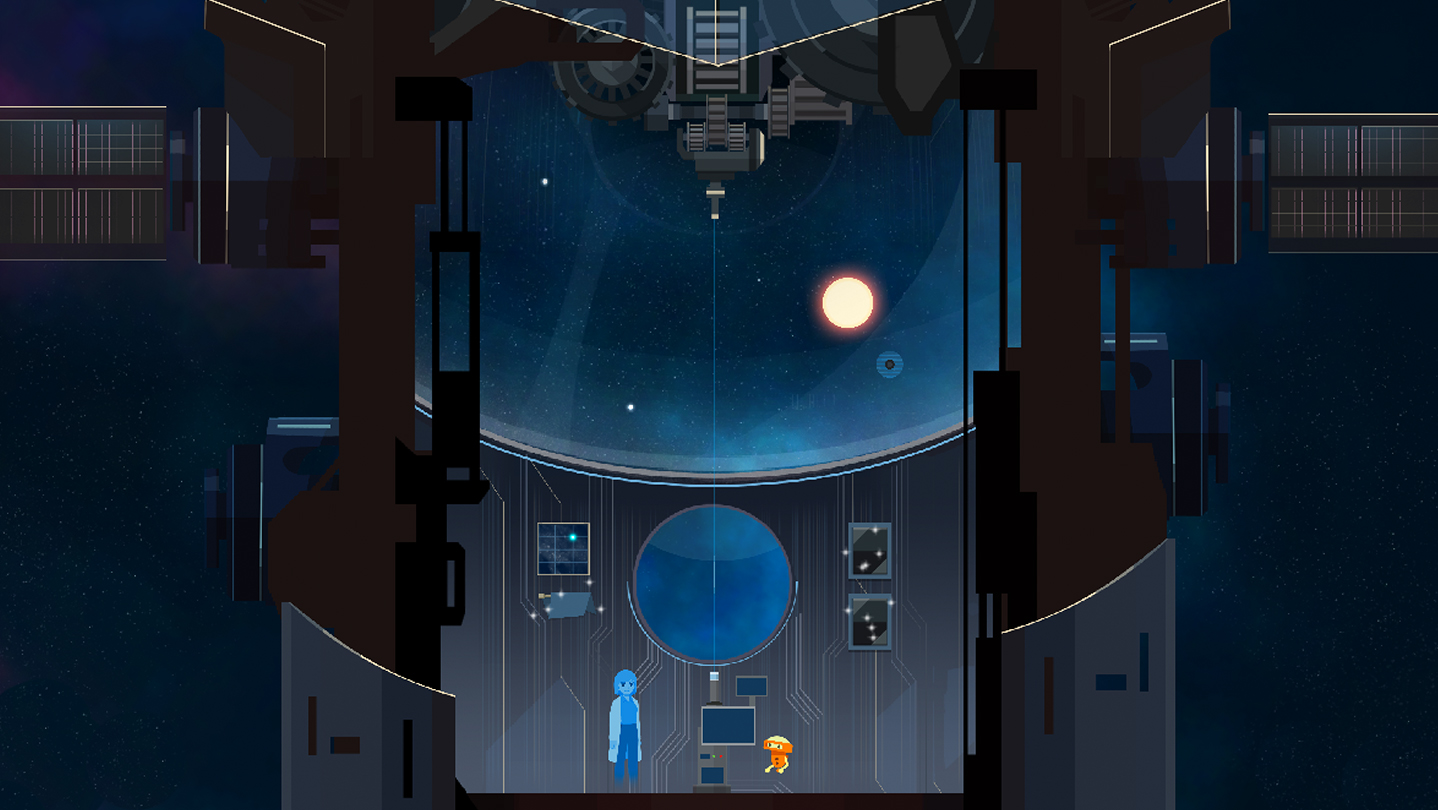
OPUS: The Day We Found Earth is a narrative stargazing game from the one-person-sized studio SIGONO INC., and it asks you to do something almost no other game does: sit still, point a telescope at the sky, and feel small in the best possible way. You play alongside Emeth, a robot, and an AI named Lisa, combing through star fields in search of a mythologized planet called Earth, lost to human memory after millennia of cosmic expansion. The premise sounds slight. The execution is anything but. The core loop involves rotating a telescope, cataloguing stars, and ruling out candidates one by one until you inch toward the one that matches ancient stellar data. It is methodical almost to the point of meditation, and people expecting a puzzle game with teeth will bounce off immediately. What it really is, underneath the coordinate-matching and the star charts, is a quiet grief story. The relationship between Emeth and Lisa carries the whole weight of the game, and SIGONO writes that relationship with enough restraint that when it does land emotionally, you feel it without having been telegraphed at every turn. The art style is pixel work that understands light. Nebulae glow in soft purples and warm ambers, and the parallax starfields have a handmade quality that a procedurally generated space game rarely achieves. The soundtrack sits somewhere between ambient and orchestral, and it paces itself to the story's rhythm rather than looping aggressively in the background. That attentiveness to soundscape is one of the things that separates OPUS from the dozens of walking-sim-adjacent titles that share its shelf space. The game is short, around two to three hours depending on how carefully you scan the sky. That runtime is not a flaw. OPUS knows precisely what it is trying to say and stops when it has said it. The slow opening, where the controls and the astronomy mechanics feel almost too gentle, is load-bearing. The deliberate pacing is what makes the final stretch hit harder than a louder, longer game would manage. If you approach this expecting spectacle or systems depth, you will be frustrated. If you approach it the way you would a beautifully illustrated short story, it rewards that patience completely. Where it shows its age and its scale is in the occasional stiffness of its translated dialogue and the barebones interface, which communicates function over comfort. These are real friction points, not dealbreakers, but worth knowing. The telescope mechanic can feel repetitive across the middle section before the story accelerates. These are the edges of a small game made by a small team, and they sit alongside craft that most larger productions simply do not bother with. If you are the kind of player who finishes a short narrative game and then sits quietly for a few minutes before doing anything else, OPUS: The Day We Found Earth was made for you specifically. Kai, Scout Team

OPUS: The Day We Found Earth

OPUS: The Day We Found Earth

22 abr 2016SIGONO INC.
GamerScout opina

A quiet, handcrafted stargazing game about a robot and an AI searching the cosmos for a lost Earth. Short, melancholic, and surprisingly affecting.

PC
Steam Deck PlayableProtonDB Platinum
Mejor precio disponible
6,99 €
en Kinguin
Mínimo registrado: 5,40 €
Sigue este precio

Veredicto de GamerScout

Best for narrative-first players who want a two-hour emotional gut-punch dressed up as a stargazing simulator.

Comparar precios(5 tiendas)

KinguinMejor precio
StandardGlobalSteam KeyClave
6,99 €
La tienda fija el precio en EUR
Comprar
StandardEuropa (UE)Steam KeyClave
8,31 €-44%
La tienda fija el precio en EUR
Comprar
StandardGlobalSteam KeyClave
8,99 €
La tienda fija el precio en EUR
Comprar
StandardGlobalSteam KeyCopia de regalo
19,66 €-12%
La tienda fija el precio en EUR
Comprar
StandardEuropa (UE)Steam KeyClave
676,03 €
La tienda fija el precio en EUR
Comprar

Todas las tiendas de esta tabla nos dan el precio en euros, así que la cifra en EUR es el precio que fijó el vendedor, no un cálculo nuestro, y por eso EUR es también la moneda en la que calculamos el ranking. Solo incluimos aquí una oferta cuando la tienda nos da su precio en euros, de modo que ninguna cifra de esta tabla es inventada por nosotros.

Elige USD, PLN, GBP, CAD o AUD en la cabecera y convertimos desde EUR con el tipo de cambio de referencia del Banco Central Europeo — los importes convertidos llevan el prefijo ~. Tu banco o la tienda pueden aplicar un tipo distinto al pagar. Nunca ocultamos ofertas según dónde estés: todo el mundo ve esta tabla completa.

We may earn a commission when you buy games through links on this page — at no extra cost to you. It never affects our rankings or verdicts.

Historial de precios

Mínimo registrado
5,40 €2 ago 2026
Mejor precio actual
6,99 €
Tiendas oficialesTiendas de claves
4,97 €6,45 €7,94 €9,42 €5 Jun29 Jun15 Jul30 Jul15 Aug
5 jun — 15 ago
Crear alerta

Capturas y multimedia

Acerca de OPUS: The Day We Found Earth

OPUS: The Day We Found Earth is a narrative stargazing game from the one-person-sized studio SIGONO INC., and it asks you to do something almost no other game does: sit still, point a telescope at the sky, and feel small in the best possible way. You play alongside Emeth, a robot, and an AI named Lisa, combing through star fields in search of a mythologized planet called Earth, lost to human memory after millennia of cosmic expansion. The premise sounds slight. The execution is anything but. The core loop involves rotating a telescope, cataloguing stars, and ruling out candidates one by one until you inch toward the one that matches ancient stellar data. It is methodical almost to the point of meditation, and people expecting a puzzle game with teeth will bounce off immediately. What it really is, underneath the coordinate-matching and the star charts, is a quiet grief story. The relationship between Emeth and Lisa carries the whole weight of the game, and SIGONO writes that relationship with enough restraint that when it does land emotionally, you feel it without having been telegraphed at every turn. The art style is pixel work that understands light. Nebulae glow in soft purples and warm ambers, and the parallax starfields have a handmade quality that a procedurally generated space game rarely achieves. The soundtrack sits somewhere between ambient and orchestral, and it paces itself to the story's rhythm rather than looping aggressively in the background. That attentiveness to soundscape is one of the things that separates OPUS from the dozens of walking-sim-adjacent titles that share its shelf space. The game is short, around two to three hours depending on how carefully you scan the sky. That runtime is not a flaw. OPUS knows precisely what it is trying to say and stops when it has said it. The slow opening, where the controls and the astronomy mechanics feel almost too gentle, is load-bearing. The deliberate pacing is what makes the final stretch hit harder than a louder, longer game would manage. If you approach this expecting spectacle or systems depth, you will be frustrated. If you approach it the way you would a beautifully illustrated short story, it rewards that patience completely. Where it shows its age and its scale is in the occasional stiffness of its translated dialogue and the barebones interface, which communicates function over comfort. These are real friction points, not dealbreakers, but worth knowing. The telescope mechanic can feel repetitive across the middle section before the story accelerates. These are the edges of a small game made by a small team, and they sit alongside craft that most larger productions simply do not bother with. If you are the kind of player who finishes a short narrative game and then sits quietly for a few minutes before doing anything else, OPUS: The Day We Found Earth was made for you specifically.

Kai
Kai · Scout Team

Indie & narrative

Etiquetas

steamNarrative-DrivenShort CompletableAtmospheric SoundtrackPixel Art SpaceEmotional StorySingle SittingStar MechanicsSlow Burn

Requisitos del sistema

Mínimos

Processor
1.4 GHz Dual Core or Greater
Memory
2 GB RAM
Graphics
256 MB OpenGL 2.0 compatible graphics card
Storage
1 GB available space

Sigue explorando

Community Discussion

Be the first to comment on OPUS: The Day We Found Earth.

Reseñas y valoraciones

Steam
87%(1,679)

Información del juego

Desarrolladora
SIGONO INC.
Distribuidora
SIGONO INC.
Fecha de lanzamiento
22 abr 2016

Alerta de precio

¡Recibe un aviso cuando el precio baje de tu objetivo!

Crear alerta
Mejor precio6,99 €
Ver oferta

En los 21.266 juegos que seguimos, una clave verificada fue más barata que la tienda oficial el 92% de las veces. Consulta el método y las cifras completas en nuestro informe de precios de juegos.

¿Sin tarjeta? Paga de otra forma

Recarga tu saldo de Steam o compra crypto con cualquier tarjeta — entrega instantánea, sin cuenta bancaria.

Más de SIGONO INC.

Compra mejor: guías útiles

¿Buscas más? Mira juegos como OPUS: The Day We Found Earth →

Preguntas frecuentes sobre OPUS: The Day We Found Earth

¿Cuánto cuesta OPUS: The Day We Found Earth?

A 15 de agosto de 2026, la oferta más barata disponible de OPUS: The Day We Found Earth es €6.99 en Kinguin, de entre 5 ofertas activas que seguimos en tiendas de claves verificadas. Los precios cambian a diario — la tabla de esta página se actualiza continuamente.

¿Dónde puedo comprar OPUS: The Day We Found Earth más barato?

El precio más bajo disponible que seguimos para OPUS: The Day We Found Earth es €6.99 en Kinguin (15 de agosto de 2026). Comparamos 5 ofertas activas de tiendas de claves verificadas — la tabla completa con cada tienda y su puntuación de confianza está en esta página.

¿En qué plataformas está disponible OPUS: The Day We Found Earth?

OPUS: The Day We Found Earth está disponible en PC.

¿Cuándo se lanzó OPUS: The Day We Found Earth?

OPUS: The Day We Found Earth se lanzó el 22 de abril de 2016.

¿Quién desarrolló OPUS: The Day We Found Earth?

OPUS: The Day We Found Earth fue desarrollado por SIGONO INC..