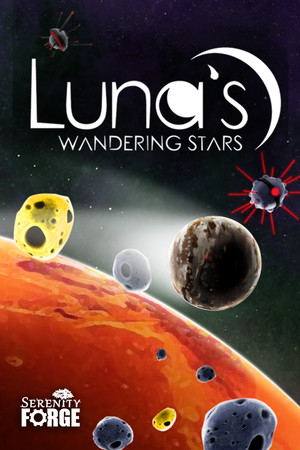
Compara los precios de Luna's Wandering Stars en tiendas de claves de confianza y encuentra la mejor oferta. Desarrollado por Serenity Forge. Publicado por Serenity Forge. Lanzado el 15/5/2015. Disponible en PC, Mac. Géneros: Action, Indie, Simulation.

Orbital mechanics as a puzzle game, one per planet, nine planets total. Satisfying when the physics clicks; punishing when it demands pixel-precise mouse work over genuine planning.

I've spent time working through puzzle games that claim to teach physics while secretly just being reflex tests, and Luna's Wandering Stars sits uncomfortably close to that line without quite crossing it. Serenity Forge built something genuinely interesting here: a solar-system tour where each planet hands you a different tool from the laws of physics and dares you to solve 15 levels with it before moving on. Mercury has you plotting your moon's launch trajectory like a miniature NASA mission. Venus introduces rocket boosts. Earth puts gravitational control in your hands. Mars gives you a limited-ammo laser cannon. Jupiter lets you place short-lived redirectors. Saturn lets you toggle your moon's density mid-orbit, which actually changes how it carves through asteroid fields. Wormholes and black holes arrive later. On paper, that is a well-paced mechanical curriculum. The catch, and it is a meaningful one, is that each planet keeps its power isolated. The mechanics never combine, so the experience reads more like nine separate mini-games sharing a physics engine than one cohesive game with escalating complexity. For a strategy-minded player expecting late-game builds that layer earlier systems together, that compartmentalization is a real letdown. What you get instead is lateral variety rather than depth, which is a different proposition entirely. Where the game genuinely earns praise is in its visual presentation and the moments when the physics engine produces something you did not plan but that works anyway. The nebula backdrops and particle trails from wormhole zips and asteroid collisions are legitimately pretty. Motion trails double as mechanical hints, so the UI is doing real design work rather than decoration. Sound effects are crisp and satisfying. The background music, however, drew consistent criticism from multiple reviewers as generic and forgettable, and that tracks; turning it off and using your own playlist is a reasonable play. The difficulty curve is the biggest red flag for casual buyers. It spikes hard and early, and chasing the three golden asteroids in each level for a perfect rating is a different, much harder game than simply completing the level. Completionists will find themselves repeating sub-30-second levels dozens of times, and the passive-aggressive voice commentary that praises or mocks your performance starts funny and ends grating. Controls are all mouse-driven, which works in planning-heavy levels but becomes a precision clicking endurance test in the more action-leaning ones. One minor but genuinely annoying design flaw: the spacebar restarts a level whether you won or lost, which means clearing a hard stage and reflexively hitting spacebar just sends you back to square one. For the sim-curious player who wants a low-commitment entry point into thinking about orbital mechanics, Newtonian mass, and angular momentum, this is a reasonable and visually rewarding playground. The built-in level editor and online level sharing also extend the lifespan meaningfully beyond the campaign. Just go in knowing that the back half of the planet roster asks more of your mouse precision than your brain, and that the depth ceiling is lower than the concept promises. Diego, Scout Team

Luna's Wandering Stars

Luna's Wandering Stars

15 may 2015Serenity Forge
GamerScout opina

Orbital mechanics as a puzzle game, one per planet, nine planets total. Satisfying when the physics clicks; punishing when it demands pixel-precise mouse work over genuine planning.

PCMac
Steam Deck PlayableProtonDB Gold
Mejor precio disponible
€0.00
en N/A
Mínimo histórico: €0.27

Comparar precios(0 tiendas)

Cargando precios...

We may earn a commission when you buy games through links on this page — at no extra cost to you. It never affects our rankings or verdicts.

Historial de precios

Historical low
€0.2726 Jun 2026
Keyshops
€0.25€0.32€0.39€0.469 Jun14 Jun19 Jun23 Jun28 Jun
Tracking prices since 9 Jun 2026
Create alert

Capturas y multimedia

Acerca de Luna's Wandering Stars

I've spent time working through puzzle games that claim to teach physics while secretly just being reflex tests, and Luna's Wandering Stars sits uncomfortably close to that line without quite crossing it. Serenity Forge built something genuinely interesting here: a solar-system tour where each planet hands you a different tool from the laws of physics and dares you to solve 15 levels with it before moving on. Mercury has you plotting your moon's launch trajectory like a miniature NASA mission. Venus introduces rocket boosts. Earth puts gravitational control in your hands. Mars gives you a limited-ammo laser cannon. Jupiter lets you place short-lived redirectors. Saturn lets you toggle your moon's density mid-orbit, which actually changes how it carves through asteroid fields. Wormholes and black holes arrive later. On paper, that is a well-paced mechanical curriculum. The catch, and it is a meaningful one, is that each planet keeps its power isolated. The mechanics never combine, so the experience reads more like nine separate mini-games sharing a physics engine than one cohesive game with escalating complexity. For a strategy-minded player expecting late-game builds that layer earlier systems together, that compartmentalization is a real letdown. What you get instead is lateral variety rather than depth, which is a different proposition entirely. Where the game genuinely earns praise is in its visual presentation and the moments when the physics engine produces something you did not plan but that works anyway. The nebula backdrops and particle trails from wormhole zips and asteroid collisions are legitimately pretty. Motion trails double as mechanical hints, so the UI is doing real design work rather than decoration. Sound effects are crisp and satisfying. The background music, however, drew consistent criticism from multiple reviewers as generic and forgettable, and that tracks; turning it off and using your own playlist is a reasonable play. The difficulty curve is the biggest red flag for casual buyers. It spikes hard and early, and chasing the three golden asteroids in each level for a perfect rating is a different, much harder game than simply completing the level. Completionists will find themselves repeating sub-30-second levels dozens of times, and the passive-aggressive voice commentary that praises or mocks your performance starts funny and ends grating. Controls are all mouse-driven, which works in planning-heavy levels but becomes a precision clicking endurance test in the more action-leaning ones. One minor but genuinely annoying design flaw: the spacebar restarts a level whether you won or lost, which means clearing a hard stage and reflexively hitting spacebar just sends you back to square one. For the sim-curious player who wants a low-commitment entry point into thinking about orbital mechanics, Newtonian mass, and angular momentum, this is a reasonable and visually rewarding playground. The built-in level editor and online level sharing also extend the lifespan meaningfully beyond the campaign. Just go in knowing that the back half of the planet roster asks more of your mouse precision than your brain, and that the depth ceiling is lower than the concept promises.

Diego
Diego · Scout Team

Strategy & simulation

Etiquetas

singleplayerachievementstrading-cardstier:sub-5Physics PuzzleOrbital MechanicsLevel EditorMouse-DrivenPrecision GameplaySingleplayer PuzzleScience-Based

Requisitos del sistema

Mínimos

OS
Windows Vista
Memory
2 GB RAM
DirectX
Version 9.0
Storage
480 MB available space
Graphics
Intel HD P3000
Processor
2 GHz

Sigue explorando

Community Discussion

Be the first to comment on Luna's Wandering Stars.

Reseñas y valoraciones

No hay valoraciones disponibles

Información del juego

Desarrolladora
Serenity Forge
Distribuidora
Serenity Forge
Fecha de lanzamiento
15 may 2015

Alerta de precio

¡Recibe un aviso cuando el precio baje de tu objetivo!

Crear alerta

Más de Serenity Forge

Compra mejor: guías útiles

¿Buscas más? Mira juegos como Luna's Wandering Stars →

Preguntas frecuentes sobre Luna's Wandering Stars

¿Cuánto cuesta Luna's Wandering Stars?

El precio de Luna's Wandering Stars cambia a menudo y varía según la tienda, la edición y la región. La tabla de precios en vivo de esta página compara las ofertas más baratas en stock de tiendas de claves de confianza como Eneba y Kinguin, para que siempre veas el precio más bajo actual antes de comprar.

¿Dónde puedo comprar Luna's Wandering Stars más barato?

Compara los precios de Luna's Wandering Stars en todas las tiendas verificadas en la tabla de precios de esta página. Listamos las ofertas de claves y tiendas más baratas en stock, actualizadas con frecuencia, para que siempre veas la mejor oferta actual antes de comprar.

¿En qué plataformas está disponible Luna's Wandering Stars?

Luna's Wandering Stars está disponible en PC, Mac.

¿Cuándo se lanzó Luna's Wandering Stars?

Luna's Wandering Stars se lanzó el 15 de mayo de 2015.

¿Quién desarrolló Luna's Wandering Stars?

Luna's Wandering Stars fue desarrollado por Serenity Forge.