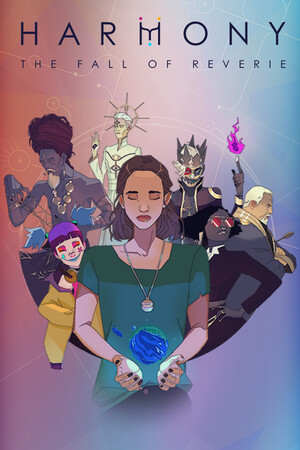
Harmony: The Fall of Reverie
DON'T NOD turns the branching-narrative flowchart into the actual game mechanic, and somehow that strange bet mostly pays off across twelve haunting hours on a sun-bleached Mediterranean island.
Veredicto de GamerScout
Best for narrative fans willing to commit to a crystal-economy choice system in exchange for genuinely beautiful world-building and a Lena Raine soundtrack.
Comparar precios(6 tiendas)
Todas las tiendas de esta tabla nos dan el precio en euros, así que la cifra en EUR es el precio que fijó el vendedor, no un cálculo nuestro, y por eso EUR es también la moneda en la que calculamos el ranking. Solo incluimos aquí una oferta cuando la tienda nos da su precio en euros, de modo que ninguna cifra de esta tabla es inventada por nosotros.
Elige USD, PLN, GBP, CAD o AUD en la cabecera y convertimos desde EUR con el tipo de cambio de referencia del Banco Central Europeo — los importes convertidos llevan el prefijo ~. Tu banco o la tienda pueden aplicar un tipo distinto al pagar. Nunca ocultamos ofertas según dónde estés: todo el mundo ve esta tabla completa.
We may earn a commission when you buy games through links on this page — at no extra cost to you. It never affects our rankings or verdicts.
Historial de precios
Capturas y multimedia
Acerca de Harmony: The Fall of Reverie
I went into this one expecting Life is Strange with mythology bolted on, and that framing is both right and deeply wrong. What DON'T NOD built in Harmony: The Fall of Reverie is quieter and more formally strange than anything in their back catalogue. You play as Polly, a woman returning to her fictional Mediterranean hometown of Atina to find her missing mother, only to discover she can slip between the material world (called Brittle) and a parallel plane called Reverie, where six god-like Aspirations of humanity - Glory, Bliss, Power, Chaos, Bond, and Truth - are waiting for her to anoint one of them as the new heart of their dying world. The setup is dense and the lore drops fast in the opening act; there is a built-in codex that helps, but the first couple of hours ask real patience before the dual-world premise clicks into place. The central invention is the Augural, a branching node map that externalises Polly's clairvoyance into something that looks like a strategy game flowchart. Between scenes you choose which nodes to activate, each one tipping Aspiration crystals - called Egregore - toward one deity or another. Accumulate enough for a given Aspiration and you unlock story outcomes that are unavailable on other paths. It is a genuinely original idea that makes choice feel spatial and deliberate rather than just a dialogue prompt. The complication, which a fair number of critics spotted, is that the crystal economy nudges you into committing to an Aspiration early and then optimising for it, which can make the later acts feel more like resource management than genuine moral reckoning. The spontaneity that made Life is Strange feel alive is occasionally missing here; some choices feel mechanical precisely because the Augural is so transparent about their consequences. That transparency is also the system's strength for some players - if you prefer to understand the shape of a story before you step into it, the Augural is almost meditative to work through. Where the game earns its keep without any asterisks is in the craft surrounding all of that. The 2D art direction is exceptionally characterful, with each of the six Aspirations rendered in palettes and silhouettes that feel genuinely inspired - Power's aggressive geometry against Bliss's soft diffusion, for instance. The voice cast is strong across the board, and the ambient soundscape leans on coastal island textures: waves, birds, the low hum of a city under a corporation's thumb. The score by Lena Raine sits underneath all of it with a kind of lo-fi luminescence that suits the game's split-reality mood far better than a more bombastic soundtrack would have. Technically the experience is clean, with a transcript rewind feature that lets you catch missed dialogue, and per-chapter saves that give you room to reconsider before locking in a chapter's final node. The main criticism on the technical side is loading screens that can interrupt short scenes with jarring frequency. The story itself spans five acts and runs roughly ten to twelve hours on a first playthrough. Its themes - corporate overreach, the cost of grief, the tension between community and self-preservation - are handled with enough textural care that they land as genuine ideas rather than backdrop. The fifth act drew criticism from some reviewers for arriving just when the narrative felt ready to close, extending the runtime when the emotional arc had already peaked. It is a real pacing issue. For all that, the characters in Polly's material-world circle - Nora, Laszlo, the slowly uncovered history of Ursula - carry a warmth that kept me in the story through the rougher structural stretches. This is a game that believes in the people it has written, and that belief is readable in every scene. If you have never touched a visual novel, Harmony is one of the more welcoming entry points the genre has produced, with recognisable mechanical scaffolding and a story ambitious enough to justify the format. If you are already a DON'T NOD devotee, the Augural system is worth experiencing on its own terms, even where it frustrates. People who need persistent agency - exploration, puzzles, the ability to wander - will hit a wall. The game is, unapologetically, a story you watch and steer rather than a world you inhabit. Know that going in and it rewards the time you give it.

Indie & narrative
Etiquetas
Requisitos del sistema
Mínimos
- OS
- Windows 8
- Memory
- 8 GB RAM
- Storage
- 9 GB available space
- Graphics
- GeForce GTX 650 / Radeon HD 7750 (1024 MB)
- Processor
- Intel Core i5-4570T (2 * 2900) / AMD FX-4300 (4 * 3800) or equivalent
Recomendados
- OS
- Windows 10
- Memory
- 8 GB RAM
- Storage
- 9 GB available space
- Graphics
- GeForce GTX 970 (4096MB) / Radeon R9 390X (8192 MB)
- Processor
- Intel Core i7-6700 (4 * 3400) / AMD FX-4350 (4 * 4200) or equivalent
Sigue explorando
Community Discussion
Be the first to comment on Harmony: The Fall of Reverie.
Reseñas y valoraciones
No hay valoraciones disponibles
Información del juego
- Desarrolladora
- DON'T NOD
- Distribuidora
- DON'T NOD
- Fecha de lanzamiento
- 8 jun 2023