
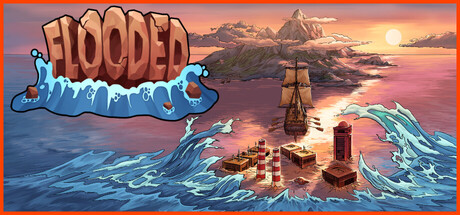
Compara los precios de Flooded en tiendas de claves de confianza y encuentra la mejor oferta. Desarrollado por Artificial Disasters. Publicado por Artificial Disasters. Lanzado el 12/4/2023. Disponible en PC. Géneros: Casual, Simulation, Strategy.

City-builder instincts will kill you here. Flooded puts your production chain under a literal ticking tide, shrinking your island every few minutes until you either escape or drown your workforce.

My first instinct when loading Flooded was to slow down and plan carefully, the way you would in Anno or Tropico. That instinct is wrong, and the game wastes no time punishing it. The flood timer ticks down constantly, and when it hits zero the outer ring of your island disappears. Anything sitting on those tiles, mines, warehouses, housing blocks, all of it goes straight to the sea floor. Once you accept that the map is always contracting and your job is to retreat gracefully while extracting every last unit of iron, copper, and lead you can, a surprisingly tight decision loop clicks into place. The production chain logic will be familiar to anyone who has touched a city-builder in the last decade: you need mines to pull raw materials, housing to staff them, water infrastructure to keep everything running, warehouses to buffer surplus, and electricity via solar panels to unlock building upgrades. What Flooded adds is a brutal spatial constraint. Every building placement is a gamble on how many tidal cycles it will survive. You can construct bulwarks and artificial land tiles to buy time, but the materials those require come from the same finite island you are desperately trying to preserve. The tension between spending resources to delay the flood versus hoarding them to advance an era and build your ark is where the real strategic meat lives. Advancing through eras gates you into offshore drilling platforms that can pull resources from the seabed after your land mines are gone, and eventually into shipbuilding, which is the only actual exit from each island. The rogue-lite layer adds some staying power. Islands are procedurally generated, so rocky terrain configurations, mountain tiles that block construction, and coastal shapes all vary each run. Commanders each bring a passive skill and a starting bonus, functioning like a light operator system, and relics accumulated through campaign progress let you bend the rules in small but meaningful ways. There are three modes: a story-driven campaign that drip-feeds new mechanics chapter by chapter, a Quickplay mode where you dial in your own parameters on a random island, and an Endless mode where the water level partially retreats every four eras, giving you just enough breathing room to see how long a well-optimized economy can survive. A Nightmare difficulty update released post-launch tightens resource availability and reduces error tolerance for players who find the standard campaign too forgiving. One legitimate frustration: Quickplay is locked behind campaign progress, which forces a tutorial-first structure even on players who would rather learn by doing. The presentation is minimal pixel art with a clean top-down grid, and that works in the game's favor during the frantic mid-game when you need to read tile states at a glance. Tiles about to be swallowed are clearly marked, the UI stays out of the way, and the isometric camera causes no readability issues. The audio is understated, ambient rather than dramatic, which actually suits the slow-burn dread of watching your coastline shrink. Critics and players flag the same ceiling: once you have internalized the build order and the era progression, campaigns stop generating genuinely new puzzles, and the total playtime to see everything sits somewhere around ten to fifteen hours. For a budget-tier release that is a reasonable proposition, but players expecting the systemic depth of a Paradox title or the build variety of a mid-tier colony sim will find the late game thin. Diego, Scout Team

Flooded

Flooded

12 abr 2023Artificial Disasters
GamerScout opina

City-builder instincts will kill you here. Flooded puts your production chain under a literal ticking tide, shrinking your island every few minutes until you either escape or drown your workforce.

PC
Steam Deck Playable
Mejor precio disponible
0,33 €
en Kinguin
Mínimo registrado: 0,33 €
Sigue este precio

Veredicto de GamerScout

Best for city-builder fans who want a tight, pressure-cooker puzzle loop and can accept a relatively short campaign ceiling.

Comparar precios(7 tiendas)

KinguinMejor precio
StandardGlobalSteam KeyClave
0,33 €
La tienda fija el precio en EUR
Comprar
StandardGlobalSteam KeyClave
0,36 €-97%
La tienda fija el precio en EUR
Comprar
StandardGlobalSteam KeyClave
0,72 €-94%
La tienda fija el precio en EUR
Comprar
StandardGlobalSteam KeyClave
0,73 €-13%
La tienda fija el precio en EUR
Comprar
StandardGlobalSteam KeyClave
1,27 €-90%
La tienda fija el precio en EUR
Comprar
StandardEuropa (UE)Steam KeyClave
1,31 €-90%
La tienda fija el precio en EUR
Comprar
StandardGrenadaSteam KeyClave
6,34 €
La tienda fija el precio en EUR
Comprar
StandardGlobalSteam KeyClave
6,34 €
La tienda fija el precio en EUR
Comprar

Todas las tiendas de esta tabla nos dan el precio en euros, así que la cifra en EUR es el precio que fijó el vendedor, no un cálculo nuestro, y por eso EUR es también la moneda en la que calculamos el ranking. Solo incluimos aquí una oferta cuando la tienda nos da su precio en euros, de modo que ninguna cifra de esta tabla es inventada por nosotros.

Elige USD, PLN, GBP, CAD o AUD en la cabecera y convertimos desde EUR con el tipo de cambio de referencia del Banco Central Europeo — los importes convertidos llevan el prefijo ~. Tu banco o la tienda pueden aplicar un tipo distinto al pagar. Nunca ocultamos ofertas según dónde estés: todo el mundo ve esta tabla completa.

We may earn a commission when you buy games through links on this page — at no extra cost to you. It never affects our rankings or verdicts.

Historial de precios

Mínimo registrado
0,33 €10 ago 2026
Mejor precio actual
0,33 €
El más bajo desde que lo seguimos
Tiendas de claves
0,30 €0,41 €0,51 €0,62 €8 Jun25 Jun12 Jul29 Jul15 Aug
8 jun — 15 ago
Crear alerta

Capturas y multimedia

Acerca de Flooded

My first instinct when loading Flooded was to slow down and plan carefully, the way you would in Anno or Tropico. That instinct is wrong, and the game wastes no time punishing it. The flood timer ticks down constantly, and when it hits zero the outer ring of your island disappears. Anything sitting on those tiles, mines, warehouses, housing blocks, all of it goes straight to the sea floor. Once you accept that the map is always contracting and your job is to retreat gracefully while extracting every last unit of iron, copper, and lead you can, a surprisingly tight decision loop clicks into place. The production chain logic will be familiar to anyone who has touched a city-builder in the last decade: you need mines to pull raw materials, housing to staff them, water infrastructure to keep everything running, warehouses to buffer surplus, and electricity via solar panels to unlock building upgrades. What Flooded adds is a brutal spatial constraint. Every building placement is a gamble on how many tidal cycles it will survive. You can construct bulwarks and artificial land tiles to buy time, but the materials those require come from the same finite island you are desperately trying to preserve. The tension between spending resources to delay the flood versus hoarding them to advance an era and build your ark is where the real strategic meat lives. Advancing through eras gates you into offshore drilling platforms that can pull resources from the seabed after your land mines are gone, and eventually into shipbuilding, which is the only actual exit from each island. The rogue-lite layer adds some staying power. Islands are procedurally generated, so rocky terrain configurations, mountain tiles that block construction, and coastal shapes all vary each run. Commanders each bring a passive skill and a starting bonus, functioning like a light operator system, and relics accumulated through campaign progress let you bend the rules in small but meaningful ways. There are three modes: a story-driven campaign that drip-feeds new mechanics chapter by chapter, a Quickplay mode where you dial in your own parameters on a random island, and an Endless mode where the water level partially retreats every four eras, giving you just enough breathing room to see how long a well-optimized economy can survive. A Nightmare difficulty update released post-launch tightens resource availability and reduces error tolerance for players who find the standard campaign too forgiving. One legitimate frustration: Quickplay is locked behind campaign progress, which forces a tutorial-first structure even on players who would rather learn by doing. The presentation is minimal pixel art with a clean top-down grid, and that works in the game's favor during the frantic mid-game when you need to read tile states at a glance. Tiles about to be swallowed are clearly marked, the UI stays out of the way, and the isometric camera causes no readability issues. The audio is understated, ambient rather than dramatic, which actually suits the slow-burn dread of watching your coastline shrink. Critics and players flag the same ceiling: once you have internalized the build order and the era progression, campaigns stop generating genuinely new puzzles, and the total playtime to see everything sits somewhere around ten to fifteen hours. For a budget-tier release that is a reasonable proposition, but players expecting the systemic depth of a Paradox title or the build variety of a mid-tier colony sim will find the late game thin.

Diego
Diego · Scout Team

Strategy & simulation

Etiquetas

singleplayerachievementscontroller-supportcloud-savestier:sub-5Reverse City-BuilderTidal TimerEra ProgressionRogue-lite Run VarietyOffshore DrillingCommander PassivesProcedural IslandsNightmare DifficultyArk Building

Requisitos del sistema

Mínimos

OS
64-bit Windows 7 SP1
Memory
4 GB RAM
DirectX
Version 11
Storage
1 GB available space
Graphics
GeForce GTX 660, Radeon R7 370 or equivalent with 2 GB VRAM
Processor
2.8 GHz Dual Core CPU
Sound Card
DirectX compatible

Recomendados

OS
64-bit Windows 7 SP1 / 8.1 / 10 / 11
Memory
8 GB RAM
DirectX
Version 11
Storage
1 GB available space
Graphics
GeForce 960, Radeon RX 570 or equivalent with 4GB VRAM
Processor
3.2 GHz Quad Core Processor
Sound Card
DirectX compatible

Sigue explorando

Community Discussion

Be the first to comment on Flooded.

Reseñas y valoraciones

No hay valoraciones disponibles

Información del juego

Desarrolladora
Artificial Disasters
Distribuidora
Artificial Disasters
Fecha de lanzamiento
12 abr 2023

Alerta de precio

¡Recibe un aviso cuando el precio baje de tu objetivo!

Crear alerta
Mejor precio0,33 €
Ver oferta

En los 21.266 juegos que seguimos, una clave verificada fue más barata que la tienda oficial el 92% de las veces. Consulta el método y las cifras completas en nuestro informe de precios de juegos.

¿Sin tarjeta? Paga de otra forma

Recarga tu saldo de Steam o compra crypto con cualquier tarjeta — entrega instantánea, sin cuenta bancaria.

Compra mejor: guías útiles

¿Buscas más? Mira juegos como Flooded →

Preguntas frecuentes sobre Flooded

¿Cuánto cuesta Flooded?

A 15 de agosto de 2026, la oferta más barata disponible de Flooded es €0.33 en Kinguin, de entre 10 ofertas activas que seguimos en tiendas de claves verificadas. Los precios cambian a diario — la tabla de esta página se actualiza continuamente.

¿Dónde puedo comprar Flooded más barato?

El precio más bajo disponible que seguimos para Flooded es €0.33 en Kinguin (15 de agosto de 2026). Comparamos 10 ofertas activas de tiendas de claves verificadas — la tabla completa con cada tienda y su puntuación de confianza está en esta página.

¿En qué plataformas está disponible Flooded?

Flooded está disponible en PC.

¿Cuándo se lanzó Flooded?

Flooded se lanzó el 12 de abril de 2023.

¿Quién desarrolló Flooded?

Flooded fue desarrollado por Artificial Disasters.