Crazy Machines
Over 200 Rube Goldberg puzzles with a physics engine sharp enough to punish sloppy placement by a single pixel. Worth it if you can handle the professor's sarcasm.
Veredicto de GamerScout
Worth it for logic-driven players who enjoy iterative trial-and-error; frustrating for anyone expecting forgiving, hint-assisted casual puzzle design.
Comparar precios(5 tiendas)
Todas las tiendas de esta tabla nos dan el precio en euros, así que la cifra en EUR es el precio que fijó el vendedor, no un cálculo nuestro, y por eso EUR es también la moneda en la que calculamos el ranking. Solo incluimos aquí una oferta cuando la tienda nos da su precio en euros, de modo que ninguna cifra de esta tabla es inventada por nosotros.
Elige USD, PLN, GBP, CAD o AUD en la cabecera y convertimos desde EUR con el tipo de cambio de referencia del Banco Central Europeo — los importes convertidos llevan el prefijo ~. Tu banco o la tienda pueden aplicar un tipo distinto al pagar. Nunca ocultamos ofertas según dónde estés: todo el mundo ve esta tabla completa.
We may earn a commission when you buy games through links on this page — at no extra cost to you. It never affects our rankings or verdicts.
Historial de precios
Capturas y multimedia
Acerca de Crazy Machines
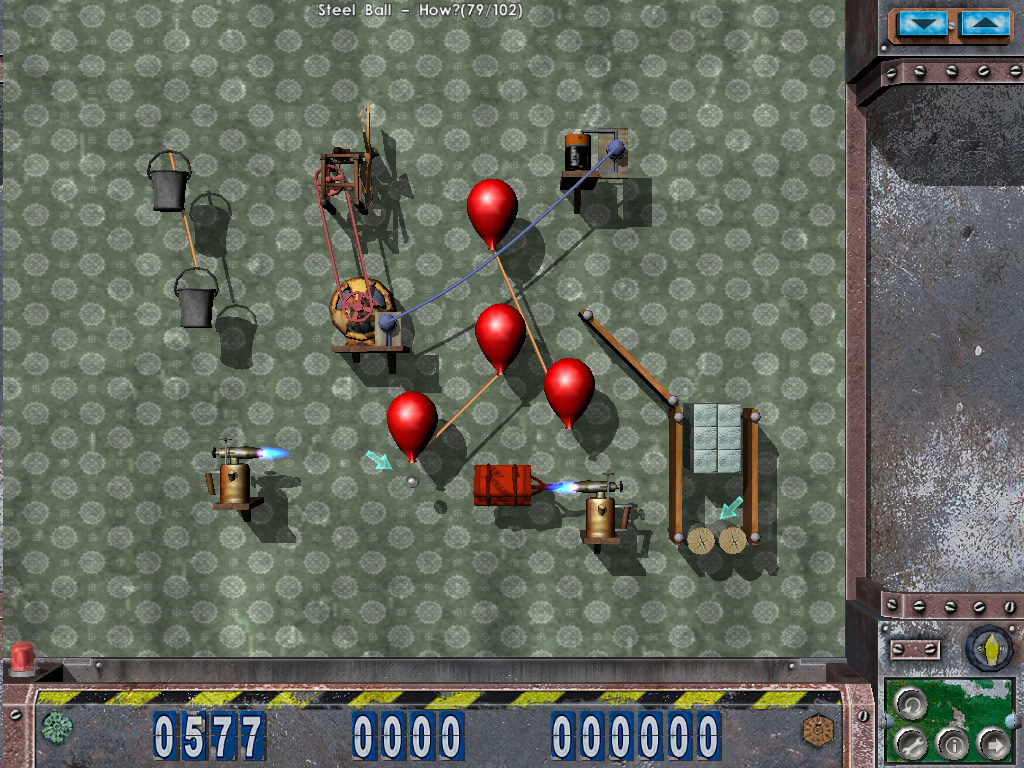
I've spent enough time with systems-driven games to know when a physics engine is doing real work versus just faking it for aesthetics, and Crazy Machines earns its respect on that front. The game simulates air pressure, gravity, electricity, and particle effects as actual variables, meaning a balloon that drifts into a candle flame pops, a boiler heated correctly drives a steam piston, and tennis balls bounce differently than billiard balls because their weight and elasticity are modeled separately. That is the kind of cause-and-effect chain that makes a strategy brain light up, and it is the game's single strongest selling point. The puzzle structure is sensible for newcomers, even if the difficulty curve has a few odd lumps. Early experiments introduce individual components one at a time, which functions as a tutorial without ever labeling itself one. Your workspace shows fixed elements already in place; your inventory of available parts sits on the right sidebar. The job is to drag, rotate, and position the missing pieces to complete a chain reaction, whether that means getting a basketball through a hoop, allowing a turtle to reach its lunch, or blasting a robot into orbit. The game ships with more than 200 of these scenarios, and the part count per puzzle scales up steadily. At its best, a puzzle hands you a pile of dominoes, conveyor belts, springs, and magnets, tells you only half of them are needed, and leaves you to figure out which half. That decoy-component design is a genuinely clever wrinkle. The frustrations are real and worth naming plainly. Piece placement is pixel-exact, and the physics engine will not forgive you for being one grid unit off. A correct conceptual solution will fail silently because a domino is fractionally misaligned, and there is no hint system to bail you out. The in-game professor, a sarcastic Einstein look-alike, provides level introductions and commentary, but his remarks sour quickly and his portrait occasionally obscures the action. The option to mute him exists and you will use it. The difficulty also oscillates unevenly: a run of genuinely hard puzzles can be followed by three that are solved by placing two items in obvious spots, which kills momentum. And for a game built on a capable physics sandbox, the restrictions on where parts can be placed feel arbitrarily tight in spots, limiting creative alternate solutions that the engine could otherwise support. The sandbox mode, called My Lab, is where patient players recoup the value. Every component unlocked during the puzzle campaign becomes available for free-form contraption building, and the freedom there is considerably wider than the structured puzzles suggest. There is no online sharing built into this version of the game, which is a real gap, but the editor itself is comprehensive enough to keep tinkerers occupied long after the main puzzle list is cleared. If you have ever wanted a digital equivalent of the Mouse Trap board game with actual physics behind it, this is functionally that, and the windowed-mode support means it runs comfortably alongside other work on your desktop without demanding your full attention. For a strategy or sim-oriented player, Crazy Machines sits in an interesting corner: it rewards systematic thinking and iterative testing far more than reflexes or timing. The depth is not grand-strategy wide, but the per-puzzle decision space is genuine. Go in expecting a logic workout with occasional pixel-hunting frustration, not a polished modern puzzler, and it delivers.

Strategy & simulation
Etiquetas
Requisitos del sistema
Mínimos
- OS
- Win 2000/XP/Vista
- Memory
- 128 MB RAM
- Graphics
- DirectX 8 compatible graphics card with 32 MB RAM (TNT 2 or comparable)
- Processor
- 800 MHz CPU
- Hard Drive
- 60 MB free disk space
- Sound Card
- DirectX 8 compatible soundcard
- DirectX Version
- 8.1 or higher
Sigue explorando
Community Discussion
Be the first to comment on Crazy Machines.
Reseñas y valoraciones
Información del juego
- Desarrolladora
- Fakt Software
- Distribuidora
- Viva Media
- Fecha de lanzamiento
- 12 dic 2008