Compara los precios de Aura of Worlds en tiendas de claves de confianza y encuentra la mejor oferta. Desarrollado por Cognitive Forge. Publicado por indie.io. Lanzado el 24/9/2024. Disponible en PC, Mac, Linux. Géneros: Action, Adventure, Indie.

A Spelunky-lineage roguelite that rewards lateral thinking over button-mashing - throw an enemy into a laser field, blow up the floor under a chest, or use a lantern as a Molotov. Cognitive Forge spent years getting this right, and it shows.

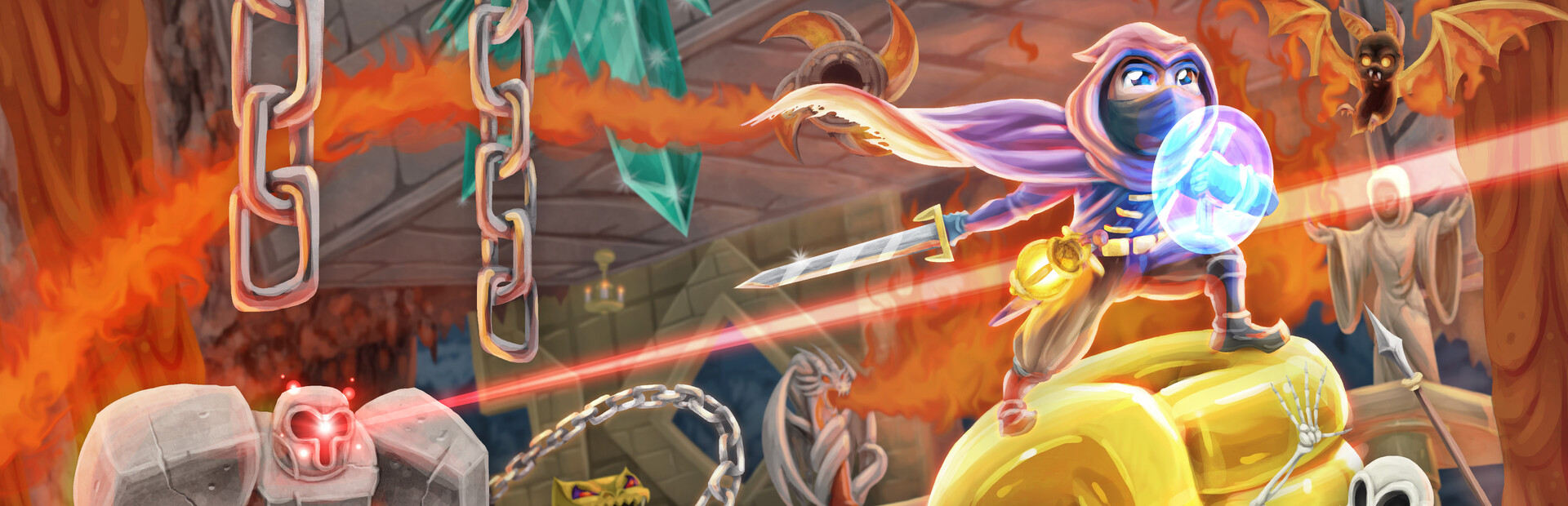
I have a soft spot for games that treat every object in a room as a potential tool, and Aura of Worlds leans into that philosophy harder than almost anything else in the roguelite space right now. The Melbourne-based Cognitive Forge team spent years in Steam Early Access iterating on this thing, gathering player feedback, and the full 1.0 release that landed in September 2024 feels earned rather than rushed. It carries the spiritual DNA of Spelunky and Terraria - games where a simple interaction can cascade into something ridiculous and wonderful - but it builds its own identity through sheer density of systems. The core loop is procedurally generated 2D platforming across 14 or more level themes, each with their own environmental hazards: tidal corridors riddled with mines, caverns filling with toxic pollen, lava that respects no platforming skill, carnivorous plants that punish hesitation. You pick your approach on the fly. The spear and energy shield let you play cautiously, trading mobility for durability. Swap to the boomerang and grapple hook and suddenly you are a chaotic pendulum swinging through rooms you probably should not survive. There are also runes, potions, gear modifiers, and rescuable NPCs like Milla the Blacksmith who, once freed, extends your meta-progression options back at the hub. Over 100 unique enemies keep the threat variety high enough that muscle memory alone will not carry you - a skeleton crossbowman and an evasive magician require completely different read-and-react rhythms. Boss encounters scale in complexity rather than just health bars, and the occasional giant worm filling an entire chamber forces you to rethink the room itself as the arena. What makes all of this feel unusual is the object interactivity. A lantern is not just scenery; you can carry it for light, hurl it as a Molotov, or shoot it to ignite a cluster of enemies. Rocks fall if you strike the ceiling above them, and they hit you just as readily as your enemies if you are careless. Laser traps can be neutralised by blowing up their conduit, bypassed with a blink ability, or exploited by throwing a creature through the beam. The game does not tell you all of this upfront - you discover it through failure, and that discovery loop is genuinely satisfying rather than punishing. Three difficulty settings (Easy, Moderate, Hard) give you room to experiment without gating you out entirely, though Easy does lock some achievements, which is a minor nuisance worth knowing about. The audiovisual side is where the craft of a small, attentive studio shows most clearly. The pixel art pulls from a retro arcade register without feeling like nostalgia bait - the enemy animations in particular carry real character. The chiptune soundtrack shifts tone biome by biome, and there is a quality of intentional sound design in the effects that makes the chaos feel textured rather than noisy. This is not a game made by people who slapped a sprite sheet on a procedural engine; it is one where someone cared what it sounded like when a skull explodes a lamp. The honest caveats: narrative is thin, still more lore-hint than story even after the post-1.0 additions, and players who want strong authored pacing will find the roguelite structure resists that craving by design. The opening hours have a steepness that can feel disorienting - the environment interaction systems are not tutorialised aggressively, so expect to accidentally drop rocks on your own head a few times before the penny drops. For those willing to sit with that initial friction, the game opens up considerably. Kai, Scout Team

Aura of Worlds

Aura of Worlds

24 sept 2024Cognitive Forgeindie.io
GamerScout opina

A Spelunky-lineage roguelite that rewards lateral thinking over button-mashing - throw an enemy into a laser field, blow up the floor under a chest, or use a lantern as a Molotov. Cognitive Forge spent years getting this right, and it shows.

PCMacLinux
Steam Deck Verified
Mejor precio disponible
2,48 €-83%
en Eneba
Mínimo registrado: 1,19 €
Sigue este precio

Veredicto de GamerScout

For fans of Spelunky-style improvisation who want more object interactivity and less pure twitch - this one has been quietly refined into something special.

Comparar precios(3 tiendas)

EnebaMejor precio
StandardGlobalSteam KeyClave
2,48 €-83%
La tienda fija el precio en EUR
Comprar
StandardEuropa (UE)Steam KeyClave
7,99 €-46%
La tienda fija el precio en EUR
Comprar
StandardGlobalSteam KeyClave
10,35 €-30%
La tienda fija el precio en EUR
Comprar
StandardGlobalSteam KeyClave
31,98 €-10%
La tienda fija el precio en EUR
Comprar

Todas las tiendas de esta tabla nos dan el precio en euros, así que la cifra en EUR es el precio que fijó el vendedor, no un cálculo nuestro, y por eso EUR es también la moneda en la que calculamos el ranking. Solo incluimos aquí una oferta cuando la tienda nos da su precio en euros, de modo que ninguna cifra de esta tabla es inventada por nosotros.

Elige USD, PLN, GBP, CAD o AUD en la cabecera y convertimos desde EUR con el tipo de cambio de referencia del Banco Central Europeo — los importes convertidos llevan el prefijo ~. Tu banco o la tienda pueden aplicar un tipo distinto al pagar. Nunca ocultamos ofertas según dónde estés: todo el mundo ve esta tabla completa.

We may earn a commission when you buy games through links on this page — at no extra cost to you. It never affects our rankings or verdicts.

Historial de precios

Mínimo registrado
1,19 €5 jun 2026
Mejor precio actual
2,48 €
Tiendas de claves
1,02 €1,60 €2,18 €2,76 €5 Jun23 Jun11 Jul28 Jul15 Aug
5 jun — 15 ago
Crear alerta

Capturas y multimedia

Acerca de Aura of Worlds

I have a soft spot for games that treat every object in a room as a potential tool, and Aura of Worlds leans into that philosophy harder than almost anything else in the roguelite space right now. The Melbourne-based Cognitive Forge team spent years in Steam Early Access iterating on this thing, gathering player feedback, and the full 1.0 release that landed in September 2024 feels earned rather than rushed. It carries the spiritual DNA of Spelunky and Terraria - games where a simple interaction can cascade into something ridiculous and wonderful - but it builds its own identity through sheer density of systems. The core loop is procedurally generated 2D platforming across 14 or more level themes, each with their own environmental hazards: tidal corridors riddled with mines, caverns filling with toxic pollen, lava that respects no platforming skill, carnivorous plants that punish hesitation. You pick your approach on the fly. The spear and energy shield let you play cautiously, trading mobility for durability. Swap to the boomerang and grapple hook and suddenly you are a chaotic pendulum swinging through rooms you probably should not survive. There are also runes, potions, gear modifiers, and rescuable NPCs like Milla the Blacksmith who, once freed, extends your meta-progression options back at the hub. Over 100 unique enemies keep the threat variety high enough that muscle memory alone will not carry you - a skeleton crossbowman and an evasive magician require completely different read-and-react rhythms. Boss encounters scale in complexity rather than just health bars, and the occasional giant worm filling an entire chamber forces you to rethink the room itself as the arena. What makes all of this feel unusual is the object interactivity. A lantern is not just scenery; you can carry it for light, hurl it as a Molotov, or shoot it to ignite a cluster of enemies. Rocks fall if you strike the ceiling above them, and they hit you just as readily as your enemies if you are careless. Laser traps can be neutralised by blowing up their conduit, bypassed with a blink ability, or exploited by throwing a creature through the beam. The game does not tell you all of this upfront - you discover it through failure, and that discovery loop is genuinely satisfying rather than punishing. Three difficulty settings (Easy, Moderate, Hard) give you room to experiment without gating you out entirely, though Easy does lock some achievements, which is a minor nuisance worth knowing about. The audiovisual side is where the craft of a small, attentive studio shows most clearly. The pixel art pulls from a retro arcade register without feeling like nostalgia bait - the enemy animations in particular carry real character. The chiptune soundtrack shifts tone biome by biome, and there is a quality of intentional sound design in the effects that makes the chaos feel textured rather than noisy. This is not a game made by people who slapped a sprite sheet on a procedural engine; it is one where someone cared what it sounded like when a skull explodes a lamp. The honest caveats: narrative is thin, still more lore-hint than story even after the post-1.0 additions, and players who want strong authored pacing will find the roguelite structure resists that craving by design. The opening hours have a steepness that can feel disorienting - the environment interaction systems are not tutorialised aggressively, so expect to accidentally drop rocks on your own head a few times before the penny drops. For those willing to sit with that initial friction, the game opens up considerably.

Kai
Kai · Scout Team

Indie & narrative

Etiquetas

singleplayerachievementscontroller-supporttrading-cardscloud-savestier:sub-5Environmental InteractionChiptune SoundtrackTactical RogueliteObject PhysicsHub ProgressionBiome VarietySpelunky-likeMulti-Solution Puzzles

Requisitos del sistema

Mínimos

OS
Windows 7 or higher
Memory
2 GB RAM
Storage
2 GB available space
Graphics
Either Direct X or Open GL Version 3.4 or higher
Processor
2 Ghz

Recomendados

2 GB RAM

Sigue explorando

Community Discussion

Be the first to comment on Aura of Worlds.

Reseñas y valoraciones

No hay valoraciones disponibles

Información del juego

Desarrolladora
Cognitive Forge
Distribuidora
indie.io
Fecha de lanzamiento
24 sept 2024

Alerta de precio

¡Recibe un aviso cuando el precio baje de tu objetivo!

Crear alerta
Mejor precio2,48 €
Ver oferta

En los 21.266 juegos que seguimos, una clave verificada fue más barata que la tienda oficial el 92% de las veces. Consulta el método y las cifras completas en nuestro informe de precios de juegos.

¿Sin tarjeta? Paga de otra forma

Recarga tu saldo de Steam o compra crypto con cualquier tarjeta — entrega instantánea, sin cuenta bancaria.

Compra mejor: guías útiles

¿Buscas más? Mira juegos como Aura of Worlds →

Preguntas frecuentes sobre Aura of Worlds

¿Cuánto cuesta Aura of Worlds?

A 15 de agosto de 2026, la oferta más barata disponible de Aura of Worlds es €2.48 en Eneba, de entre 4 ofertas activas que seguimos en tiendas de claves verificadas. Los precios cambian a diario — la tabla de esta página se actualiza continuamente.

¿Dónde puedo comprar Aura of Worlds más barato?

El precio más bajo disponible que seguimos para Aura of Worlds es €2.48 en Eneba (15 de agosto de 2026). Comparamos 4 ofertas activas de tiendas de claves verificadas — la tabla completa con cada tienda y su puntuación de confianza está en esta página.

¿En qué plataformas está disponible Aura of Worlds?

Aura of Worlds está disponible en PC, Mac, Linux.

¿Cuándo se lanzó Aura of Worlds?

Aura of Worlds se lanzó el 24 de septiembre de 2024.

¿Quién desarrolló Aura of Worlds?

Aura of Worlds fue desarrollado por Cognitive Forge y publicado por indie.io.