
Where are my Internets?
Tiny, strange, and oddly sincere: a one-dev digital board game about a city dweller's wifi withdrawal that works better as a couch curiosity than a solo marathon.
GamerScout Verdict
Best for two players who want a short, absurd couch game and can forgive thin late-game depth.
Compare Prices(3 stores)
Every store in this table quotes us in euros, so the EUR figure is the price the seller actually set, not our arithmetic — which is why EUR is also the currency we rank in. We only list an offer here when the store gives us its price in euros, so nothing in this table is a number we invented.
Pick USD, PLN, GBP, CAD or AUD in the header and we convert from EUR at the European Central Bank reference rate — converted amounts are prefixed with ~. Your bank or the store may apply a different rate at checkout. We never hide offers based on where you are: everyone sees this whole table.
We may earn a commission when you buy games through links on this page — at no extra cost to you. It never affects our rankings or verdicts.
Price History
Screenshots & Media
About Where are my Internets?
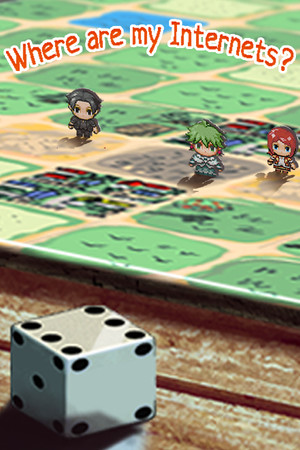
I'll be honest, the premise hooked me before the gameplay did. You are a smartphone-addled urbanite stranded in a village so remote that nobody around you even knows what the internet is, and your only path to survival is becoming a one-person ISP across an entire countryside map. That joke should wear out in ten minutes. Somehow, Lokator Studio stretches it into a full turn-based board game with a loop that has more mechanical texture than the title suggests. The board is divided into three zones: wilderness, vicinities, and villages. You roll dice, move your token, and watch a resource called mood points tick down every single turn. That is the pressure valve. Staying offline too long means your character slowly loses the will to exist, which is both mechanically tense and quietly funny as a piece of writing. Connecting to the internet at a village restores your mood, but the cost of access climbs each time you use it, so the economy never lets you idle. You farm item cards by triggering event tiles in the wilderness, sell what you earn, and spend it on buying internet access for each village on the board. There are 27 event cards, with three unique to each location type, and surprise cards marked with question marks that add genuine unpredictability to each run. Bonus cards, earned after completing a full circuit of the board, let you nudge your dice roll up or down by one to three points, which is a small but welcome layer of control over what is otherwise a dice-luck game. The multiplayer is hotseat only, up to four characters sharing one keyboard, which makes this much more of a living-room game than an online one. One Steam community poster mentioned buying it specifically to play with a child, and that is exactly the context where it sings. The anime-influenced art style is soft and readable, the atmospheric soundtrack is genuinely pleasant rather than looping torture, and the comedy lands on the right side of absurd. Where it struggles is in late-game pacing. Once you understand the economy, the final villages feel like chores rather than challenges, and a player who gets knocked out by having their mood points hit zero is left watching until the round ends, which the community flagged early on without any patch response visible since. This is a game made with obvious care by a small team, built on RPG Maker MV in a way that hides its engine well. It carries around 75% positive sentiment on Steam across its small review pool, which feels accurate. It is not deep enough to hold a solo player for repeated sessions, and the RNG can be punishing in ways that feel arbitrary rather than exciting. But as a thirty-to-sixty-minute diversion for two people who appreciate a dumb, heartfelt concept executed with personality, it earns its place.

Indie & narrative
Tags
System Requirements
Minimum
- OS
- WindowsR 7/8/8.1/10 (32bit/64bit)
- Memory
- 2 GB RAM
- Storage
- 1 GB available space
- Graphics
- DirectX 9/OpenGL 4.1 capable GPU
- Processor
- Intel Core2 Duo or better
Keep exploring
Community Discussion
Be the first to comment on Where are my Internets?.
Reviews & Ratings
No ratings available
Game Info
- Developer
- Lokator Studio
- Publisher
- DNVA
- Release Date
- Dec 16, 2016