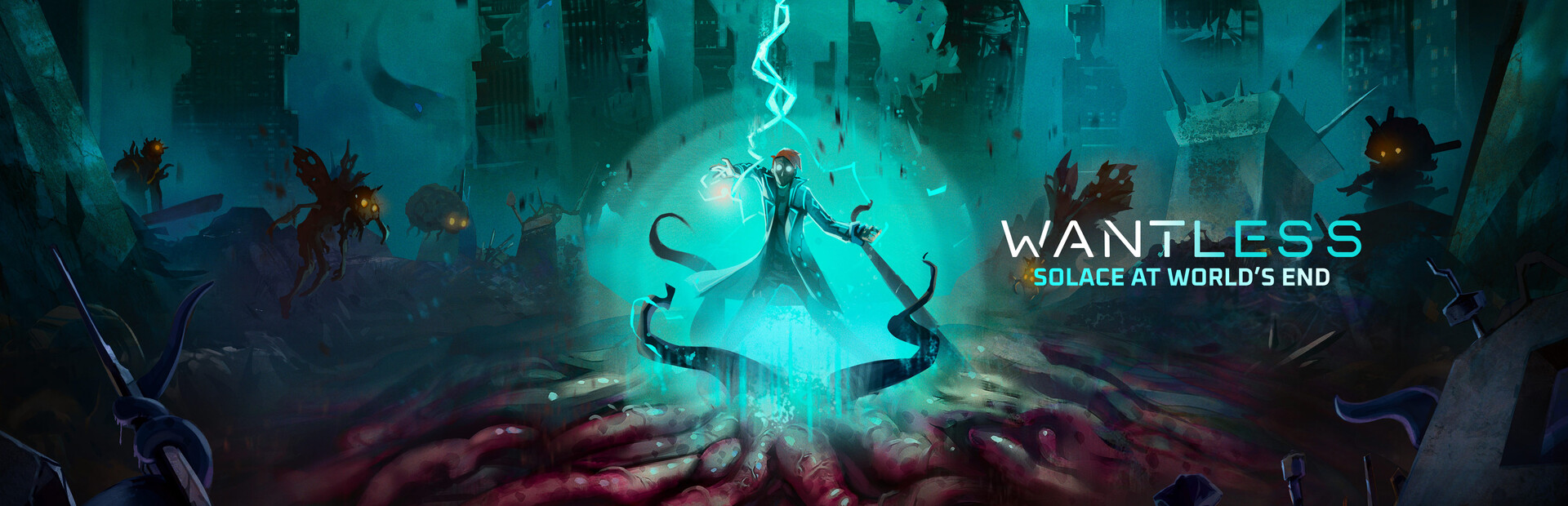

Wantless : Solace at World’s End
Skip-turn discipline meets mind-bending skill assembly in a roguelite tactical RPG that punishes button-mashing but richly rewards players who treat every action point like it costs real money.
GamerScout Verdict
Built for players who want to engineer their own toolkit turn by turn and feel real consequences for every wasted action point.
Compare Prices(0 stores)
Loading prices...
We may earn a commission when you buy games through links on this page — at no extra cost to you. It never affects our rankings or verdicts.
Price History
Screenshots & Media
About Wantless : Solace at World’s End
My first instinct when I saw Wantless described as a tactical RPG with 'millions of skill combinations' was to roll my eyes. That number almost always means three sliders and a marketing intern. Then I actually sat with the Neural Shaping system, and the eye-roll turned into a spreadsheet. The core conceit is genuinely clever: you craft each of your skills from three discrete synapse components - a Form synapse that defines the area of effect and range, an Effect synapse that determines what the skill actually does (damage, bleed, poison, thorns, fear, buffs, pushes), and an Efficiency synapse that sets the AP cost and cooldown. Swap any one of those three parts and you have a functionally different ability. With 100-plus synapses in the full release pool, the combinatorics hold up. This is not a fake number. The action-point economy is where Wantless earns its tactical credentials. You start each turn with eight AP, but every single AP you spend is handed directly to every enemy on the board. Use six points - your opponents get six. Move, attack, reposition, cast a buff - every decision feeds the opposition. Eliminating an enemy reclaims those points for you, which creates a kill-priority calculus that makes each turn feel like a constraint-satisfaction problem rather than a dice roll. Players who like to think in terms of opportunity cost and sequencing will find this deeply satisfying. Players who want to click attack until things die will bounce off hard. The rest of the progression stack complements this pressure nicely. Between runs you operate out of the Afterthought, a mobile clinic-ship, where you can access the Mind Tree - a passive perk web with over 170 nodes, with the important wrinkle that stronger nodes carry genuine drawbacks. You pick patients from a rotating selection, each offering different loot and difficulty, and losing the unchosen ones is permanent for that session. Randomly generated mind-dungeon maps keep the run-to-run layouts fresh, while named unique patients with handcrafted stories provide harder, more structured challenges that stress-test whatever build you have scraped together. The trader Deeler sells synapses and gear like the Abandon Robe (which converts unspent AP into damage resistance), adding a resource management layer through Tokens and Knowledge Shards earned in the field. The weaknesses are real and worth flagging. The skill-building interface has been criticized for lacking a clear overview screen, which makes comparing your assembled kit against your options feel more fiddly than it should at this level of game complexity. Some encounter designs veer into puzzle territory with near-mandatory solutions - fun if you figure it out, frustrating if the RNG hands you a bad synapse pool that session. The player base is small, which means limited community guides and no mod ecosystem to speak of. If you like to lean on wikis and third-party build planners the way I normally do, you are mostly on your own here. The Steam review count sits around 300 with an 89 percent positive rating, which for a niche tactical RPG suggests a loyal, satisfied audience rather than broad breakout success. That community size cuts both ways: the game is underplayed and underrated, but it also means slower patch cadence feedback loops. For the right player - someone who enjoys constructing their own toolkit turn by turn, who treats each patient selection as a loot-theory decision, and who finds genuine tension in the question 'can I afford to spend that AP right now' - Wantless is one of the more interesting tactical RPGs to arrive in the 2024 PC landscape. Approach it expecting Darkest Dungeon's atmosphere retuned into a mind-horror sci-fi register, with the build-craft depth of a card-game deckbuilder but expressed through freeform skill assembly instead. The tutorial is functional and honest about the mechanics, which is more than most games in this subgenre manage. Give it two or three runs before judging the difficulty ceiling - the system only reveals its depth once you start actively shaping your synapse loadout rather than taking whatever drops.

Strategy & simulation
Tags
System Requirements
Minimum
- OS
- Windows 7 or newer
- Memory
- 4 GB RAM
- Storage
- 2 GB available space
- Graphics
- Geforce GTX 960
- Processor
- Intel core i5-6400
Keep exploring
Community Discussion
Be the first to comment on Wantless : Solace at World’s End.
Reviews & Ratings
No ratings available
Game Info
- Developer
- Drop Rate Studio
- Publisher
- Twin Sails Interactive
- Release Date
- May 16, 2024