Verne: The Shape of Fantasy
A five-hour steampunk love letter to Jules Verne that earns its place on your wishlist through stunning pixel art and a genuinely clever alternate-history conceit, even if its best mechanic never quite reaches its potential.
GamerScout Verdict
Best for Jules Verne readers and pixel-art adventure fans who want a beautiful five-hour story and can forgive an underused headline mechanic.
Compare Prices(7 stores)
Every store in this table quotes us in euros, so the EUR figure is the price the seller actually set, not our arithmetic — which is why EUR is also the currency we rank in. We only list an offer here when the store gives us its price in euros, so nothing in this table is a number we invented.
Pick USD, PLN, GBP, CAD or AUD in the header and we convert from EUR at the European Central Bank reference rate — converted amounts are prefixed with ~. Your bank or the store may apply a different rate at checkout. We never hide offers based on where you are: everyone sees this whole table.
We may earn a commission when you buy games through links on this page — at no extra cost to you. It never affects our rankings or verdicts.
Price History
Screenshots & Media
About Verne: The Shape of Fantasy
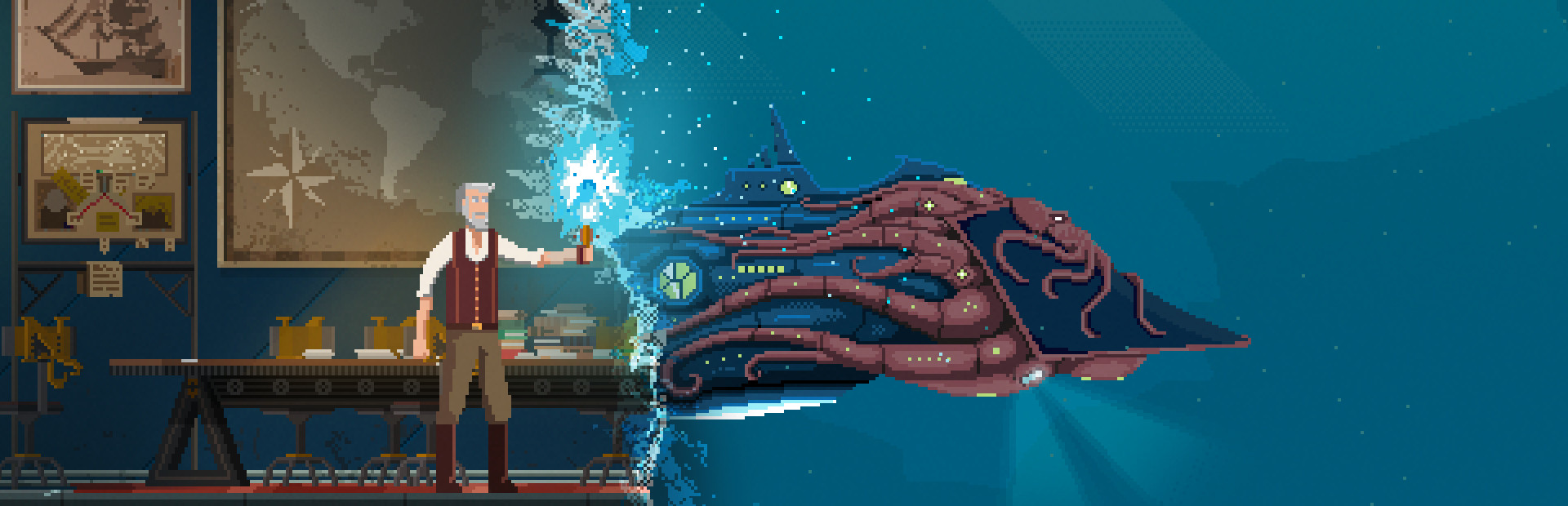
I spent my afternoon aboard the Nautilus with a version of Jules Verne who carries an artifact called the IMAG, and I walked away charmed, a little frustrated, and quietly wishing the whole thing were another three hours longer. That mix of feelings is basically the game in a nutshell. Gametopia built something genuinely unusual here: a side-scrolling point-and-click adventure set in Hemera, an alternate 1888 world assembled from Verne's own literary imagination. You play the author himself, a scientist fighting alongside Captain Nemo against a totalitarian force called the Nation, while hunting for the Flame of Hephaestus buried somewhere in the ruins of Atlantis. On paper, that premise is extraordinary. In practice, the game only half-delivers on it. The IMAG is the headline mechanic, an Atlantean device that lets Verne bend reality and rewrite moments in the timeline. When the game leans on it, the results are genuinely engaging, letting you pick from two or three alternate versions of a scene to unlock a new path or reshape a situation. But the IMAG shows up far less often than you would expect, and each chapter tends to open with Verne scrambling to recover it before you get any real use out of it. The loop reads as: explore, gather items and complete a fetch quest or two, recover the IMAG, use it exactly once or twice, finish the chapter. Stealth sections appear between puzzles and are mostly relaxed, though reviewers flagged a late-game stealth sequence where guard patrol timing behaves inconsistently across attempts, which is the most friction the game generates and not in a satisfying way. The puzzles themselves occupy a wide band. Slider dials, inventory combinations and environmental observations make up the bulk, and most are breezy enough that trial-and-error gets you through without a guide. Veteran adventure players will find them light. One final concentric-circle puzzle stands out as the single piece of genuine logic-puzzle design, timed and reset-heavy, sitting awkwardly against everything that came before it. The non-linear dialogue system adds texture but rarely produces meaningful divergence. Collectible Verne Logs, recruitment posters, audio recordings and scattered documents build out the lore of Hemera beautifully, and if you are the kind of player who reads every scrap of in-world text, you will get more out of this than the five-hour runtime suggests. What nobody disputes is the art. The pixel work here is crisp and deliberate, with each location carrying its own colour palette, from the dark iron corridors of the Nautilus to sun-bleached Atlantean ruins. The developers clearly know what they made, because they build in quiet camera pull-back moments where you can stop and just look. Voice acting is warm and committed, though Verne's accent occupies a no-man's-land between French and British that takes some adjusting to. Captain Nemo fares better, his voice tracking a satisfying arc from cautious authority toward something darker. The soundtrack, by contrast, is the one element that underserves the visuals, often sitting too quietly in the background when the imagery calls for something more alive. This is the kind of game I will always advocate for: focused, handcrafted, genuinely respectful of its source material, and confident enough to end before it overstays its welcome. The player community agrees more than critics do, and I think that gap makes sense. If you have any warmth toward Verne's novels, or toward the tradition of atmospheric pixel-art adventures from the 1990s, this earns your time. Go in knowing it is a narrative experience first, a puzzle game second, and that the IMAG promises more than it delivers. If that calculus works for you, there is a lot of quiet joy in those five hours.

Indie & narrative
Tags
System Requirements
Minimum
- OS
- Windows 7 or later
- Memory
- 1 GB RAM
- Storage
- 1 GB available space
- Processor
- 1.2Ghz+
Recommended
- OS
- Windows 10
- Memory
- 4 GB RAM
- Storage
- 1 GB available space
- Processor
- 2Ghz+
Keep exploring
Community Discussion
Be the first to comment on Verne: The Shape of Fantasy.
Reviews & Ratings
Game Info
- Developer
- Gametopia
- Publisher
- Assemble Entertainment
- Release Date
- Aug 14, 2023