
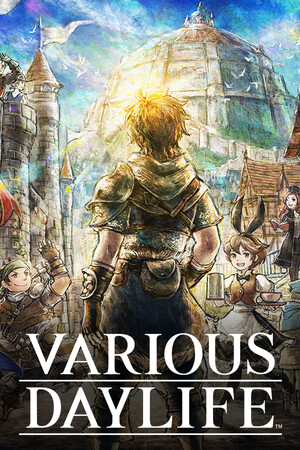
VARIOUS DAYLIFE
Carries the Bravely Default pedigree in name only, this mobile-born life-sim/JRPG hybrid has genuine ideas buried under repetitive menus and punishing RNG that will test your patience before it rewards it.
GamerScout Verdict
Worth it only for Team Asano devotees who can stomach a menu-heavy mobile port, everyone else should temper expectations sharply.
Compare Prices(2 stores)
Every store in this table quotes us in euros, so the EUR figure is the price the seller actually set, not our arithmetic — which is why EUR is also the currency we rank in. We only list an offer here when the store gives us its price in euros, so nothing in this table is a number we invented.
Pick USD, PLN, GBP, CAD or AUD in the header and we convert from EUR at the European Central Bank reference rate — converted amounts are prefixed with ~. Your bank or the store may apply a different rate at checkout. We never hide offers based on where you are: everyone sees this whole table.
We may earn a commission when you buy games through links on this page — at no extra cost to you. It never affects our rankings or verdicts.
Price History
Screenshots & Media
About VARIOUS DAYLIFE
My spreadsheet instincts kicked in about thirty minutes into Various Daylife, and the picture they painted was not flattering. The core loop asks you to select menu options representing jobs, watch a progress bar fill, collect a modest paycheck, and repeat across dozens of in-game days before the guild quests that actually push the story unlock. For a strategy player who likes optimising systems, that premise is not automatically a dealbreaker. The problem is that the depth is unevenly rationed, arriving too slowly and wrapped in too much friction. The building blocks are interesting on paper. There are over 20 job classes spanning the expected, Warrior, Cleric, Scholar, to the genuinely odd, like Politician, Merchant, and Server. Each character can hold up to three classes simultaneously, and mixing them for the combat encounters is where the game flashes something real. The Three CHAs battle system, Change, Chain, and Chance, rewards you for inflicting status effects, chaining them across party members, and cashing out with a heavy Chance strike. The Politician's Codify skill, for instance, can freeze a Secretary's magic-doubling buff in place for the rest of a long fight, creating the kind of layered combo planning that actually warrants a second tab in a spreadsheet. The Lutist's Breakthrough ability pairing with the Merchant's Venture Capital to bust through the 999 damage ceiling is legitimate late-game optimization. Those moments exist. They are just surrounded by a lot of clicking. The expedition design compounds the friction. Your party walks automatically from left to right while a progress meter fills; you watch more than you play. Fatigue chips away at maximum HP as days pass, food and camping supplies are consumed from a limited pack of only four item slots, and a wipe resets your stat experience, a punishing loss condition for what is fundamentally a casual-paced game. The gossip system, which grants buffs for activities like visiting the baths or the tavern, is entirely RNG-driven, meaning you can spend several in-game days farming the bathhouse and receive nothing useful. The economy is similarly lopsided: training your party members costs real money in-game, and the work quests that generate income barely keep up, especially in the mid-game stretch where the difficulty spikes and the resources do not. The characters are legitimately the game's best asset. Party members have five affinity levels, three unlockable job classes each, and personal story arcs that go well beyond their initial archetypes. Spending time with them, attending festivals, celebrating birthdays, that slice-of-life texture has warmth to it, and the true story that opens up post-credits reportedly deepens considerably. But the main campaign runs 30-plus hours at a pace designed for mobile sessions of fifteen minutes at a time, and on PC that rhythm clashes hard. The port itself has been criticised for sluggish loading between screens, a problem that compounds when the content in each screen is essentially a menu choice. For Team Asano completionists or players who can genuinely treat this as a fifteen-minutes-a-day side habit, the class system and character writing will carry them through. For anyone expecting the mechanical density of Bravely Default or the exploration of Octopath Traveler, the gap between expectation and product is wide enough to sting. Go in with calibrated expectations or don't go in at all.

Strategy & simulation
Tags
System Requirements
Minimum
- OS
- Windows® 10 64-bit / Windows® 11 64-bit
- Memory
- 8 GB RAM
- DirectX
- Version 11
- Storage
- 5 GB available space
- Graphics
- AMD Radeon™ R7 240 / Intel® HD Graphics 530 / NVIDIA® GeForce® GT 730
- Processor
- AMD A8-7600 / Intel® Core™ i3-3210
- Sound Card
- DirectX Compatible Sound Card
Recommended
- OS
- Windows® 10 64-bit / Windows® 11 64-bit
- Memory
- 8 GB RAM
- DirectX
- Version 11
- Storage
- 5 GB available space
- Graphics
- AMD Radeon™ RX 470 / NVIDIA® GeForce® GTX 1060 /
- Processor
- AMD Ryzen™ 3 1200 / Intel® Core™ i5-6400
- Sound Card
- DirectX Compatible Sound Card
Keep exploring
Community Discussion
Be the first to comment on VARIOUS DAYLIFE.
Reviews & Ratings
No ratings available
Game Info
- Developer
- Square Enix
- Publisher
- Square Enix
- Release Date
- Sep 13, 2022