
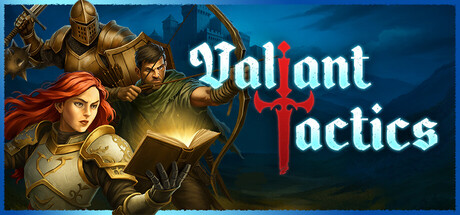
Valiant Tactics
Tired of watching a 95% hit chance whiff the kill shot? Valiant Tactics rips accuracy rolls out of hex-grid tactics entirely, making every bad outcome your fault, and your win completely earned.
GamerScout Verdict
Worth it for tactics players who want zero RNG in combat; too content-thin for roguelite veterans chasing deep meta progression.
Compare Prices(7 stores)
Every store in this table quotes us in euros, so the EUR figure is the price the seller actually set, not our arithmetic — which is why EUR is also the currency we rank in. We only list an offer here when the store gives us its price in euros, so nothing in this table is a number we invented.
Pick USD, PLN, GBP, CAD or AUD in the header and we convert from EUR at the European Central Bank reference rate — converted amounts are prefixed with ~. Your bank or the store may apply a different rate at checkout. We never hide offers based on where you are: everyone sees this whole table.
We may earn a commission when you buy games through links on this page — at no extra cost to you. It never affects our rankings or verdicts.
Price History
Screenshots & Media
About Valiant Tactics
I have a spreadsheet for tracking roguelite run variance. Valiant Tactics broke it, because there is almost no combat variance to track. Every attack connects. Every cooldown choice, every positioning call on the hex grid, every decision to burn an ability now versus saving it for the next encounter, that is the entire game. For strategy players who have spent years blaming the dice, this is either a revelation or a quiet moment of terror, because there is nowhere left to hide. The mechanical core is tighter than it first appears. Felid Entertainment, a three-person studio out of Tbilisi, built the challenge around cooldown management as the primary resource rather than hit probability. You field five active heroes from a pool of eight distinct classes, including roles like Cleric, Marksman, and Guardian, each carrying their own cooldown timings and talent trees. The question on every turn is whether a basic attack finishes the job or whether you spend an ability for the guaranteed kill and leave yourself exposed the following round. Terrain tiles carry status effects like poison clouds and slowing mud, weather shifts mid-run and can collapse a positioning plan that looked solid two turns earlier, and nine enemy factions each demand a different read. The determinism means the enemy telegraphs its intentions too, so when you lose, the post-run summary screen pinpoints the exact turn your formation became unsalvageable and lists synergies you missed, like a weapon effect that would have chained with a talent. That feedback loop is genuinely useful rather than decorative. The roguelite scaffolding is competent without being exceptional. Between hex-grid skirmishes, a branching map of nodes covers battles, random events, merchants, upgrade shrines, and rest stops, with health and consumables carrying over across all of them. The tension of pushing into a hard fight for better loot versus taking the quiet rest after a rough skirmish is real. Permanent progression is intentionally lean: individual heroes reset between runs, and lasting unlocks are limited to additional classes, certain artifacts, and cosmetic badges. Some players have flagged this as too unforgiving, particularly the single-item carry over deep into later runs after a defeat, and that criticism has merit. The meta progression layer is thin relative to what the genre currently benchmarks. Community feedback has also pointed toward wanting a more thorough tutorial, clearer pre-combat difficulty signals, and better tooltip detail on item effects, which suggests the new-player experience still has rough edges despite the accessible-on-paper concept. Content breadth is where the game shows its indie budget most clearly. Eight classes is a workable number for a first release, but players who run through all compositions report that team-building starts to feel familiar sooner than the ten difficulty levels would suggest. Forty dynamic events and over 120 weapons and equipment pieces give individual runs reasonable variety, but the event dialogue reads as generic filler rather than world-building, and the AI occasionally makes odd choices under pressure. The Steam reception sits at roughly 71 percent positive on a small sample, which tracks with the pattern of a mechanically solid debut that could use more content and polish passes. The developers have shown responsiveness to community feedback, which is worth weighting for a live indie title. For the strategy player who wants a clean, no-excuses tactics game, Valiant Tactics delivers exactly that. The no-RNG combat is not a gimmick, it restructures how you think about every turn. Newcomers to hex-grid tactics will find the deterministic system actually lowers the learning curve in one key way: you can plan properly because the numbers do not lie. Just do not arrive expecting the meta depth of a roguelite that has had three years of post-launch updates. This is a tight first release from a small team with a clear, defensible design philosophy.

Strategy & simulation
Tags
System Requirements
Minimum
- OS
- Windows XP, Windows Vista, Windows 7, Windows 8, Windows 10, Windows 11
- Memory
- 1024 MB RAM
- Storage
- 1 GB available space
- Graphics
- OpenGL 3.3 compatible video card with 512 MB
- Processor
- 1.2 Ghz
Recommended
- OS
- Windows 7, Windows 8, Windows 10, WIndows 11
- Memory
- 2048 MB RAM
- Storage
- 1 GB available space
- Graphics
- OpenGL 3.3 compatible video card with 1024 MB
- Processor
- 2+ Ghz
Keep exploring
Community Discussion
Be the first to comment on Valiant Tactics.
Reviews & Ratings
No ratings available
Game Info
- Developer
- Felid Entertainment
- Publisher
- indie.io
- Release Date
- Aug 4, 2025