Utopia Colony
A slow-burn Mars mining sim for players who find factory games too frantic - the loop is thin, the atmosphere is genuine, and the UI will test your patience before the dust storms do.
GamerScout Verdict
Best for patient solo players who want Martian atmosphere over mechanical depth, and can forgive a thin tooltip layer.
Compare Prices(4 stores)
Every store in this table quotes us in euros, so the EUR figure is the price the seller actually set, not our arithmetic — which is why EUR is also the currency we rank in. We only list an offer here when the store gives us its price in euros, so nothing in this table is a number we invented.
Pick USD, PLN, GBP, CAD or AUD in the header and we convert from EUR at the European Central Bank reference rate — converted amounts are prefixed with ~. Your bank or the store may apply a different rate at checkout. We never hide offers based on where you are: everyone sees this whole table.
We may earn a commission when you buy games through links on this page — at no extra cost to you. It never affects our rankings or verdicts.
Price History
Screenshots & Media
About Utopia Colony
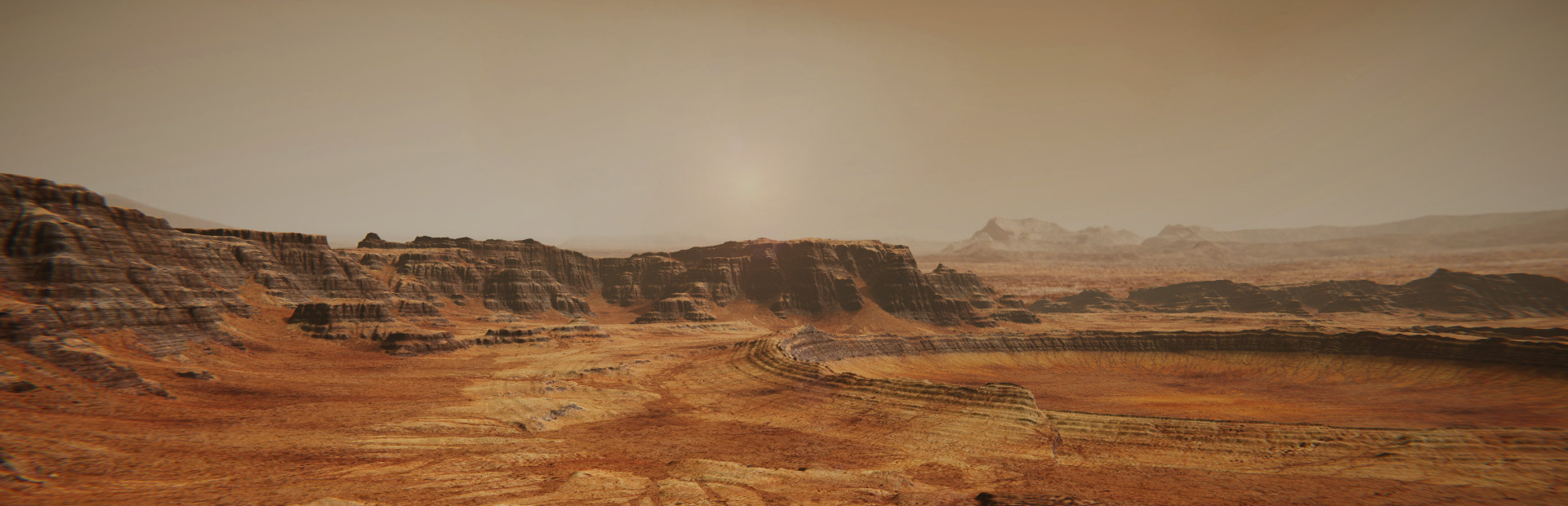
I kept a rough mental spreadsheet while playing Utopia Colony, and after a few sessions the numbers told a specific story: narrow loop, genuine atmosphere, shaky feedback systems. That combination produces a game you either settle into or bounce off within the first hour, and knowing which camp you fall into before paying is worth a few minutes of your time. The core structure is a third-person solo survival-sim set in Utopia Planitia. You start with a small outpost, mine ore deposits on foot, haul credits back to base, and reinvest in station upgrades, suit improvements, rover capacity, and eventually deployable drilling rigs that passively generate resources while you range further out. Reaching the top base upgrade tier unlocks a researcher hire and opens research tasks, while a fluctuating ore marketplace lets you time sales for better returns. On paper that progression tree reads reasonably well. In practice, the feedback layer around it is thin: the game does not clearly display how much power your rigs are consuming, how much food your greenhouse will generate, or how many units of each ore type are sitting in storage. A strategy-minded player will feel that gap acutely. You are making upgrade decisions with incomplete tooltips, which is a design sin that hurts more than any content shortage. What GridSky gets right is the mood. Dust storms roll in without warning, cut visibility to near zero, and drain your oxygen if you wander too far from a waypoint. That single mechanic does real work: it forces you to plan rover routes with an exit strategy in mind and punishes complacency in a way that feels earned rather than arbitrary. The open map in Utopia Planitia is large enough that you can genuinely get lost, and the atmospheric stillness between storms lands closer to genuine Mars fiction than most games in this sub-genre manage. NPC interaction is sparse but present - other pioneers at outposts and the domed colony hand out tasks and drip small story details, including diary entries at locations like the deuterium mine. Do not expect a narrative arc; treat it as ambient world-building and you will not be disappointed. The honest concern for any buyer right now is update cadence. Community discussion has flagged extended gaps between patches, and the review total after a long development window remains modest, sitting at a mixed rating near 65 percent positive across roughly 95 reviews. Animations, models, and UI polish are noticeably below par compared to contemporaries like Occupy Mars. The soft-building system, where whole structures appear when you spend credits rather than requiring manual placement, keeps the base-management side accessible but also removes most of the strategic tension a builder-sim player would expect. If you need tight resource flow charts and meaningful build-order decisions, this is the wrong game. Who it is actually for: players who want a quiet, solitary Mars experience and can tolerate rough edges in exchange for genuine atmosphere. Think of it as a light exploration-survival piece with a thin economy layer rather than a colony sim with depth. The rover traversal and dust storm survival hold up; the upgrade decision-making needs more information surfaced to the player before it can feel satisfying. Approach with calibrated expectations and a tolerance for a small-studio pace.

Strategy & simulation
Tags
System Requirements
Minimum
- OS
- Windows® 8 64-bit or later
- Memory
- 8 GB RAM
- Storage
- 5 GB available space
- Graphics
- NVIDIA® GeForce® GTX 970 4GB or GTX 1060 6GB / AMD R9 390 8GB
- Processor
- Intel® Core™ i5 7400 3.5 GHz / AMD Ryzen R5 1600X 3.6 GHz
Recommended
- OS
- Windows® 10 64-bit (latest Service Pack)
- Memory
- 16 GB RAM
- Storage
- 5 GB available space
- Graphics
- NVIDIA® GeForce® GTX 1060 6GB / AMD RX 580 8GB
- Processor
- Intel® Core™ i7 9700 3.6 GHz / AMD Ryzen R7 2700X 3.7 GHz
Keep exploring
Community Discussion
Be the first to comment on Utopia Colony.
Reviews & Ratings
No ratings available
Game Info
- Developer
- GridSky Software
- Publisher
- GridSky Software
- Release Date
- Apr 4, 2026