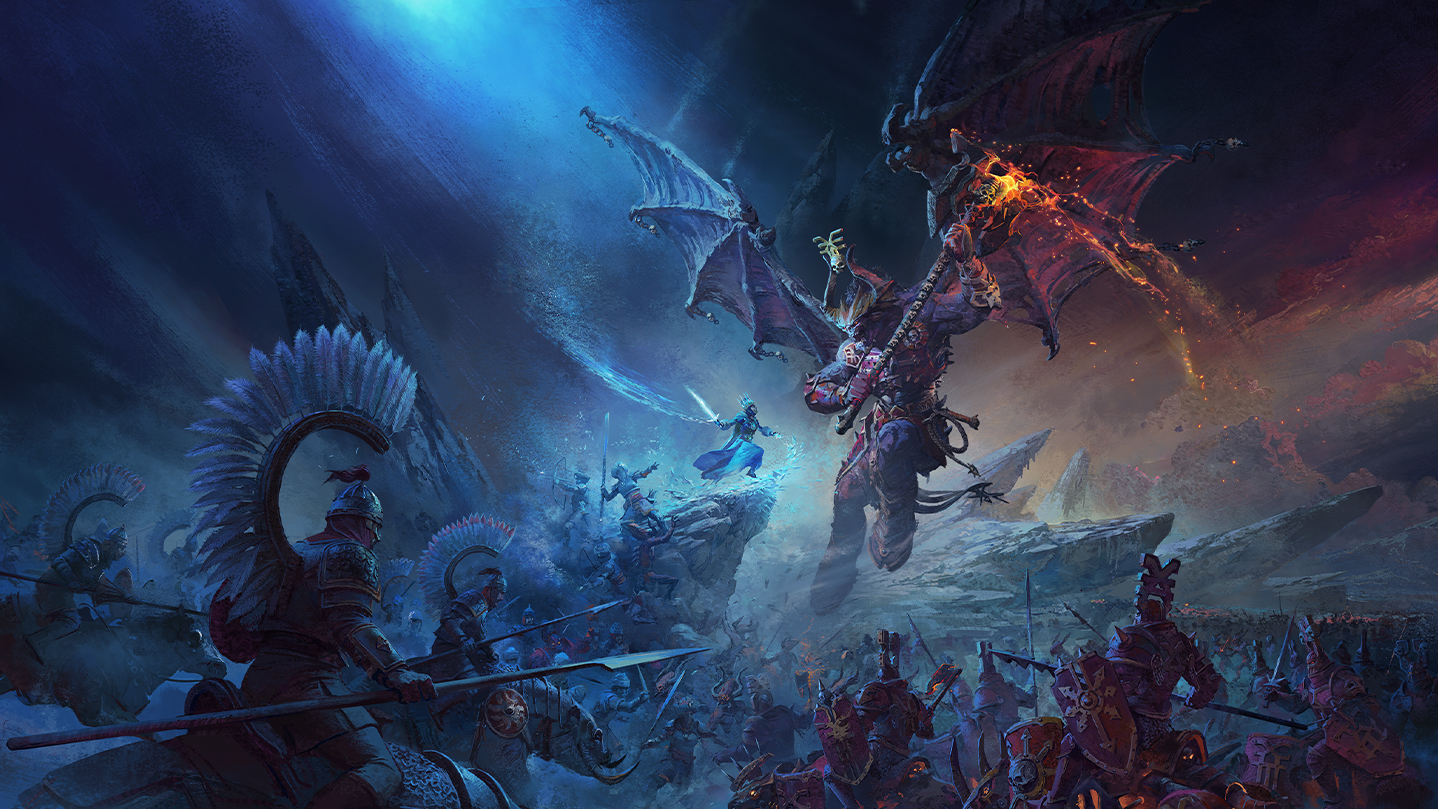
Total War: WARHAMMER III – Tides of Torment (DLC)
Add-on / DLC for Total War: WARHAMMER III — view full gameThe Warhammer trilogy's chaotic finale adds Daemon-infused factions and a Realm of Chaos campaign that swaps typical conquest for a frantic race against the apocalypse.
GamerScout Verdict
The deepest entry in the trilogy, best approached with patience, a faction guide, and Immortal Empires enabled from the start.
Compare Prices(1 stores)
Every store in this table quotes us in euros, so the EUR figure is the price the seller actually set, not our arithmetic — which is why EUR is also the currency we rank in. We only list an offer here when the store gives us its price in euros, so nothing in this table is a number we invented.
Pick USD, PLN, GBP, CAD or AUD in the header and we convert from EUR at the European Central Bank reference rate — converted amounts are prefixed with ~. Your bank or the store may apply a different rate at checkout. We never hide offers based on where you are: everyone sees this whole table.
We may earn a commission when you buy games through links on this page — at no extra cost to you. It never affects our rankings or verdicts.
Price History
Screenshots & Media
About Total War: WARHAMMER III – Tides of Torment (DLC)
Total War: WARHAMMER III closes out Creative Assembly's decade-long Warhammer trilogy by doing something most strategy sequels avoid: it breaks its own map. Instead of a familiar land-grab across recognisable geography, the campaign sends you into the Realm of Chaos, a fragmented dimension ruled by the four Chaos Gods. Each god controls a pocket realm with its own rules, hazards, and boss encounter. You are not here to paint the map your colour. You are here to sprint through a gauntlet before the other factions do it first. That shift in win condition changes the entire feel of your session, and it is the most interesting structural decision in the trilogy. Faction variety is the headline stat for this entry. You get the four Chaos God factions (Khorne, Tzeentch, Nurgle, Slaanesh), each with wildly different playstyles, plus Kislev and Grand Cathay as order-side bookends. Kislev leans into attrition and Bears, Cathay rewards supply-line micromanagement with its Harmony mechanic that buffs units depending on Yin-Yang balance in your army composition. On the Chaos side, Khorne rewards constant aggression through a Blood Tithe resource, while Tzeentch punishes static play with change tokens that flip unit abilities mid-battle. That is four entirely separate resource loops to learn before you even touch confederation or the endgame. The tutorial does the bare minimum, so newcomers should treat the first campaign as a learning run and not a scored attempt. For veterans, the depth of decision-making per turn is the highest in the trilogy. Diplomatic complexity increased substantially, daemon-prince customisation lets you build a bespoke legendary lord from body parts and abilities across multiple playthroughs, and the Immortal Empires combined map (added post-launch and now the primary way most players run the game) drops every faction from all three titles onto a single enormous sandbox. That map alone justifies hundreds of hours if you rotate factions. The AI on the campaign layer is functional but unambitious at lower difficulties. Ramp it up or install SFO Grimhammer for a proper challenge. The modding scene is active and the Steam Workshop is well-stocked, which covers a lot of the rough edges Creative Assembly left unpolished. The Mixed review tag on Steam needs context. The base game launched without Immortal Empires, which was the feature most buyers were waiting for. Once it shipped, satisfaction improved substantially. The 86 Metacritic score better reflects the finished product as it stands today. That said, performance is still inconsistent in late-game Immortal Empires campaigns with large armies, and Cathay's campaign can feel gated in awkward ways if you do not optimise your trade routes early. These are real complaints, not nitpicks, and a player expecting a polished out-of-the-box experience should be aware. If you have never played a Total War game, this is a harder entry point than Warhammer II was in its prime. The faction count is overwhelming and the campaign structure is less forgiving for orientation. But if you are willing to spend two hours watching a faction overview video before your first session, the payoff curve is steep and deeply satisfying. The Warhammer setting does a lot of work by giving every unit and mechanic a flavourful reason to exist. A spreadsheet helps, but the lore does too.

Strategy & simulation
Tags
System Requirements
Minimum
- Processor
- Intel i3/Ryzen 3 series
- Memory
- 6 GB RAM
- Graphics
- Nvidia GTX 900/AMD RX 400 series | Intel Iris Xe Graphics
- DirectX
- Version 11
- Storage
- 120 GB available space Additiona…
Recommended
- OS
- Windows 10 64-bit
- Processor
- Intel i5/Ryzen 5 series
- Memory
- 8 GB RAM
- Graphics
- Nvidia GeForce GTX 1660 Ti/AMD RX 5600-XT/Intel Arc A750
- DirectX
- Version 11
- Storage
- 120 GB available space Additio…
Keep exploring
Community Discussion
Be the first to comment on Total War: WARHAMMER III – Tides of Torment (DLC).
Reviews & Ratings
Game Info
- Developer
- CREATIVE ASSEMBLY
- Publisher
- SEGA
- Release Date
- Feb 16, 2022