TIS-100
TIS-100 drops you into a broken parallel-node computer and asks you to fix it in actual assembly language. Brutal, addictive, and 97% loved on Steam.
GamerScout Verdict
Best for logic-puzzle fans and Factorio-brained optimisers who don't mind earning every solution the hard way.
Compare Prices(6 stores)
Every store in this table quotes us in euros, so the EUR figure is the price the seller actually set, not our arithmetic — which is why EUR is also the currency we rank in. We only list an offer here when the store gives us its price in euros, so nothing in this table is a number we invented.
Pick USD, PLN, GBP, CAD or AUD in the header and we convert from EUR at the European Central Bank reference rate — converted amounts are prefixed with ~. Your bank or the store may apply a different rate at checkout. We never hide offers based on where you are: everyone sees this whole table.
We may earn a commission when you buy games through links on this page — at no extra cost to you. It never affects our rankings or verdicts.
Price History
Screenshots & Media
About TIS-100
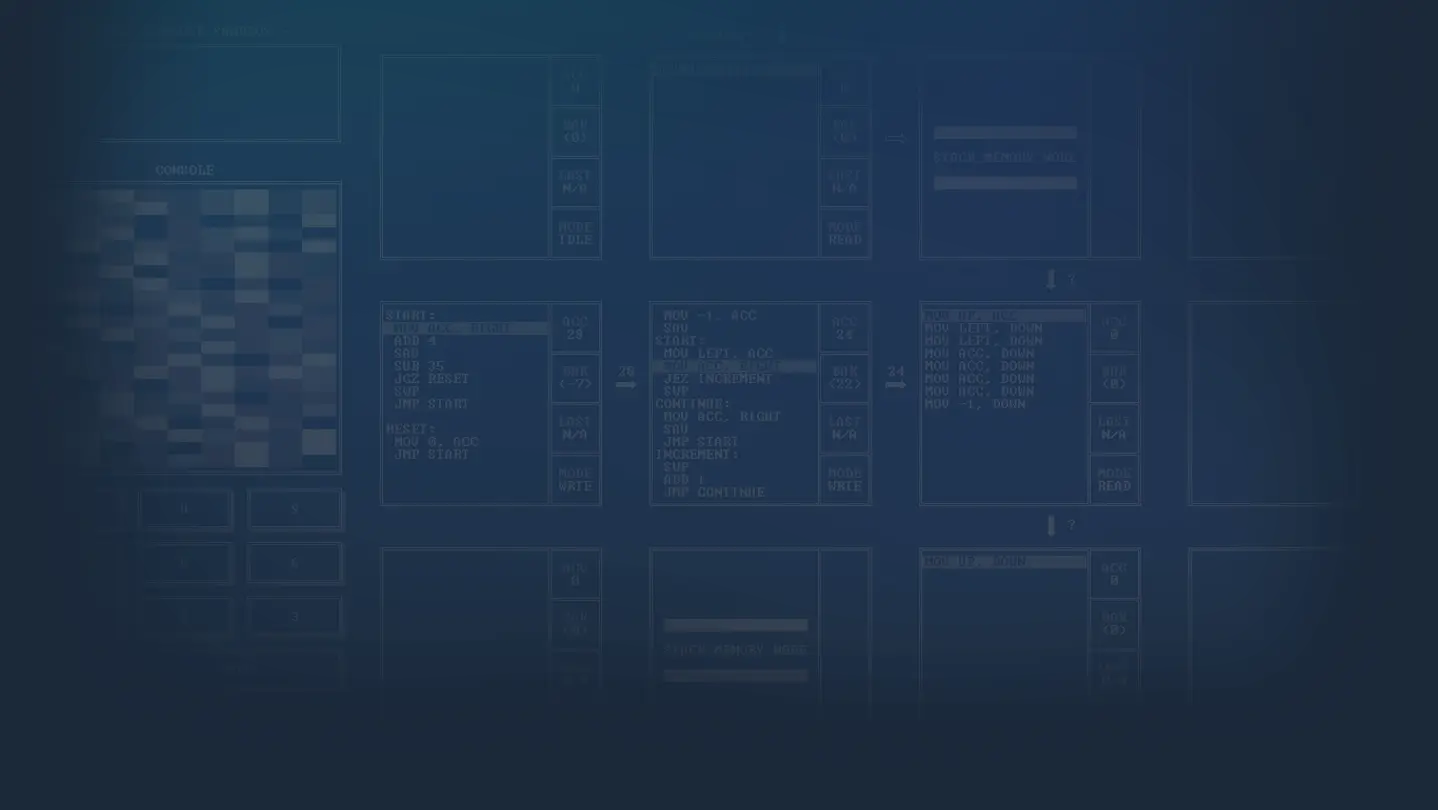
TIS-100 is a puzzle game built around a fictional parallel-node processor architecture, and it asks you to write real assembly-style code to repair corrupted segments of the machine. Each node has a tiny instruction set: MOV, ADD, SUB, JMP, a handful of registers, and almost nothing else. You pass values between adjacent nodes, choreograph data flows across a grid, and watch your solution either click into place or silently produce wrong outputs until you figure out which node is lying to you. This is not a game where you press buttons and things explode. This is a game where you stare at two numbers that should be equal and are not. Who is this for? Anyone who has ever enjoyed logic puzzles, optimisation problems, or the particular satisfaction of a compiler finally shutting up. You do not need a computer science degree. The game eases you in with one-node problems before asking you to coordinate grids of up to twelve nodes simultaneously, and the sparse manual that ships as a printable PDF is genuinely well-written. That said, if the phrase "read values from input, compute running average, write to output" makes your eyes glaze over, this is the wrong weekend purchase. The learning curve is real, and the game does not apologise for it. What works is the depth of optimisation available after you find a solution that merely works. Every puzzle tracks three metrics: number of cycles to complete, number of nodes used, and total lines of code written. The leaderboard histogram compares your score against the entire player base, and that comparison is quietly devastating in the best way. A working solution in 400 cycles feels fine until you see the histogram peak sitting at 180. Then you go back. This loop - solve, profile, rebuild, solve again - is where TIS-100 keeps its real hours. The mod ecosystem via Steam Workshop extends this further, with community-authored puzzles that push the architecture in directions the base game never attempts. The weaknesses are honest ones. The visual presentation is intentionally austere, green text on black, no music to speak of beyond a short ambient loop, no narrative reward beyond cryptic lore fragments that appear as you clear segments. Players expecting any kind of production value will bounce immediately. The fiction is thin - you are repairing a relative's old machine and uncovering what it was actually doing - and while the environmental storytelling has a quiet charm, it is not carrying anyone who isn't already hooked by the mechanics. AI in the traditional sense does not exist here; this is single-player entirely, and the challenge is the puzzle itself rather than an opponent. For strategy and simulation players specifically: the mental model you need here is closer to optimising a supply chain than to playing chess. You are distributing work across parallel processors, identifying bottlenecks, rerouting data when one path is slower than another. If you have ever redrawn a factory layout in Factorio because throughput on the iron plate line was choking downstream assemblers, TIS-100 scratches the same itch at a much lower level of abstraction. It is also, at its price point, one of the most hours-per-dollar-efficient puzzle games available on PC.

Strategy & simulation
Tags
System Requirements
Minimum
- Processor
- 2.0 GHz
- Memory
- 2 GB RAM
- Storage
- 100 MB available space
Keep exploring
Community Discussion
Be the first to comment on TIS-100.
Reviews & Ratings
Game Info
- Developer
- Zachtronics
- Publisher
- Zachtronics
- Release Date
- Jul 20, 2015