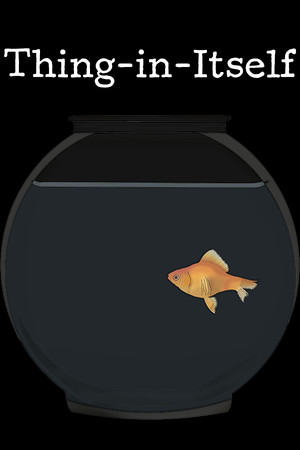
Thing-in-Itself
Fifteen minutes of Kant applied to a failing relationship, with object labels that shift as Ted's mood sours. Short, pointed, and honest about what it is.
GamerScout Verdict
Worth one short sitting for players curious about philosophy-in-game-form; skip if you need mechanical depth or branching outcomes.
Compare Prices(0 stores)
Loading prices...
We may earn a commission when you buy games through links on this page — at no extra cost to you. It never affects our rankings or verdicts.
Price History
Screenshots & Media
About Thing-in-Itself
I usually spend my sessions with a game measuring build trees and late-game scaling curves, so sitting down with Thing-in-Itself felt like swapping a spreadsheet for a short story someone left on a train. That said, there is genuine design thinking here, and it earns at least a fair hearing from anyone who cares about how games communicate ideas. The whole experience runs about fifteen minutes. You play as Ted, moving through a single apartment, interacting with a phone to text or call Molly, feeding a pet fish named Henry, and poking at a handful of objects around the room. The mechanic that actually justifies the philosophical framing is the object-labeling system: depending on how a conversation with Molly goes, the same bed might read as 'happy place' in one scene and something far more deflating in the next. It is a compact, smart way to literalize Kant's argument that we cannot perceive objects independently of the mental states we bring to them. The environmental color palette and minimalist sound score shift alongside those labels, reinforcing mood rather than spelling it out with cutscenes. Where the experience runs into friction is on two fronts. First, the dialogue quality is uneven. Some players find Ted and Molly's exchanges natural and relatable; others report the writing feels stilted enough to break immersion, and with only fifteen minutes of runtime there is no recovery time if the opening lines fail to land. Second, the choices you make during phone interactions do not alter the ending. The story arrives at the same conclusion regardless of how you respond to Molly, which makes the dialogue options feel more like pacing tools than genuine decisions. For a title built around the idea that perception shapes reality, locked-in outcomes create a slight irony the developers probably know about. Production values are modest but considered. The art mixes flat 2D objects inside a 3D first-person space, which sounds like a budget shortcut but actually reinforces the game's slightly dreamlike tone. The voice acting lands better than the writing sometimes deserves: both lead performances are committed and carry emotional weight that the sparse dialogue alone cannot always sustain. On the technical side, the settings menu is bare, resolution is essentially the only adjustable variable, and there are some reported achievement-unlock inconsistencies that remain unpatched years on. None of this is a dealbreaker for a sub-five-dollar micro-experience, but it is worth knowing before you load it up expecting a polished production. The Steam community sits at roughly 77 percent positive across 100 reviews, which is an honest reflection of what it is: a concept that works, wrapped in an execution that is slightly rough at the edges. Achievement hunters will note that a full 100 percent clear takes maybe two playthroughs and requires small interactions like cleaning the room or feeding Henry the fish, so the list is completion-friendly without being trivial. This is not a strategy title, a sim, or anything close to my usual beat. But as a proof that interactive media can carry philosophical weight without 200 hours of systems, Thing-in-Itself makes a quiet argument worth hearing once.

Strategy & simulation
Tags
System Requirements
Minimum
- OS
- Windows 7 or higher
- Memory
- 4 GB RAM
- Storage
- 700 MB available space
- Graphics
- Video card with 512MB of VRAM or higher
- Processor
- Dual Core 2.1Ghz or higher
Keep exploring
Community Discussion
Be the first to comment on Thing-in-Itself.
Reviews & Ratings
No ratings available
Game Info
- Developer
- Party for Introverts
- Publisher
- Party for Introverts
- Release Date
- Jan 5, 2017