
These Doomed Isles
Closer to a puzzle-deckbuilder wearing a city-builder costume than the god-sim the screenshots suggest - but if card synergies and resource math are your thing, there's a tidy game hiding here.
GamerScout Verdict
Solid pick for deckbuilder fans who want spatial decisions and god-themed variety, but misrepresents itself to city-builder and sim audiences.
Compare Prices(8 stores)
Every store in this table quotes us in euros, so the EUR figure is the price the seller actually set, not our arithmetic — which is why EUR is also the currency we rank in. We only list an offer here when the store gives us its price in euros, so nothing in this table is a number we invented.
Pick USD, PLN, GBP, CAD or AUD in the header and we convert from EUR at the European Central Bank reference rate — converted amounts are prefixed with ~. Your bank or the store may apply a different rate at checkout. We never hide offers based on where you are: everyone sees this whole table.
We may earn a commission when you buy games through links on this page — at no extra cost to you. It never affects our rankings or verdicts.
Price History
Screenshots & Media
About These Doomed Isles
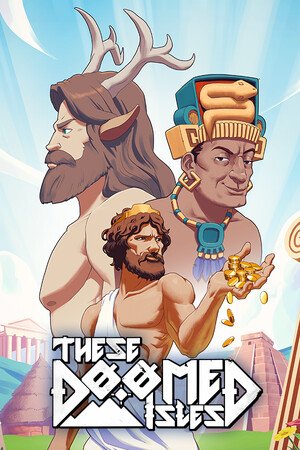
My first few hours with These Doomed Isles were spent arguing with myself about what kind of game it actually is. The marketing leans hard on the city-builder angle, but let me set expectations straight: the buildings you place are primarily number-modifiers rather than simulated infrastructure. There is no supply-chain simulation running underneath, no citizen pathfinding to optimise, no urban sprawl to admire. What you actually have is a compact turn-based deckbuilder where the cards happen to be farms, fishing docks, cabins, and crossbow towers. Once you reframe it that way, the design starts to make a lot more sense. The core loop runs on a seasonal calendar. Each year cycles through four turns, and every season asks you to do slightly different things: place buildings, harvest resources, repel raid waves, and buy new cards during the harvest phase to grow your deck. Faith is the engine that lets you draw more cards per turn, which means keeping your population housed, fed, and happy is not a flavour mechanic - it is literally your throughput stat. Wood, stone, food, gold, and happiness all interlock in ways that punish you for ignoring any single track. The four playable gods - Cernunnos (Celtic, the baseline), Plutus (Greek, with taxation and mercenary mechanics), Acan (Mayan, with ritual sacrifice and environment-friendly workers), and Inari (Japanese, with seasonal card variance and samurai) - each reshuffle those priorities meaningfully. A Plutus run that leans into statue buffs and gold taxation plays nothing like an Acan run built around preserving forest tiles for resource chains. That variety is the game's strongest argument for replay value, and with over 300 cards in the pool and relics to bolt on, early runs barely scratch the surface of available combos. There are three modes to work through: a campaign that functions more like a structured tutorial series with preset objectives and restrictions, a Challenge Mode that is the proper roguelite run format where you unlock new cards and boons with earned currency between attempts, and a sandbox. New players should note that campaign completion gates god unlocks, so grinding through it first is basically mandatory. The progression currency in Challenge Mode earns slowly unless you stack difficulty modifiers, and the challenge mode's enemy variety has attracted fair criticism from the community - the raid waves do not evolve as interestingly as the deck-building side does. God Power balance is also uneven; some feel significantly stronger than others at equivalent difficulty. The RNG is the most divisive element. A bad opening hand of cards can brick a run before it has momentum, particularly if you miss cabin cards early and cannot grow your population to power later turns. The game counters this somewhat by letting you spend faith to cycle your hand, and the card shop randomisation is described by veterans as "controlled" rather than pure chaos - patterns emerge after a few runs and you learn to build around what the shop offers rather than waiting for specific cards. That said, players coming from Against the Storm, which shares a similar survival-city-builder DNA, will notice that the RNG here feels less forgiving than that game's reroll systems. The pixel art is clean, the seasonal music does its job without overstaying its welcome, and controller support is present for anyone who prefers the couch. Steam reception sits at mixed overall, with the most common praise pointing at the god variety and combo depth, and the most common criticism landing on slow meta-progression and weak enemy design in extended runs. It is a modest, well-scoped indie with a clearly defined audience: deckbuilder players who want a spatial, turn-based layer on top of their card decisions. If you are expecting Anno or Frostpunk, step back. If Slay the Spire scratches one itch and you have always wanted the cards to literally build a civilisation, this is worth several evenings.

Strategy & simulation
Tags
System Requirements
Minimum
- OS
- Windows 10
- Memory
- 4 GB RAM
- DirectX
- Version 11
- Storage
- 150 MB available space
- Graphics
- Intel HD 3000 / AMD Radeon R7 Graphics
- Processor
- Intel Core i3-2125 / AMD A10-7850K
Recommended
- OS
- Windows 10
- Memory
- 8 GB RAM
- DirectX
- Version 11
- Storage
- 150 MB available space
- Graphics
- Nvidia GeForce GTX 285 / AMD Radeon R7 260x AMD Ryzen 5 5600G, AMD Radeon™ 7 Graphics / Intel Core i5-11400, Intel® UHD Graphics 730
- Processor
- Intel Core i5-6600 / AMD Ryzen 3 1200
Keep exploring
Community Discussion
Be the first to comment on These Doomed Isles.
Reviews & Ratings
No ratings available
Game Info
- Developer
- Triplevision Games Limited
- Publisher
- Fireshine Games
- Release Date
- Oct 30, 2024