Compare The White Laboratory prices across 50+ stores and find the best deal. Developed by Laboratory Systems. Published by Laboratory Systems. Released on 3/28/2019. Available on PC. Genres: Indie, Strategy.

Salvage blocks from defeated robots and immediately bolt them onto your defenses - tower defense has rarely felt this hands-on, or this physics-chaotic.

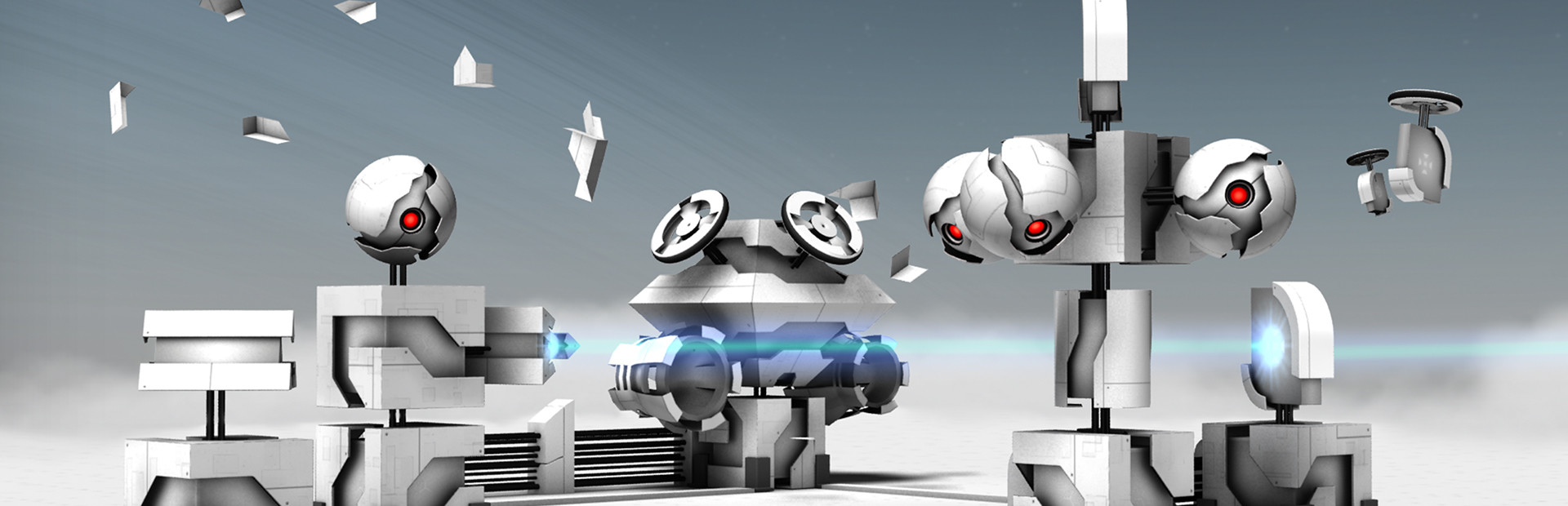
I've spent enough time with physics-based strategy titles to know when a clever mechanical idea is fighting against its own implementation, and The White Laboratory sits squarely in that tension. The core hook is genuinely smart: there are no upgrade menus, no tech trees in the traditional sense. Instead, you harvest geometric components - cubes, spheres, cylinders, prisms - directly off defeated enemies and snap them onto your existing structures in real-time. Cubes form the frame, spheres fire projectiles, cylinders spin your weapon mounts for higher fire rates, and prisms act as laser emitters. The combinatorial space is real, and for a strategy-minded player, the first couple of hours feel like a proper puzzle. The game ships with three distinct modes. Experiment mode (the campaign) pushes you through a mission series covering expansionary defense, conquest, and resource production scenarios. Sandbox gives you a generous material supply to prototype designs and tackle optional challenges at your own pace. Survival mode strips it back to pure fortress defense with unrelenting waves. That is a reasonable breadth of content for a sub-five-dollar indie, and the clean, clinical visual style - all metallic geometry against a gas-planet sky - actually helps you read structural layouts clearly during the chaos. Colorblindness support is present too, which is a small but welcome detail. Now for the numbers that matter. Steam sits the game at roughly 73% positive across around 275 reviews, and that split tells you exactly what you need to hear. The physics simulation is listed as 99% physically driven, which sounds like a feature until your carefully constructed turret topples under its own weight before a wave even begins, or a laser array misses every target because a rotating mount has thrown off the firing angle by degrees you cannot measure because there is no visible damage or stats readout anywhere in the UI. Community feedback consistently flags the absence of any numerical feedback loop - no DPS displays, no structural integrity meters - which for a strategy game in 2019 is a real problem. You are essentially doing calculus in your head while the tower wobbles. For the right kind of player, this is still worth the attention it asks for. If you like systems-first games where the rules are physical rather than numerical, and you have patience for emergent jank, the sandbox mode alone can generate genuinely interesting sessions. The real-time-with-pause building means you are never truly helpless mid-wave. The concept of modifying towers by grafting salvaged enemy parts rather than clicking an upgrade button is the sort of design idea that a larger studio should have stolen by now. The AI is not sophisticated, and there is no mod ecosystem to speak of, but the underlying loop has a scrappy originality that keeps it from feeling like a nothing release. Approach it as an experimental sandbox first and a polished strategy game second, and your frustration tolerance will be correctly calibrated. Veterans of Besiege-style physics builders will find familiar pleasures and familiar headaches. If you need precise numbers and reliable AI pathing, look elsewhere. Diego, Scout Team

The White Laboratory
IndieStrategy

The White Laboratory

Mar 28, 2019Laboratory Systems
GamerScout Says

Salvage blocks from defeated robots and immediately bolt them onto your defenses - tower defense has rarely felt this hands-on, or this physics-chaotic.

PC
Best Price Available
0.00
at N/A
Historical low: $3.3

Compare Prices(0 stores)

Loading prices...

We may earn a commission when you buy games through links on this page — at no extra cost to you. It never affects our rankings or verdicts.

Screenshots & Media

Screenshot

About The White Laboratory

I've spent enough time with physics-based strategy titles to know when a clever mechanical idea is fighting against its own implementation, and The White Laboratory sits squarely in that tension. The core hook is genuinely smart: there are no upgrade menus, no tech trees in the traditional sense. Instead, you harvest geometric components - cubes, spheres, cylinders, prisms - directly off defeated enemies and snap them onto your existing structures in real-time. Cubes form the frame, spheres fire projectiles, cylinders spin your weapon mounts for higher fire rates, and prisms act as laser emitters. The combinatorial space is real, and for a strategy-minded player, the first couple of hours feel like a proper puzzle. The game ships with three distinct modes. Experiment mode (the campaign) pushes you through a mission series covering expansionary defense, conquest, and resource production scenarios. Sandbox gives you a generous material supply to prototype designs and tackle optional challenges at your own pace. Survival mode strips it back to pure fortress defense with unrelenting waves. That is a reasonable breadth of content for a sub-five-dollar indie, and the clean, clinical visual style - all metallic geometry against a gas-planet sky - actually helps you read structural layouts clearly during the chaos. Colorblindness support is present too, which is a small but welcome detail. Now for the numbers that matter. Steam sits the game at roughly 73% positive across around 275 reviews, and that split tells you exactly what you need to hear. The physics simulation is listed as 99% physically driven, which sounds like a feature until your carefully constructed turret topples under its own weight before a wave even begins, or a laser array misses every target because a rotating mount has thrown off the firing angle by degrees you cannot measure because there is no visible damage or stats readout anywhere in the UI. Community feedback consistently flags the absence of any numerical feedback loop - no DPS displays, no structural integrity meters - which for a strategy game in 2019 is a real problem. You are essentially doing calculus in your head while the tower wobbles. For the right kind of player, this is still worth the attention it asks for. If you like systems-first games where the rules are physical rather than numerical, and you have patience for emergent jank, the sandbox mode alone can generate genuinely interesting sessions. The real-time-with-pause building means you are never truly helpless mid-wave. The concept of modifying towers by grafting salvaged enemy parts rather than clicking an upgrade button is the sort of design idea that a larger studio should have stolen by now. The AI is not sophisticated, and there is no mod ecosystem to speak of, but the underlying loop has a scrappy originality that keeps it from feeling like a nothing release. Approach it as an experimental sandbox first and a polished strategy game second, and your frustration tolerance will be correctly calibrated. Veterans of Besiege-style physics builders will find familiar pleasures and familiar headaches. If you need precise numbers and reliable AI pathing, look elsewhere. Diego, Scout Team

Tags

singleplayerachievementscloud-savestier:sub-5Real-Time with PauseModular BuildingSalvage MechanicsPhysics SandboxTower ConstructionWave DefenseNo Upgrade TreesColorblind Support

Steam Deck & Linux

Steam Deck Playable

Valve rates this game Steam Deck Playable.

System Requirements

Minimum

OS
Windows 7
Memory
3 GB RAM
DirectX
Version 9.0c
Storage
2 GB available space
Graphics
Shader Model 3.0 1.0 GB VRAM
Processor
Core 2 Duo
Additional Notes
Minimum Resolution 1280x720

Recommended

OS
Windows 7
Memory
4 GB RAM
DirectX
Version 9.0c
Storage
2 GB available space
Graphics
Shader Model 3.0 2.0 GB VRAM

Community Discussion

Be the first to comment on The White Laboratory.

Reviews & Ratings

No ratings available

Game Info

Developer
Laboratory Systems
Publisher
Laboratory Systems
Release Date
Mar 28, 2019

Price Alert

Get notified when the price drops below your target!

Create Alert

Price History

2026-06-103.30(lowest)

Buy smarter: helpful guides

Looking for more? See games like The White Laboratory

Frequently asked questions about The White Laboratory

How much does The White Laboratory cost?

The White Laboratory pricing changes often and varies by store, edition and region. The live price table on this page compares the cheapest in-stock key and store offers across 50+ verified shops, so you always see the current lowest price before you buy.

Where can I buy The White Laboratory cheapest?

Compare The White Laboratory prices across every verified store in the price table on this page. We list the cheapest in-stock key and store offers, updated regularly, so you always see the best current deal before you buy.

What platforms is The White Laboratory available on?

The White Laboratory is available on PC.

When was The White Laboratory released?

The White Laboratory was released on 28 March 2019.

Who developed The White Laboratory?

The White Laboratory was developed by Laboratory Systems.