
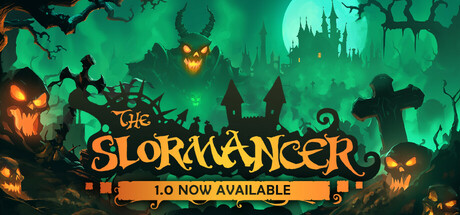
The Slormancer
Four years of Early Access refinement packed into a two-person passion project that quietly out-features plenty of studio-sized ARPGs. Worth your time if the grind is the point.
GamerScout Verdict
Best for grind-tolerant ARPG fans who want Last Epoch-style build freedom from a two-person studio that really cared.
Compare Prices(8 stores)
Every store in this table quotes us in euros, so the EUR figure is the price the seller actually set, not our arithmetic — which is why EUR is also the currency we rank in. We only list an offer here when the store gives us its price in euros, so nothing in this table is a number we invented.
Pick USD, PLN, GBP, CAD or AUD in the header and we convert from EUR at the European Central Bank reference rate — converted amounts are prefixed with ~. Your bank or the store may apply a different rate at checkout. We never hide offers based on where you are: everyone sees this whole table.
We may earn a commission when you buy games through links on this page — at no extra cost to you. It never affects our rankings or verdicts.
Price History
Screenshots & Media
About The Slormancer
My instinct with small indie ARPGs is usually to temper expectations before the first run ends. The Slormancer broke that instinct fast. Slormite Studios, a two-person team, spent four years in Early Access before the 1.0 release in May 2025, and that time shows in the density of systems on offer. This is a top-down pixel-art hack-and-slash in the vein of early Diablo or Last Epoch, but it carries its own personality: absurdist humour threaded through a linear story, a visual style that looks simple until spell effects start filling the screen, and a soundtrack that somehow stays welcome through dozens of hours of repetition. The three classes, Knight, Huntress, and Mage, each branch into three Specializations that unlock around level 10. The Knight is a melee bruiser whose Distinguished Knight spec deploys Banners of War for random buffs and debuffs, keeping even brawler gameplay tactically alive. The Huntress leans into mobility and projectiles, with the Mist-Walker spec folding in stealth, poison, and Ravenous Dagger burst windows for a genuine rogue flavour. The Mage starts fragile and mana-hungry but scales into devastating screen-wide clears, particularly through the Devoted Scholar's Emblem system, where cycling spell schools stacks damage bonuses. Every class can freely swap between all previously collected Slorm Reapers, the game's 120 named weapons that function less like stat sticks and more like build pivots. Finding a weapon that rewires your whole playstyle is the central joy here, and it hits reliably. What separates The Slormancer from its ARPG neighbours is the quality-of-life philosophy baked in from the ground up. A loot filter lives in the inventory corner. Unwanted gear auto-dismantles on pickup once configured. Crafting materials transfer with a single click. Respeccing skills, attribute points, and the Ancestral Legacy tree costs only a soft currency fee rather than a restart. The passive skill tree draws Path of Exile comparisons, but the comparison that actually fits is Last Epoch: broadly approachable, meaningfully deep, punishing only to those who refuse to read. The UI is layered enough that new players will feel briefly overwhelmed, and early maps can blur together in a way that makes the first couple of hours feel more repetitive than they ultimately are. That early friction is real, and it is worth naming plainly. The endgame has genuine legs. The Slorm Temple, The Great Forge, and Wrath-level scaling in The Netherworld give build-obsessed players a long runway for optimisation. The criticism that post-campaign progression feels gated behind mandatory grinding tasks is fair; legendary drop rates can make specific build completions feel artificially slow. Boss design leans more toward stat-check than spectacle, which is the one area where the two-person scope shows through. There is no co-op, and the developers have said clearly they prefer to keep it a focused solo experience, which is a defensible call even if it closes a door. The pixel art rewards close attention: spell animations are punchy, enemy variety across seven environments reads clearly mid-chaos, and the screen fills with numbers without becoming unreadable. The soundtrack earns its reputation. It is the kind of score that loops without grating, which for a grind-loop game is as functional as it is aesthetic. The Slormancer sat at 87 percent positive across over three thousand Steam reviews at launch, a number built over years of Early Access iteration. That trust was earned, not gifted.

Indie & narrative
Tags
System Requirements
Minimum
- OS
- Windows 7 and Above
- Memory
- 4 GB RAM
- DirectX
- Version 9.0
- Storage
- 450 MB available space
- Graphics
- 512 Mb
- Processor
- Dual-Core 1.8 GHZ or equivalent
Recommended
- OS
- Windows 7 and Above
- Memory
- 8 GB RAM
- DirectX
- Version 11
- Storage
- 450 MB available space
- Graphics
- 1 Gb
- Processor
- Quad-Core 2.4 GHZ or equivalent
Keep exploring
Community Discussion
Be the first to comment on The Slormancer.
Reviews & Ratings
No ratings available
Game Info
- Developer
- Slormite Studios
- Publisher
- Slormite Studios
- Release Date
- May 13, 2025