The Pathless
Giant Squid stripped the open-world genre down to its bones and built something genuinely rare: a 6-7 hour adventure where moving through the world is itself the reward.
GamerScout Verdict
Best for players who value mood, movement, and a world that trusts them to find their own way through it.
Compare Prices(9 stores)
Every store in this table quotes us in euros, so the EUR figure is the price the seller actually set, not our arithmetic — which is why EUR is also the currency we rank in. We only list an offer here when the store gives us its price in euros, so nothing in this table is a number we invented.
Pick USD, PLN, GBP, CAD or AUD in the header and we convert from EUR at the European Central Bank reference rate — converted amounts are prefixed with ~. Your bank or the store may apply a different rate at checkout. We never hide offers based on where you are: everyone sees this whole table.
We may earn a commission when you buy games through links on this page — at no extra cost to you. It never affects our rankings or verdicts.
Price History
Screenshots & Media
About The Pathless
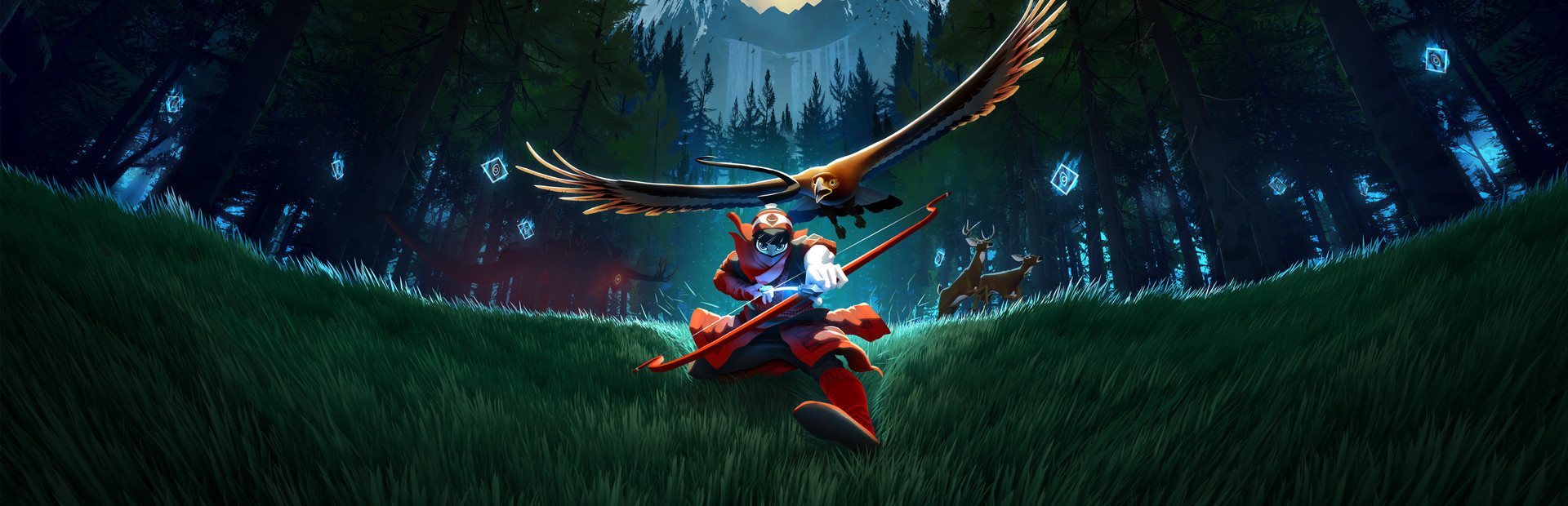
I keep coming back to one specific moment in The Pathless: the first time the dash chain clicks. You shoot a floating talisman, the Hunter surges forward, you hit another, and another, and suddenly you are not walking through a forest but flowing through it, bow singing, eagle banking at your shoulder. That sensation is the whole thesis of this game, and Giant Squid earns it entirely. The core loop is unusual and worth explaining clearly. The Hunter has no traditional sprint button. Instead, her movement is powered by shooting talismans scattered across the landscape, each shot topping up a dash meter that would otherwise drain in seconds. The lock-on system handles aim automatically, so you are never fighting your controller to hit targets. You are timing, rhythming, chaining. It creates something that feels closer to music than action. Combined with the eagle companion, who can be called to carry you into the air, gain altitude through wing-flaps, and unlock a second jump mid-leap, traversal evolves as you upgrade the bird throughout the game. Forests, open plains, a wintry abandoned city nestled in the mountains: each region is distinct, and the movement system reshapes itself subtly in each one. The structure is less exciting to describe. Each of the game's regions asks you to find Lightstones locked behind environmental puzzles, carry them to towers to light up three beacons, and then face a corrupted god in a multi-phase boss encounter that blends aerial chases with archery. Puzzle variety is honest: some involve threading arrows through consecutive rings or igniting pyres at precise angles, and the better ones use the eagle as a co-solver. The weaker ones are block switches and pressure plates that feel carried over from a different era. The boss encounters themselves are genuinely tense, partly because the corrupted spirits roam their domains as living storms. Get caught inside one and your eagle is separated from you, and you are forced into a quiet, nervous cat-and-mouse sequence to reach her before the beast's searchlight eye finds you. It is the only real friction in a game that otherwise refuses to punish. There is no death state, and losing the crystals that upgrade your eagle's flap count is as dire as it gets. Whether that feels liberating or a little soft depends entirely on what you came for. And then there is Austin Wintory's score, recorded with throat singing that shifts registers the way light shifts through branches. Moving atmospheric percussion during exploration. Something lower and more urgent when a storm rolls in. It does not decorate the game; it is part of how the game communicates mood, and it is the best thing Wintory has done since Journey. Spirit Sight, the Hunter's equivalent of a detective mode, is used tastefully: it pulses points of interest but fades as you approach, keeping discovery in your hands rather than the developer's. The story is minimal on the surface, told through stone tablets and skeletal remains of previous Hunters who came close but not close enough, and that restraint is exactly right. The honest weakness is structural repetition. The same sequence of find-stones, light-towers, face-boss plays out across every region without much variation in its framing. A few reviewers noted it starts to feel formulaic by the third region, and that is a fair reading. The world is also beautiful but occasionally sparse, and players who want density of content or meaningful side activities will feel the gaps. The PC version has limited graphics settings, worth noting for lower-spec machines. But for a game that runs six to seven hours and knows exactly when to stop, these are costs I am prepared to pay.

Indie & narrative
Tags
System Requirements
Minimum
- OS
- Windows 10
- Memory
- 6 GB RAM
- DirectX
- Version 9.0c
- Storage
- 15 GB available space
- Graphics
- Nvidia GeForce GTX 660 | AMD Radeon HD 7870
- Processor
- Intel Core i5-2300 | AMD FX-4350
Recommended
- OS
- Windows 10
- Memory
- 8 GB RAM
- DirectX
- Version 11
- Storage
- 15 GB available space
- Graphics
- Nvidia GeForce GTX 1070 | AMD Radeon RX Vega 56
- Processor
- Intel Core i7-6700 | AMD Ryzen 7 1800X
Keep exploring
Community Discussion
Be the first to comment on The Pathless.
Reviews & Ratings
Game Info
- Developer
- Giant Squid
- Publisher
- Annapurna Interactive
- Release Date
- Nov 16, 2021