The Lone Blade
Controlling a sword-soul ascending a broken world is a stranger premise than it sounds, and Opia Games earns it with movement design that rewards patience and experimentation over reflexes alone.
GamerScout Verdict
Worth picking up for players who value atmosphere and offbeat movement design over polished mechanics, especially with a controller in hand.
Compare Prices(7 stores)
Every store in this table quotes us in euros, so the EUR figure is the price the seller actually set, not our arithmetic — which is why EUR is also the currency we rank in. We only list an offer here when the store gives us its price in euros, so nothing in this table is a number we invented.
Pick USD, PLN, GBP, CAD or AUD in the header and we convert from EUR at the European Central Bank reference rate — converted amounts are prefixed with ~. Your bank or the store may apply a different rate at checkout. We never hide offers based on where you are: everyone sees this whole table.
We may earn a commission when you buy games through links on this page — at no extra cost to you. It never affects our rankings or verdicts.
Price History
Screenshots & Media
About The Lone Blade
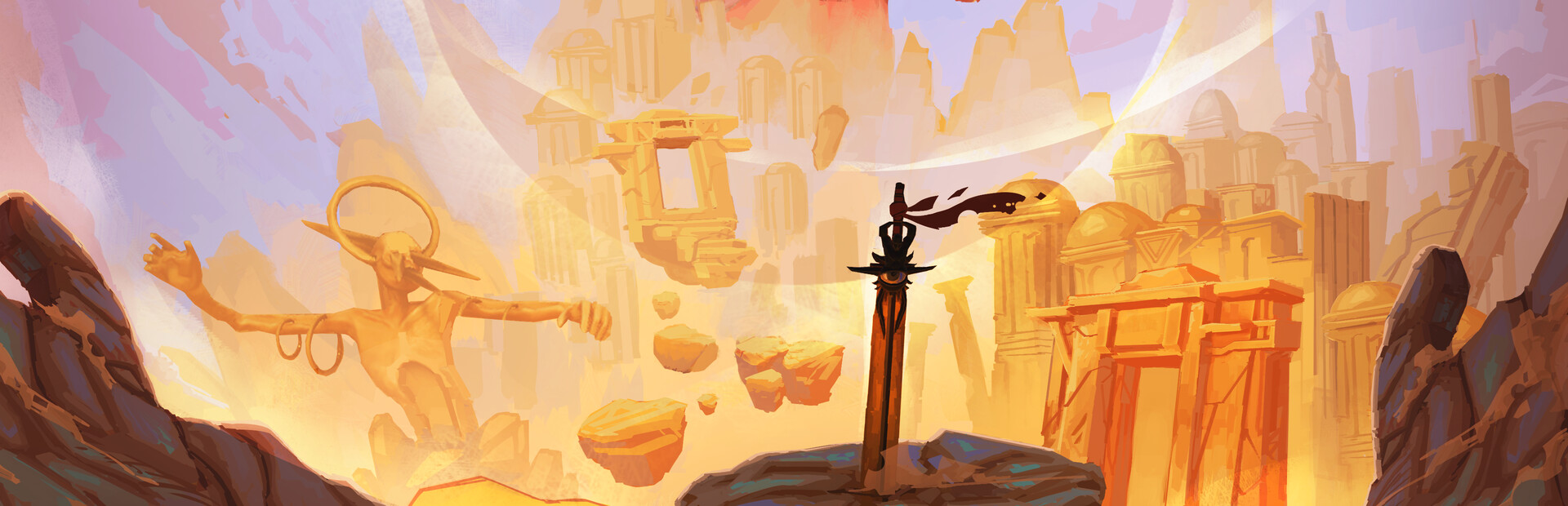
I kept coming back to The Lone Blade not because it was easy to love, but because its central idea is genuinely singular: you are not a hero wielding a weapon, you are the weapon, a greedy soul imprisoned inside a blade by divine punishment, clawing your way upward through a ruined world to find something like redemption. That premise alone pushed me past the awkward first minutes of learning how a sword actually moves. The movement system is the whole game, really. Jump, dash, wall-spike, spin - four verbs that combine into a surprisingly open vocabulary once the logic clicks. The three-act structure takes you from an arid wasteland of buried giants and sand-locked folk, down into an ancient underground temple packed with grinding mechanical traps, and finally up to a mountain summit that the whole game has been promising. Each zone is roughly self-contained, closing with a boss encounter. The developer has been candid that the bosses were the hardest part of the game to design, and that honesty shows - the traversal sections are where the craft lives, and the boss fights feel like a different, slightly rougher game. That said, they are short enough not to sour the overall experience. The atmosphere deserves more credit than the tiny review pool has given it. The world-building is conveyed through geometry and visual storytelling rather than lengthy text dumps: humongous gates looming at the edge of vision, walls of staring eyes that feel genuinely uncanny, a silent instrumental soundtrack that leans into the desolation without overpowering it. This is the kind of place you want to glide slowly through rather than sprint. The stylized 3D aesthetic is low-poly but deliberate, and it holds up well against the surreal imagery the game wants to invoke. Where the cracks show is in the controls, specifically on keyboard. The Steam community tags it as "Intentionally Awkward Controls," which is partly a design philosophy - mastering a sword body is supposed to feel alien before it feels fluid - but the gap between intentional friction and actual jank is narrow and the game occasionally falls on the wrong side of it. A controller closes that gap considerably, and I would call it borderline required here. The physics interactions with some environmental elements, particularly rotating gear platforms in the temple section, can also produce the occasional collision read that sends you into the void for reasons that feel genuinely unearned. The Lone Blade is Opia Games' first title, and it reads that way in both the best and less polished senses. The imaginative premise, the cohesive atmosphere, and the willingness to commit fully to a strange central mechanic all point to a studio with something real to say. It is short - most players will finish it in two to four hours - but it knows when to end, which is rarer than it sounds. If you have the patience for a precision platformer that cares more about mood and movement poetry than difficulty curves, this small, strange blade is worth picking up.

Indie & narrative
Tags
System Requirements
Minimum
- OS
- Windows 8
- Memory
- 4 GB RAM
- Storage
- 3 GB available space
- Graphics
- GTX 960 M
- Processor
- Intel Core i5
Keep exploring
Community Discussion
Be the first to comment on The Lone Blade.
Reviews & Ratings
No ratings available
Game Info
- Developer
- Opia Games
- Publisher
- Opia Games
- Release Date
- May 23, 2023