The Girl and the Robot
Ghibli-flavored atmosphere wrapped around clunky combat and controls that fight you harder than the enemies do. Worth a look if the puzzle half sounds appealing, but go in clear-eyed about what the other half delivers.
GamerScout Verdict
Best for ICO-mood chasers who can stomach sluggish combat in exchange for a brief, wordless fairy-tale and some clever two-character puzzles.
Compare Prices(4 stores)
Every store in this table quotes us in euros, so the EUR figure is the price the seller actually set, not our arithmetic — which is why EUR is also the currency we rank in. We only list an offer here when the store gives us its price in euros, so nothing in this table is a number we invented.
Pick USD, PLN, GBP, CAD or AUD in the header and we convert from EUR at the European Central Bank reference rate — converted amounts are prefixed with ~. Your bank or the store may apply a different rate at checkout. We never hide offers based on where you are: everyone sees this whole table.
We may earn a commission when you buy games through links on this page — at no extra cost to you. It never affects our rankings or verdicts.
Price History
Screenshots & Media
About The Girl and the Robot
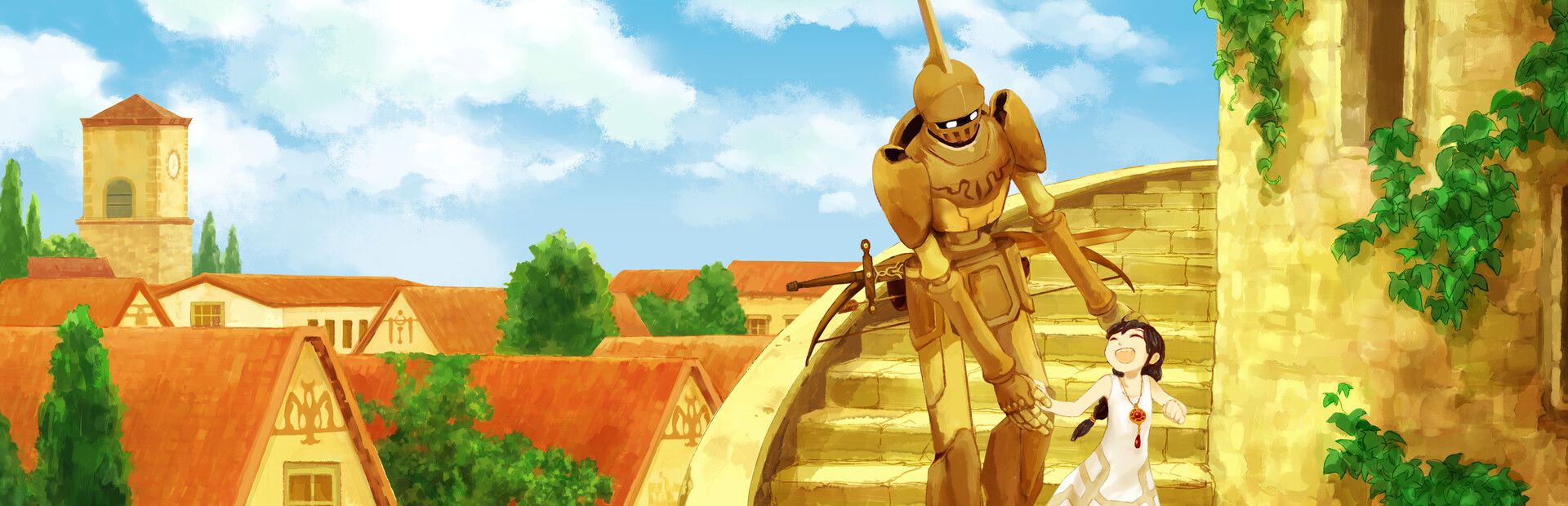
My first hour with The Girl and the Robot genuinely charmed me, and I want to be upfront about that before this gets complicated. Montreal studio Flying Carpets Games built something visually sincere here: hand-painted castle walls washed in cel-shaded watercolour, a wordless fairy-tale told through environmental paintings and voiceless cutscenes, character designs that consciously nod toward Studio Ghibli. The references to Nausicaa and Laputa are not subtle, and for a short stretch the game earns them. You control two characters, switching on the fly between a girl who can crawl through tight passages and climb walls, and a robot companion she activates via a magical pendant. The robot brings the sword, a three-hit combo, a bow for long-range switches, and a jetpack dodge. The girl brings mobility and the ability to repair her metal friend. On paper the setup is genuinely interesting, and the puzzle design in the first half of the roughly three-to-four-hour runtime shows real craft: pressure plates that require one character to read a symbol while the other responds in an adjacent room, an invisible walkway that only the robot can see while you guide the girl across bit by bit. Those moments land. The back half of the game is where things unravel, and I want to be honest about the degree to which they do. Combat is the fulcrum. The robot's moveset is thin: block, three-hit combo, block, repeat. The controls carry a stiffness that reviewers across the board noted at launch and nothing has fundamentally changed since. The camera catches on walls. The character swap triggers a loading flash instead of a clean cut. The girl herself has zero offensive capability, which in the first half functions as mild escort tension and in the second half collapses into something closer to frustration, particularly inside a mid-game maze that floods the area with exploding robots while the pacing drags to a near-halt. Enemies that capture the girl trigger an instant game-over, and their spawning carries enough randomness that some encounters read as luck rather than design. The bow is genuinely useful for triggering distant switches and picking off faster enemies at range, and that helps, but it does not fix the underlying feel of the controls. There is also the matter of structure. The game ends on a cliffhanger, credits rolling on what it labels Act 1. No Act 2 has materialized in the years since release. The story told through those environmental paintings is thin enough that the open ending lands less as a teaser and more as an absence. The narrative never explains why the girl was imprisoned, what drives the evil queen, or what the robot was before she found the pendant. Some players will read that minimalism as wabi-sabi restraint. Others will read it as an unfinished script. So who is this for? Honestly, it is for someone who wants roughly ninety minutes of genuinely thoughtful puzzle design wrapped in a quiet, fairy-tale visual tone, and who can tolerate that the action segments surrounding those puzzles are going to feel stiff and occasionally cheap. The watercolour aesthetic holds up, the dual-character mechanic produces its best moments before the combat-heavy sections take over, and the complete silence of the world, no voice acting, minimal music, lets the atmosphere breathe in ways a louder game would not. If you love ICO not for its combat but for the mood of its spaces, there is something here worth tolerating the rough patches for. Just do not arrive expecting polish.

Indie & narrative
Tags
System Requirements
Minimum
- OS
- Windows XP SP3
- Memory
- 4 GB RAM
- DirectX
- Version 9.0
- Storage
- 4 GB available space
- Graphics
- Direct 9 compatible card
- Processor
- Intel Core 2 Duo
Keep exploring
Community Discussion
Be the first to comment on The Girl and the Robot.
Reviews & Ratings
Game Info
- Developer
- Flying Carpets Games
- Publisher
- Flying Carpets Games
- Release Date
- Aug 17, 2016