The Chess Variants Club
Twelve ways to break classical chess, plus 400-plus puzzles spanning Atomic, Circe, and Demi-Chess variants. Narrow but honest value for the price bracket it sits in.
GamerScout Verdict
Worth it for offline casual sessions with a friend; seasoned players will outgrow the AI and variant selection fast.
Compare Prices(0 stores)
Loading prices...
We may earn a commission when you buy games through links on this page — at no extra cost to you. It never affects our rankings or verdicts.
Price History
Screenshots & Media
About The Chess Variants Club
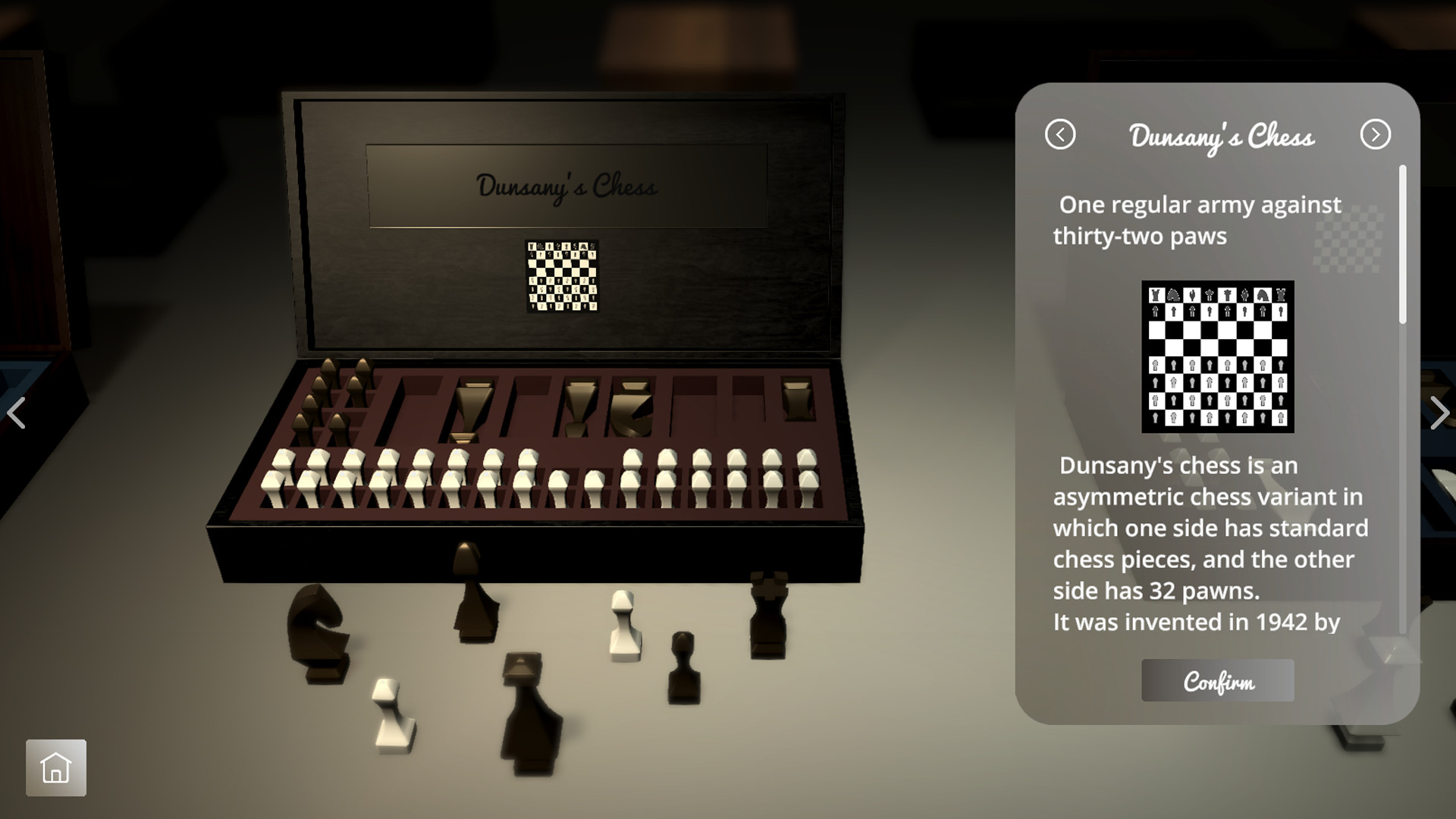
My spreadsheet instincts kicked in immediately here: twelve variants, four-hundred-plus puzzles, one modest price tag. The math invites curiosity, but the depth on offer is thinner than that list implies, and knowing that upfront saves frustration later. The roster covers a genuinely diverse range of rule sets. Chess960 (Fischer Random) reshuffles the back rank to kill opening memorisation. Atomic Chess explodes every captured piece and any adjacent non-pawn, turning endgames into a minefield of chain reactions. Los Alamos Chess strips away bishops and rooks for a 6x6 board that plays faster than a blitz round. Circe Chess returns captured pieces to their starting squares, which sounds minor until your opponent's queen keeps resurrecting itself. Dunsany's Chess flips material asymmetry completely, pitting a full set of pawns against a conventional army. None of these are invented by Minimol Games, and if you have already spent time on Lichess or Chess.com, you have seen some of them before. What the package offers is a single offline home for all of them, presented in a clean, minimalist interface with a purpose-composed ambient soundtrack that does its job quietly and without fuss. The puzzle mode is where the real solo value lives. Over 400 puzzles spread across Classical, Atomic, 3-Checks, Micro-Chess, Demi-Chess, Diana Chess, and Circe Chess mean you are not just drilling standard tactics but learning the specific tactical motifs each variant creates. That is genuinely useful for anyone trying to internalise why an Atomic pin works differently from a classical one. The community hub even has an answer key written in algebraic notation, which is a small but appreciated detail for learners. From a decision-depth standpoint, the puzzle set does more work than the freeplay mode, and I would weight it accordingly. The weaknesses are real and worth naming plainly. The concurrent player count is effectively a ghost town, so any online matchmaking ambition should be set aside immediately. The AI opponent is functional but not rated or adaptive, meaning experienced players will exhaust the challenge ceiling quickly. There is no ELO tracking, no progression system, no variant tutorial beyond the rules text, and the developer is a tiny solo-style studio that has built this openly alongside community suggestions rather than shipping a finished product. The Steam review pool is small (41 reviews, with around 82 percent positive) and the Metacritic score is an outlier that reflects a single data point rather than any critical consensus. Player sentiment in the community skews positive, with the main complaint being a wish for more content rather than any technical breakdown. For a pure chess fan who already owns Lichess in a browser tab, this is redundant. For a casual player who wants an offline, local-multiplayer-friendly, low-friction way to show a friend what Dunsany's or Aleut Chess looks like, the value proposition is clear enough at the price point. The Remote Play Together implementation means the friend does not even need a Steam account, which is a genuinely useful friction-remover for couch sessions.

Strategy & simulation
Tags
System Requirements
Minimum
- OS
- Windows 8 or higher
- Memory
- 2 GB RAM
- Storage
- 350 MB available space
- Graphics
- Graphics card supporting DirectX 9.0c
- Processor
- 2 Ghz Dual Core
- Sound Card
- Any
Keep exploring
Community Discussion
Be the first to comment on The Chess Variants Club.
Reviews & Ratings
Game Info
- Developer
- Minimol Games
- Publisher
- Minimol Games
- Release Date
- Dec 15, 2020