The Axis Unseen
One solo dev's love letter to heavy metal and folklore horror, built in Unreal 5 with almost no HUD, real stealth tension, and a bug list that may or may not have caught up to its ambition by the time you read this.
GamerScout Verdict
Best for players who can tolerate a rough-edged solo-dev launch in exchange for one of the most committed atmospheric hunting games in years.
Compare Prices(5 stores)
Every store in this table quotes us in euros, so the EUR figure is the price the seller actually set, not our arithmetic — which is why EUR is also the currency we rank in. We only list an offer here when the store gives us its price in euros, so nothing in this table is a number we invented.
Pick USD, PLN, GBP, CAD or AUD in the header and we convert from EUR at the European Central Bank reference rate — converted amounts are prefixed with ~. Your bank or the store may apply a different rate at checkout. We never hide offers based on where you are: everyone sees this whole table.
We may earn a commission when you buy games through links on this page — at no extra cost to you. It never affects our rankings or verdicts.
Price History
Screenshots & Media
About The Axis Unseen
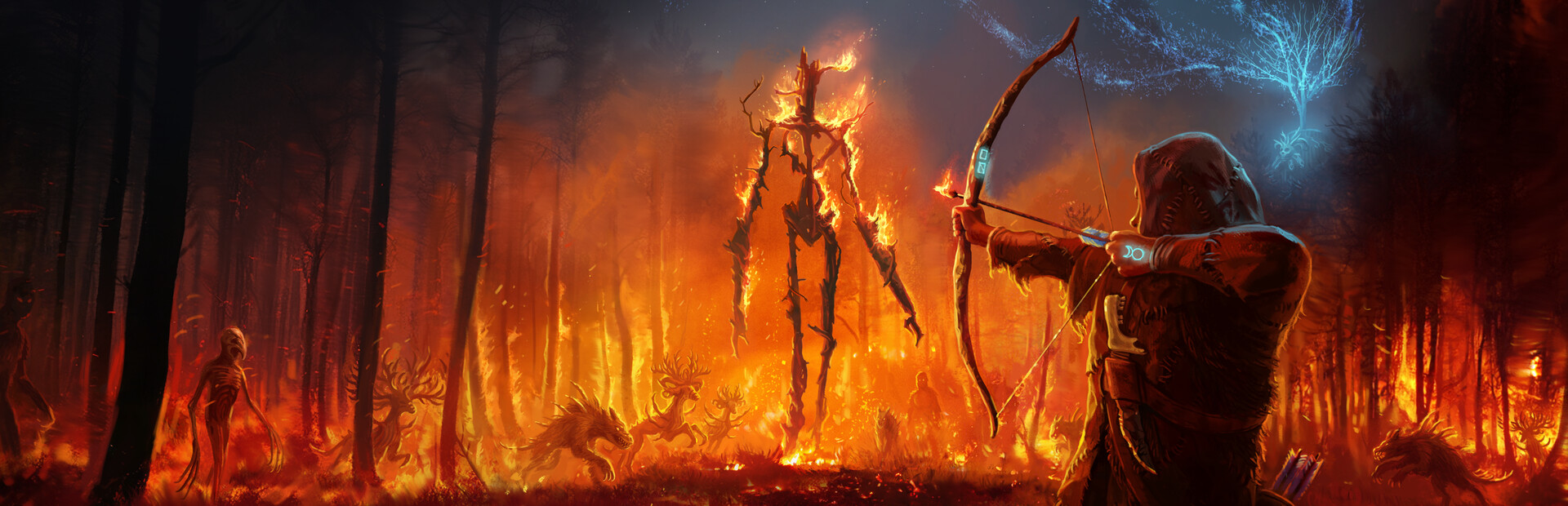
I keep a mental file of games that have no business being as atmospheric as they are given how they were made. The Axis Unseen goes straight into that file. This is a first-person open-world hunting game built almost entirely by one person, Nate Purkeypile, a veteran who spent 14 years at Bethesda working on everything from Fallout 3 to Skyrim before quitting to make exactly the game he wanted. The result is simultaneously one of the most committed atmosphere exercises in recent indie history and a product that arrives with the rough edges you would expect from a one-person studio swinging this big. The core loop is tighter than the genre label suggests. You start with a bow, a hunting knife, and a spirit arrow that doubles as a scout and a light source. From there you learn to read the wind to keep your scent away from prey, watch your footfall on different surfaces to control noise, and track creatures by the warmth their prints leave behind. The bow itself carries almost the entire UI: carvings and indicators on the weapon body tell you how much noise you are making, how visible you are, and how much magic charge remains. Tattoos on your hand serve as a health display. It sounds gimmicky until you realize it keeps your eyes in the world instead of a HUD corner, and then it feels genuinely clever. Killing creatures earns spiritual energy, which you spend at your camp hub to upgrade health, stamina, and sound dampening. Energy drops on death and must be recovered Dark Souls-style, which creates real stakes in a game where even small folklore creatures can end a run fast. Arrow types compound the decision space over time: fire arrows that ignite tall grass and chain to normal arrows nearby, wind arrows that accelerate fire spread, time-distorting arrows, and more. The interactions between arrow types are the closest thing this game has to a build system, and experimenting with them is legitimately satisfying. The world spans six distinct regions, from forested openings through a swamp, a place called the Crimson Abyss, and a region called the Darkness where at least one monster can only be seen in your peripheral vision. Creatures range from a Bigfoot that will end you the first three times you meet it, to Tree Golems, Elder Horned Beasts, obsidian werewolves, and nightmarish skinless things that shake the ground when they walk. Each has specific weaknesses to figure out yourself, because the game does not tell you. That discovery loop is where the tension lives. The music, composed by Clifford Meyer of post-metal bands ISIS and Red Sparowes, adjusts dynamically to encounters, pulling from atmospheric drone to full metal depending on threat level, and it is one of the better dynamic soundtracks in any game this generation. Now for the honest part. The launch version shipped with framerate issues, collision problems that could drop you through rock walls, and AI that occasionally lost track of you for reasons that had nothing to do with your stealth skill. Steam user reception landed at roughly 76 percent positive across around 290 reviews, which is a reasonable signal of a game people like despite its problems. The no-map navigation is a deliberate choice and you will either accept it or you will not, though a 3D camp sculpture unlocks map sections as you explore to help orient you over time. Some players also found the upgrade loop thin in the late regions, with the world feeling less differentiated than those first forest hours suggested. A physical PS5 edition was announced post-launch, which indicates ongoing developer support, but there is no public patch roadmap to cite right now. For strategy and sim players specifically, this is worth framing correctly. The decision-making here is not spreadsheet depth. It is read-the-room depth, the same instinct that makes a good hunt feel different from a lucky one. If you want to optimize arrow elemental interactions and creature weakness tables, there is enough system there to reward that approach. A first playthrough runs roughly 20-25 hours depending on how much lore you chase. That is a reasonable ask for the price point, bugs and all, if the aesthetic grabs you. If heavy metal album cover aesthetics and methodical stealth archery are not your thing at the genre level, no amount of atmosphere will paper over that mismatch.

Strategy & simulation
Tags
System Requirements
Minimum
- OS
- Windows 10+ 64-bit
- Memory
- 8 GB RAM
- DirectX
- Version 12
- Storage
- 24 GB available space
- Graphics
- 4 GB VRAM GeForce GTX 980/Radeon RX 580
- Processor
- i7-3770k/Ryzen 5 1600
- Sound Card
- DX11 compatible
Recommended
- OS
- Windows 10+ 64-bit
- Memory
- 8 GB RAM
- DirectX
- Version 12
- Storage
- 24 GB available space
- Graphics
- 8 GB VRAM NVIDIA GeForce RTX 3060 / AMD Radeon RX 5700 XT
- Processor
- i7-3770k/Ryzen 5 1600
- Sound Card
- DX11 compatible
Keep exploring
Community Discussion
Be the first to comment on The Axis Unseen.
Reviews & Ratings
No ratings available
Game Info
- Developer
- Just Purkey Games
- Publisher
- Just Purkey Games
- Release Date
- Oct 22, 2024