
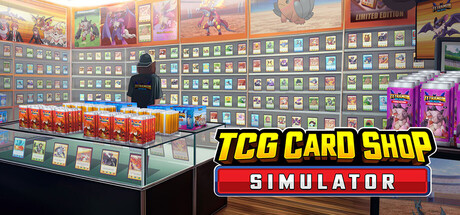
TCG Card Shop Simulator
Running a card shop is more interesting than it has any right to be, and this lean Early Access sim from a solo developer has the numbers to prove it: over 32,000 Steam reviews sitting at 97% positive.
GamerScout Verdict
Best for sim fans and TCG hobbyists who want a genuinely clever retail loop, provided they accept an Early Access ceiling around hour 30.
Compare Prices(4 stores)
Every store in this table quotes us in euros, so the EUR figure is the price the seller actually set, not our arithmetic — which is why EUR is also the currency we rank in. We only list an offer here when the store gives us its price in euros, so nothing in this table is a number we invented.
Pick USD, PLN, GBP, CAD or AUD in the header and we convert from EUR at the European Central Bank reference rate — converted amounts are prefixed with ~. Your bank or the store may apply a different rate at checkout. We never hide offers based on where you are: everyone sees this whole table.
We may earn a commission when you buy games through links on this page — at no extra cost to you. It never affects our rankings or verdicts.
Price History
Screenshots & Media
About TCG Card Shop Simulator
I went in expecting a thin novelty act and came out forty hours later debating whether to grade my Tetramon holofoils or flip them raw. That tension, sell versus collect, is the engine that keeps TCG Card Shop Simulator running longer than its modest scope suggests. At its core the game asks you to build a retail business from an empty room, but the decision layer underneath is more interesting than the storefront implies. You are constantly weighing margin against collection progress: crack a booster box yourself and hunt for high-value singles, or shelve it whole and let customer traffic do the work? Early on, stocking booster packs is the safer play because the math on individual card sales only turns favorable once you unlock pack-opening machines and a workbench that lets you liquidate low-tier pulls. Card grading adds another variable, bumping single-card value by a meaningful percentage on average, though bad grades do happen. Pricing is free-form, but set it too high and customers who arrive with target shopping lists will browse a few shelves and walk out. The simulation goes deeper than it looks on the surface. Customer behavior runs off a layered formula: shop level, room expansions, active play tables, and even store cleanliness all influence how many buyers show up and how much money they carry. At higher shop levels a growing percentage of customers spawn as "stinky," and if they get too close to clean customers there is a stacking chance those clean customers abandon their purchases and head for the exit. So crowd hygiene becomes a genuine mid-game resource management problem, not a joke mechanic. Play tables generate passive XP income tied to your average review score, which in turn reflects how well you keep shelves stocked, queues short, and the floor sprayed. There is also a hard customer cap of 28 that means store expansion and level progression matter a lot for throughput. None of this is explained clearly by any in-game tutorial, which is the biggest stumbling block for newcomers. The community wiki and a healthy mod scene (fast pack-open mods are widely recommended) paper over the gaps, but the lack of guided onboarding is a real friction point. What the game does not do yet is let you actually play the card game. The fictional TCG sets, including the Tetramon line whose foil card designs drew genuine praise from reviewers, exist purely as commodities. A playable card game mode sits on the public roadmap but is absent from the current build. If your fantasy is dueling customers across the table, you are buying a promise not a feature. Similarly, once you crack the pricing model and staff up your registers, the late game loses urgency fast. Customer interactions do not evolve much, the store layout tools are functional rather than creative, and the single music track will start to test your patience well before you hit the achievement grind, which one reviewer estimated at around 80 to 120 hours depending on mod use. That said, for a solo-developer Early Access title the foundation is genuinely solid. The Xbox version runs without meaningful technical issues, load times are near-instant, and the developer has been consistently shipping updates, with the roadmap visible right on the main menu. The mod ecosystem is active, reception has stayed overwhelmingly positive through multiple patches, and the scope of planned additions, difficulty modes, decoration systems, more TCG types, and the playable card game itself, gives a credible reason to think the 1.0 version will address the mid-game flatness. Right now, the first 25 to 30 hours deliver a satisfying loop; the hours after that are for collectors and completionists only.

Strategy & simulation
Tags
System Requirements
Minimum
- OS
- Windows (64-bit) 10
- Memory
- 8 GB RAM
- DirectX
- Version 11
- Storage
- 5 GB available space
- Graphics
- NVidia GeForce GTX 1050
- Processor
- Intel Core i5-3550
Recommended
- OS
- Windows (64-bit) 10
- Memory
- 8 GB RAM
- DirectX
- Version 11
- Storage
- 5 GB available space
- Graphics
- NVidia GeForce GTX 1070
- Processor
- Intel Core i5-6400
Keep exploring
Community Discussion
Be the first to comment on TCG Card Shop Simulator.
Reviews & Ratings
No ratings available
Game Info
- Developer
- OPNeon Games
- Publisher
- OPNeon Games
- Release Date
- Sep 15, 2024

![[TCG CARD SHOP SIMULATOR] Pokemon Mods [18+] [Road To 400]](https://static-cdn.jtvnw.net/previews-ttv/live_user_blades6900-440x248.jpg)
![My Neighborhood has a New Business! [Retro Rewind & TCG Shop]](https://static-cdn.jtvnw.net/previews-ttv/live_user_starkkarst-440x248.jpg)