
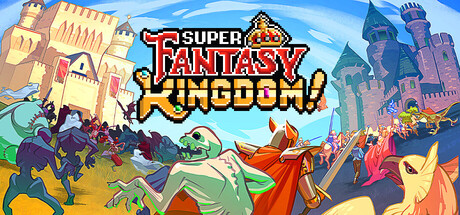
Super Fantasy Kingdom
If your ideal Tuesday night involves agonising over a sawmill vs. second peasant hut and then watching your entire economy burn by day 18, Super Fantasy Kingdom has your number. Solo dev passion project, Hooded Horse pedigree, sharp early-game hook.
GamerScout Verdict
Best for strategy players who enjoy optimising economic chains and can tolerate repetitive early-run pacing in an Early Access title with genuine late-game depth.
Compare Prices(7 stores)
Every store in this table quotes us in euros, so the EUR figure is the price the seller actually set, not our arithmetic — which is why EUR is also the currency we rank in. We only list an offer here when the store gives us its price in euros, so nothing in this table is a number we invented.
Pick USD, PLN, GBP, CAD or AUD in the header and we convert from EUR at the European Central Bank reference rate — converted amounts are prefixed with ~. Your bank or the store may apply a different rate at checkout. We never hide offers based on where you are: everyone sees this whole table.
We may earn a commission when you buy games through links on this page — at no extra cost to you. It never affects our rankings or verdicts.
Price History
Screenshots & Media
About Super Fantasy Kingdom
I put about thirty hours into Super Fantasy Kingdom before I stopped losing and started understanding it, and that gap is both the game's biggest strength and its clearest liability. The core loop is deceptively familiar from the outside: you are a king, your lands are in ruin, build wood and stone chains by day, watch your heroes autobattle monster waves by night, die, repeat with a slightly larger unlock pool. But the moment you try to wing it past day 15, you learn that this is a build-order game first. The sawmill-to-boards pipeline unlocks your second peasant hut. Your second peasant hut funds the workers that fill a fisher hut. A fed monk levels up faster. A levelled monk heals your front line long enough to survive a curse wave. Every decision threads back to an economic dependency chart, and that is where players like me get very, very comfortable. The two-faction structure deserves attention up front. Human and Undead kingdoms share a global star currency, which means you are expected to alternate between them. The undead side replaces permanent workers with one-shot skeletons that harvest once and collapse, forcing a completely different resource micromanagement mindset. Stars unlocked on either map open events and buildings for both, so ignoring one faction actively slows your other campaign. That cross-faction progression system is clever on paper and slightly opaque in practice, since the game does not spell out the dependency clearly in its tutorial. New players hitting a wall on the human side around day 28 have very likely just not touched the undead run yet. The autobattle component sits somewhere between tower defense and a light tactics layer. You place heroes such as the knight, priestess, or Sheva across positional slots outside your castle, spend gold to unlock additional slots, and then manage their food intake post-combat so they level up between nights. Each hero has a favourite meal that accelerates their XP gain, so your cooking and brewing chains are not flavour, they are load-bearing systems. Relics dropped from boss kills add a per-run power modifier that layers nicely on top of the 70-plus unit roster and 100-plus item pool. With 11 heroes available per run, team compositions shift meaningfully, and community threads are already cataloguing synergies like Sheva's slow stacked with a troll's knockback and artillery at tier 8. Where the game earns its criticism, and it is valid criticism, is in the mid-to-late run repetition. Once you internalise an efficient build order, the first ten or twelve days of each run start to feel like mandatory chores before the interesting decisions appear. Some players in the Steam forums report multi-hour runs required just to unlock a single new progression path, while the build order itself barely changes. That friction is a genuine design tension, not just a skill gap, and it sits unresolved in the current Early Access build. The city-building layer is also lighter than the genre breadth implies: a handful of production building types, limited placement freedom, and a resource economy that can feel opaque until it suddenly clicks. The Metacritic critic perspective flagged exactly this, noting that the roguelite and city-builder halves both feel undercooked in isolation. And yet, Steam sits at 88 percent positive across nearly 3,000 reviews for good reason. The moment those systems do click, usually somewhere around your eighth failed run, Super Fantasy Kingdom becomes genuinely hard to close. The glory-for-roads exploration loop, world quests, merchant trades, and the procedural map layout provide enough run-to-run variation to keep the meta-progression feel earned rather than hollow. The fact that this is a solo developer title, published by Hooded Horse, a label with a consistent track record of patient, community-responsive Early Access support, gives it meaningful longevity headroom. The developer adjusted systems within days of launch based on player feedback, and the roadmap includes additional kingdom types and a complete narrative layer. If you are comfortable buying into a game that is already very playable but not yet fully resolved, the foundation here is solid and the ceiling is high.

Strategy & simulation
Tags
System Requirements
Minimum
- OS
- Windows® 10 (64-bit)
- Memory
- 4 GB RAM
- DirectX
- Version 10
- Storage
- 1 GB available space
- Graphics
- NVIDIA® GeForce® 8600 GT (512 MB) / AMD® Radeon™ HD 6450 (512 MB)
- Processor
- Intel® Core™ i3-530 (dual-core) / AMD® Athlon™ II X2 270 (dual-core)
Recommended
- OS
- Windows® 10 (64-bit)
- Memory
- 4 GB RAM
- DirectX
- Version 11
- Storage
- 1 GB available space
- Graphics
- NVIDIA® GeForce® 9500 GT (512 MB) / AMD® Radeon™ HD 6670 (1 GB)
- Processor
- Intel® Core™ i3-530 (dual-core) / AMD® Athlon™ II X2 270 (dual-core)
Keep exploring
Community Discussion
Be the first to comment on Super Fantasy Kingdom.
Reviews & Ratings
No ratings available
Game Info
- Developer
- Super Fantasy Games
- Publisher
- Hooded Horse
- Release Date
- Oct 24, 2025