
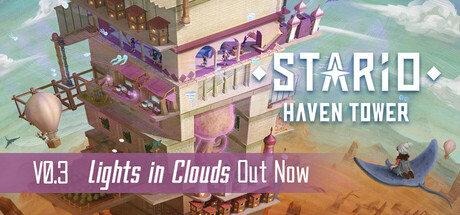
STARIO: Haven Tower
City-building rotated 90 degrees, with every floor a fresh logistics puzzle and a sky full of disasters waiting to test your supply chain. Worth the Early Access price if vertical resource management is your thing.
GamerScout Verdict
Solid Early Access pick for city-builder fans who want a logistics puzzle in the vertical axis, with UI rough edges to tolerate.
Compare Prices(4 stores)
Every store in this table quotes us in euros, so the EUR figure is the price the seller actually set, not our arithmetic — which is why EUR is also the currency we rank in. We only list an offer here when the store gives us its price in euros, so nothing in this table is a number we invented.
Pick USD, PLN, GBP, CAD or AUD in the header and we convert from EUR at the European Central Bank reference rate — converted amounts are prefixed with ~. Your bank or the store may apply a different rate at checkout. We never hide offers based on where you are: everyone sees this whole table.
We may earn a commission when you buy games through links on this page — at no extra cost to you. It never affects our rankings or verdicts.
Price History
Screenshots & Media
About STARIO: Haven Tower
I spend a lot of time in grand-strategy and sim games obsessing over supply lines, and STARIO: Haven Tower scratches exactly that itch, just compressed into a single column punching upward through the atmosphere. The premise is post-apocalyptic survival by ascent: humanity retreated underground after a cataclysm, and your job is to guide a band of Towertizens up through six distinct atmospheric layers, from the Sand Zone all the way through Mist, Rain, Frost, and Clear Skies toward the Stars. That vertical framing is not just cosmetic. It completely rewires how city-builder logic works. The core tension here is inter-floor logistics. Each floor stores its own supplies independently, which means food surplus on level three does nothing for a starving level nine without active transport. Early on you rely on porter pathways and manual carrier routes. Later you unlock pipelines, hot-air balloons, and Stronghands that hurl cargo skyward, and the satisfaction of watching a well-optimised vertical supply chain finally tick over like clockwork is genuinely rewarding for anyone who enjoys this kind of systems thinking. The efficiency rating attached to each floor acts as a constant nudge to tighten your layout, a mechanic that will appeal immediately to players who find optimisation inherently motivating. There are also around 70 buildable structures and 50 production recipes in the current build, plus a completed tech tree funded by faith resources, which gives the Early Access version more actual content than many finished indie sims. The disaster system and stability mechanic add meaningful strategic friction. Buildings attach to the outer walls of each floor, but the further they jut out, the more vulnerable they are when timed events hit, and four disaster types including sandstorms can degrade structures and crater Towertizen morale. You manage morale through Ritual Platforms that convert accumulated faith into environmental effects like summoning wind for turbines or rain for crops. That spiritual layer sits on top of the resource loop rather than replacing it, which keeps the decision-making grounded rather than hand-wavy. The jump between atmospheric zones also forces recalibration: the Mist Zone introduces quartz and new farming types, and higher layers thin out resources in ways that expose any complacency in your lower-floor planning. Now, the honest caveats. The UI is the main friction point right now. Menus can overwhelm newcomers, information feedback is sometimes patchy (a stalled research task silently stops without an alert), and experienced city-builder players will feel the roughness of an Early Access product. The disasters, while thematically present, currently lean toward mild inconvenience rather than genuine crisis management, which means the tension ceiling is lower than something like Frostpunk. There is no competing faction, no external political pressure, and no exploration component, so if you need adversarial complexity to stay engaged, this will feel quiet. The developer has flagged a 6-to-12-month Early Access window with a sandbox mode and expanded logistics options planned, and the Steam user response has been strongly positive, suggesting the community is engaged and the developer is responsive. For strategy and sim players specifically: this is not a deep-end Paradox experience, but it is a genuinely fresh spatial puzzle that rewards pre-planning over reactive firefighting. The onboarding is gentle enough that newcomers to the city-builder genre will find it approachable, and the per-floor efficiency system gives veterans a meaningful optimisation target from the first session. The vertical format alone makes it worth a look if your library is full of sprawling horizontal city sims and you want something that forces a completely different mental model.

Strategy & simulation
Tags
System Requirements
Minimum
- OS
- Windows 7 (64bit)
- Memory
- 4 GB RAM
- DirectX
- Version 11
- Storage
- 4 GB available space
- Graphics
- Dedicated graphics card, GTX 750 Ti 2GB
- Processor
- i3-530 2.93GHZ 2-Core
- Sound Card
- DirectX compatible
Recommended
- OS
- Windows 10 (64bit)
- Memory
- 16 GB RAM
- DirectX
- Version 11
- Storage
- 8 GB available space
- Graphics
- Dedicated graphics card, GTX 2060 Ti
- Processor
- i5 10600K 4.10GHZ 12-Core
- Sound Card
- DirectX compatible
Keep exploring
Community Discussion
Be the first to comment on STARIO: Haven Tower.
Reviews & Ratings
No ratings available
Game Info
- Developer
- Stargate Games
- Publisher
- Stargate Games
- Release Date
- Sep 25, 2025