
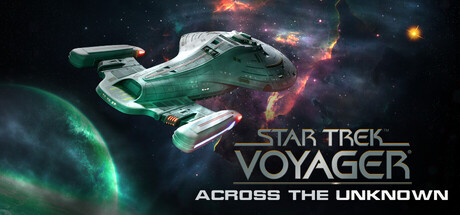
Star Trek: Voyager - Across the Unknown Deluxe Edition
FTL meets the Delta Quadrant: a rogue-lite ship manager that makes every deuterium canister feel like life or death, and every Janeway call genuinely yours.
GamerScout Verdict
Worth it for FTL fans and Voyager faithful; too RNG-reliant and text-heavy to convert players with no patience for either.
Compare Prices(7 stores)
Every store in this table quotes us in euros, so the EUR figure is the price the seller actually set, not our arithmetic — which is why EUR is also the currency we rank in. We only list an offer here when the store gives us its price in euros, so nothing in this table is a number we invented.
Pick USD, PLN, GBP, CAD or AUD in the header and we convert from EUR at the European Central Bank reference rate — converted amounts are prefixed with ~. Your bank or the store may apply a different rate at checkout. We never hide offers based on where you are: everyone sees this whole table.
We may earn a commission when you buy games through links on this page — at no extra cost to you. It never affects our rankings or verdicts.
Price History
Screenshots & Media
About Star Trek: Voyager - Across the Unknown Deluxe Edition
I've spent a lot of hours watching resource bars inch toward zero in strategy games, but rarely has the pressure felt this thematically appropriate. Across the Unknown drops you straight into command of a battered Voyager, 70,000 light-years from home, and the weight of that premise is baked into every mechanic. The core loop is tighter than it first appears: a turn-based cycle framework where even sitting still burns deuterium, morale decays if the crew feels stranded too long, and a mutiny ending is always lurking a few bad decisions away. That is not window dressing. It is the whole game. The ship management layer is where the decision-making gets genuinely interesting. Voyager starts damaged, and you rebuild her room by room using a grid-based, Fallout Shelter-style cross-section view. The tech tree splits across Engineering, Crew, Science, Combat, and a Borg branch that the show's writers would have found morally uncomfortable. Every construction choice trades off against another. Packing the hull with phaser control stations and shield generators means skipping crew quarters and the holodeck, which are the primary tools for fighting morale decay. Hydroponics bays versus replicator stations is a recurring power-budget argument you will have with yourself repeatedly. The game also tells you upfront what skill checks an away mission will demand before you commit a crew, which is a transparency that a lot of roguelites refuse to offer, and it makes roster planning feel like a real exercise rather than a guess. Ship-to-ship combat sits in a different register. You are not piloting Voyager like Tom Paris; you are issuing captain's calls, directing which enemy subsystem to target, deciding when to spend finite torpedoes, managing shield facings, and activating the special abilities of up to three slotted hero characters. It is legible and serviceable without being deep. The autopilot movement can look embarrassing against larger enemies like Borg cubes, and reviewers broadly agree it is the weaker half of the package. The strong half, the resource loop and narrative layer, carries real weight. The game branches across five different endings, sectors are procedurally varied across runs, and story decisions let you rewrite canonical Voyager moments, spare Tuvix, recruit Seska, lean hard into Borg tech. That replayability is genuine. Post-launch, the developers have already patched in the Delta Flyer as a buildable asset with its own Tom Paris questline in Sector 7, which signals an active update cadence worth tracking. The caveats are real and should not be undersold. The RNG can punish you in ways that feel disconnected from your planning, particularly on away missions where a single bad roll on an underleveled room can end named crew members permanently. The autosave-only structure, which caused significant early backlash, has been substantially improved by patches but a manual save-and-exit option still does not exist at time of writing. Voice acting is sparse, with what appear to be original Tom Paris and Tuvok actors providing chapter intros and very little else; the rest of the story arrives as text at adventure-game volume. The presentation is uneven too: hand-drawn hero art is genuinely good, certain character models are not. None of this kills the game. It does mean you should calibrate expectations toward a 15-20 hour indie with a budget that is visible at the seams. For the strategy player who also has Voyager opinions: this is an unusually good match of license and mechanics. For the pure strategy player with no Trek attachment: the resource management and roguelite structure hold up on their own terms, closer to FTL than to anything Paradox ships, but with enough XCOM-style base-building texture to satisfy a planning brain. The difficulty options accommodate newcomers without making the choices feel trivial, and the tutorial covers the essentials without condescending. Steam user sentiment has settled around 79% positive across a substantial review pool, which feels about right. Flawed, clearly made with genuine care, and the best argument in years that the Star Trek license can carry a smart, small-scale strategy game.

Strategy & simulation
Tags
System Requirements
Minimum
- OS
- WIn 11 64 Bit
- Processor
- AMD Ryzen 5 2600 or Intel Core i5-8500
- Memory
- 8 GB RAM
- Graphics
- NVIDIA GeForce GTX 1060 (6GB) or AMD Radeon RX 580 (8GB)
- DirectX
- Version 1…
Recommended
- OS
- WIn 11 64 Bit
- Processor
- AMD Ryzen 7 7800X3D or Intel Core i5-14600K
- Memory
- 16 GB RAM
- Graphics
- NVIDIA GeForce RTX 3060 or AMD Radeon RX 5700 XT Di…
Keep exploring
Community Discussion
Be the first to comment on Star Trek: Voyager - Across the Unknown Deluxe Edition.
Reviews & Ratings
No ratings available
Game Info
- Developer
- Gamexcite
- Publisher
- Daedalic Entertainment
- Release Date
- Feb 18, 2026