Star Trek: Infinite
Stellaris wearing a combadge: a focused, lore-anchored grand strategy that delivers the TNG-era power fantasy but arrived abandoned by its publisher before it ever found its footing.
GamerScout Verdict
Best for TNG/DS9 fans new to grand strategy who can catch it at a heavy discount, knowing no further updates are coming.
Compare Prices(9 stores)
Every store in this table quotes us in euros, so the EUR figure is the price the seller actually set, not our arithmetic — which is why EUR is also the currency we rank in. We only list an offer here when the store gives us its price in euros, so nothing in this table is a number we invented.
Pick USD, PLN, GBP, CAD or AUD in the header and we convert from EUR at the European Central Bank reference rate — converted amounts are prefixed with ~. Your bank or the store may apply a different rate at checkout. We never hide offers based on where you are: everyone sees this whole table.
We may earn a commission when you buy games through links on this page — at no extra cost to you. It never affects our rankings or verdicts.
Price History
Screenshots & Media
About Star Trek: Infinite
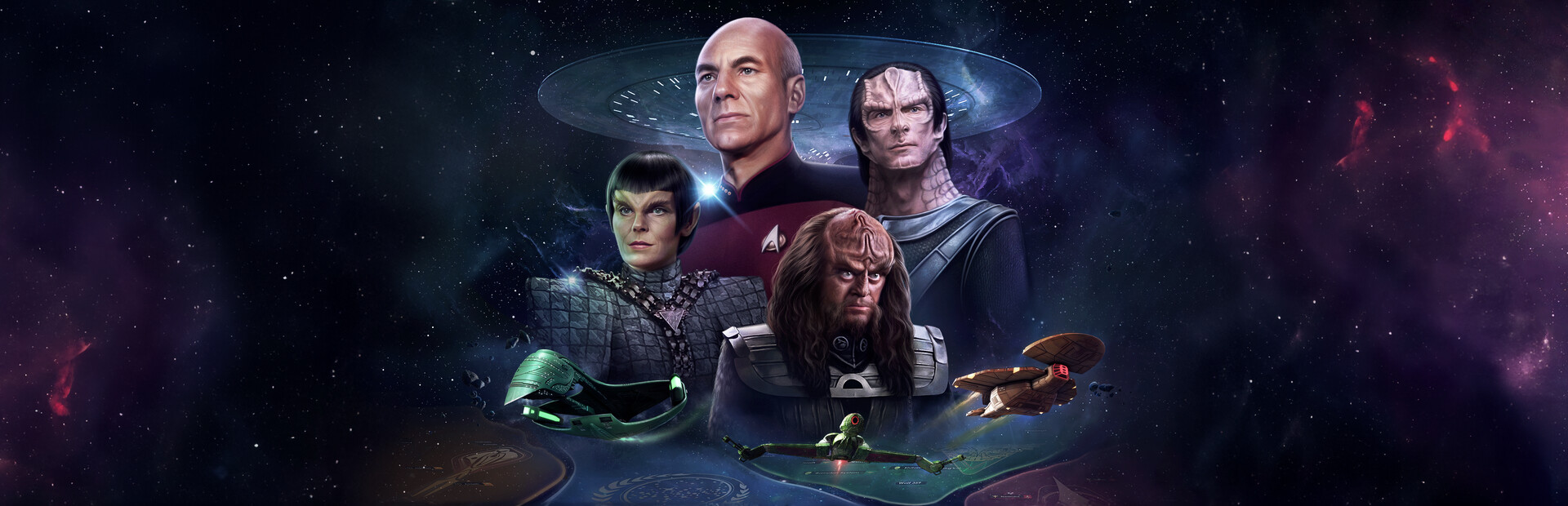
My color-coded Stellaris patch notes spreadsheet did not prepare me for the particular sting of Star Trek: Infinite, a game I genuinely wanted to love and one that gets several things right before the context around it poisons the well. Built on an earlier build of the Stellaris engine and streamlined specifically for the Star Trek setting, it drops you into the Alpha Quadrant circa The Next Generation as one of four major powers: the United Federation of Planets, the Klingon Empire, the Romulan Star Empire, or the Cardassian Union. Each faction is mechanically nudged toward its canonical identity. The Federation leans into exploration and diplomacy, the Romulans into espionage and subterfuge, the Klingons into warfare, and the Cardassians into spying and control. You can try to run a belligerent Federation campaign or turn the Cardassians into benevolent peacemakers, but the mission tree resists you, which is either elegant design or a straitjacket depending on your tolerance for railroading. The mission tree itself is the game's strongest original contribution. Structured like the focus trees in Paradox's historical titles, each faction's tree traces the major lore beats of the shows: the creation of the Tal Shiar for the Romulans, the launch of the Enterprise-D for the Federation, entanglement with Section 31. Completing nodes grants buffs and unlocks faction-specific ships, including iconic classes like the Intrepid, Defiant, Galor, D'deridex, and Negh'Var. On paper this is exactly what a strategy Trekkie wants. In practice, the map starts semi-fixed rather than fully randomized, meaning the four great powers always collide in roughly the same positions each run, which cuts long-term replayability compared to Stellaris proper. The minor factions scattered in the fog of war do shift, so exploration still has teeth, but veteran Stellaris players will feel the reduced scope inside a few sessions. Where the game stumbles hardest is in two areas that matter a lot to me: AI quality and combat depth. The AI opponents are passive at default difficulty, too easily bought off with diplomacy, and generally unwilling to press advantages. Bumping the difficulty adds stat bonuses that paper over the problem rather than fix the underlying decision-making. Fleet combat is fully automated once you commit your ships to a sector, which works thematically but removes almost all tactical agency. War causes like humiliation campaigns carry so little material consequence that losing one barely registers. For a franchise whose best drama comes from high-stakes confrontations, that flatness hurts. The Borg appear as a scripted event-driven threat rather than a playable faction, which is the correct lore call, but reports suggest they can feel underwhelming once your fleet scales up. Here is the part I have to say plainly, because it changes the purchase calculus entirely: Paradox announced in March 2024 that the game would receive no further updates. That is an unusual and stark endpoint for a Paradox-published title, and it means the mod ecosystem, the post-launch content pipeline, and the iterative patching that normally salvage rough Paradox launches are all off the table. Steam's overall review score sits at Mostly Negative at roughly 39 percent positive across over two thousand reviews. The Metacritic critic score of 66 is more charitable and reflects genuine positives: the faction fantasy works for Star Trek fans, the mission tree delivers memorable lore moments, and the tutorial system is accessible enough for 4X newcomers even if it lacks a reference guide. But there is no longer a road map to fix what is broken, and the Stellaris New Horizons mod covers similar ground for players who already own that base game. Buy it on a steep discount if you are a TNG or DS9 fan who has never touched Stellaris and wants a contained, story-shaped grand strategy experience. If you already own Stellaris with a decent DLC stack, the value proposition is thin. The bones are solid; the support structure is gone.

Strategy & simulation
Tags
System Requirements
Minimum
- OS
- Windows® 7 SP1 64 Bit
- Memory
- 4 GB RAM
- DirectX
- Version 9.0c
- Storage
- 15 GB available space
- Graphics
- Nvidia® GeForce™ GTX 460 or AMD® ATI Radeon™ HD 5870 (1GB VRAM), or AMD® Radeon™ RX Vega 11 or Intel® HD Graphics 4600
- Processor
- Intel® iCore™ i3-530 or AMD® FX-6350
Recommended
- OS
- Windows® 10 Home 64 Bit
- Memory
- 4 GB RAM
- DirectX
- Version 12
- Storage
- 15 GB available space
- Graphics
- Nvidia® GeForce™ GTX 560 Ti (1GB VRAM) or AMD® Radeon™ R7 370 (2 GB VRAM)
- Processor
- Intel® iCore™ i5-3570K or AMD® Ryzen™ 5 2400G
DLC & Add-ons for Star Trek: Infinite1
Expansions, DLC packs and add-on content for this game. Click any item to see store offers.
Keep exploring
Community Discussion
Be the first to comment on Star Trek: Infinite.
Reviews & Ratings
Game Info
- Developer
- Nimble Giant Entertainment
- Publisher
- Paradox Interactive
- Release Date
- Oct 12, 2023
