Sphinx and the Cursed Mummy
A cult-favourite PS2 action-platformer gets its PC second life, and if you can stomach the camera and the silence where voice acting should be, there is a genuinely clever dual-protagonist structure underneath.
GamerScout Verdict
Worth it for PS2-era action-adventure fans who want a focused, mythology-rich platformer with a genuinely clever dual-character puzzle hook.
Compare Prices(9 stores)
Every store in this table quotes us in euros, so the EUR figure is the price the seller actually set, not our arithmetic — which is why EUR is also the currency we rank in. We only list an offer here when the store gives us its price in euros, so nothing in this table is a number we invented.
Pick USD, PLN, GBP, CAD or AUD in the header and we convert from EUR at the European Central Bank reference rate — converted amounts are prefixed with ~. Your bank or the store may apply a different rate at checkout. We never hide offers based on where you are: everyone sees this whole table.
We may earn a commission when you buy games through links on this page — at no extra cost to you. It never affects our rankings or verdicts.
Price History
Screenshots & Media
About Sphinx and the Cursed Mummy
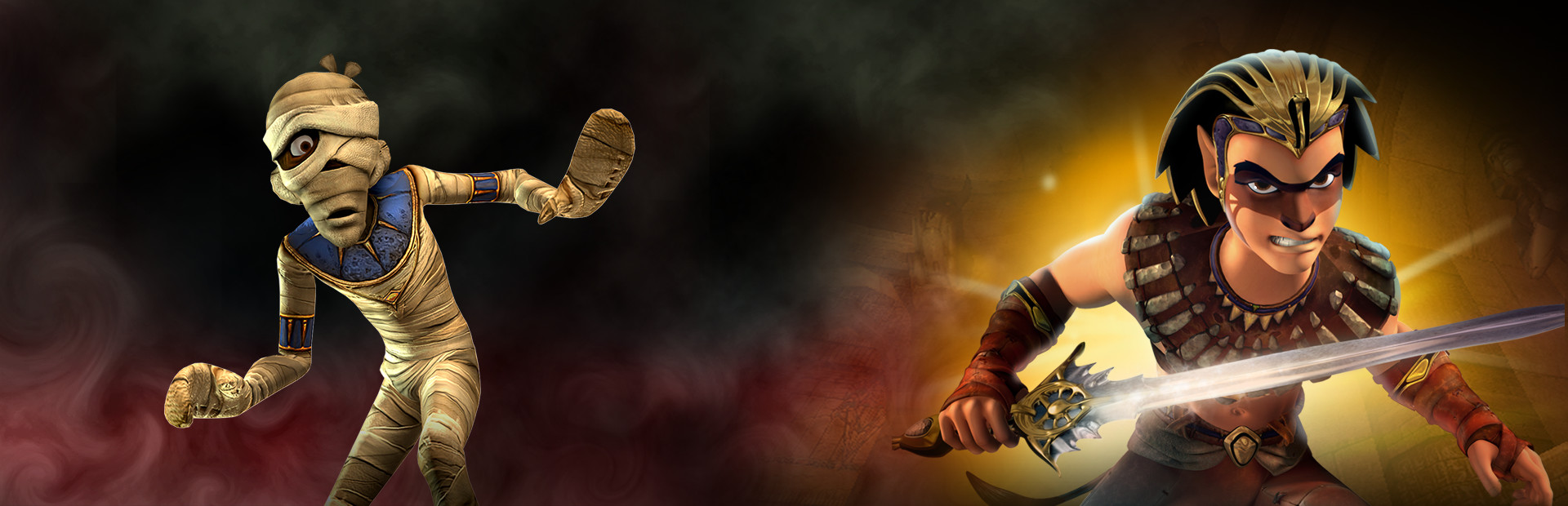
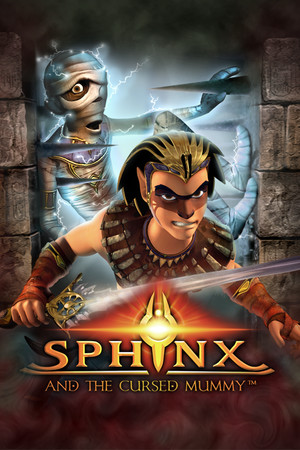
I came to this one as someone who missed it the first time around, which means I had no rose-tinted PS2 memories to carry me through the rougher patches. What I found was a game that is smarter than its modest reputation suggests, built around a core concept that still works: you play as two characters with completely opposite skill sets, and the tension between those styles is where the game earns its keep. Sphinx is your combat half - a demigod who swings the Blade of Osiris, fires a blowpipe loaded with acid, ice, or bouncing darts, captures weakened enemies using beetles to weaponize their abilities later, and gradually unlocks tools like the double-jump Wings of Ibis and the hookshot. The Mummy, meanwhile, is Prince Tutankhamun in his newly-undead form, and his sections flip the game into something closer to a deadpan stealth-puzzle experience. He cannot fight, cannot permanently die, and can exploit his own cursed state - walking through fire, getting flattened, surviving traps that would end Sphinx instantly - to solve problems that pure combat could never touch. The rhythm of swapping between the two keeps things from going stale, and the Mummy's dark-comedy physics puzzles provide genuine breathing room when Sphinx's platforming sections get irritating. The world is a fictionalized Egypt with its own internal mythology: multiple kingdoms connected by Solar Disc portals, a conspiracy involving the god Set disguised as a prince, and Anubis playing a morally ambiguous role in the middle chapters that adds some welcome complexity. The narrative has more layers than the genre typically bothers with, and the structure of collecting the four Sacred Crowns while both protagonists' stories converge gives the pacing a real shape. The scarab-beetle currency system, the Canopic Vases that power Tutankhamun's temporary revivals, and the creature-capture mechanic all interlock in ways that feel intentional rather than padded. There are no filler fetch quests in the traditional sense; the game is focused and clocks in at around ten to twelve hours, which for this kind of action-platformer is exactly the right length. That said, the friction points are real and they are old. The camera is uncooperative with regularity, particularly during precise platforming sections where Sphinx's slightly floaty physics already demand full cooperation from the control scheme. Save points are infrequent, and the system punishes you for saving with low health - if you commit to a bad checkpoint, you are locked into it. Cutscenes cannot be skipped. There is no voice acting at all, which is a jarring omission given how much dialogue the game contains; characters talk in text while their mouths move silently, which reads as unfinished rather than stylistic. Visually, the PC remaster bumps up the resolution and restores original HD textures, but the environmental geometry is still unmistakably early 2000s - flat surfaces, sparse NPC detail, worlds that feel slightly underpopulated. The PC version has continued to receive updates from its solo developer-maintainer, and a Steam beta branch now includes improved character lighting and bug-fixed levels that mirror the later PS4 release. There is also a community mod that restores the two cut worlds - Akaria and Sakkara - that were dropped before the original 2003 launch, which is a remarkable bonus for anyone curious about what the full game was supposed to be. Steam players have rated the remaster positively at a strong majority, suggesting that people who go in with clear expectations tend to come out satisfied. This is not a game for players who need a modern action-platformer's smoothness or handholding. There are no waypoint markers, puzzle solutions require genuine lateral thinking, and you will probably consult a walkthrough at least once. For anyone who grew up with Zelda-adjacent mid-tier PS2 games and wants a compact, Egyptian-mythology-flavored adventure with a genuinely funny undead co-protagonist, it punches well above its obscure reputation.

RPGs
Tags
System Requirements
Minimum
- OS
- Windows XP / Vista / 7 / 8 / 10 32 or 64 bit
- Memory
- 1 GB RAM
- Storage
- 1 GB available space
- Graphics
- OpenGL 3.0 Core Profile compatible like GeForce 8600
- Processor
- Intel or AMD 1.5 GHz supporting SSE2 instructions
Recommended
- OS
- Windows XP / Vista / 7 / 8 / 10 32 or 64 bit
- Memory
- 2 GB RAM
- Storage
- 2 GB available space
- Graphics
- OpenGL 3.0 Core Profile compatible like GeForce 8800
- Processor
- Intel or AMD 2 GHz supporting SSE2 instructions
Keep exploring
Community Discussion
Be the first to comment on Sphinx and the Cursed Mummy.
Reviews & Ratings
Game Info
- Developer
- Eurocom
- Publisher
- THQ Nordic
- Release Date
- Nov 10, 2017
