
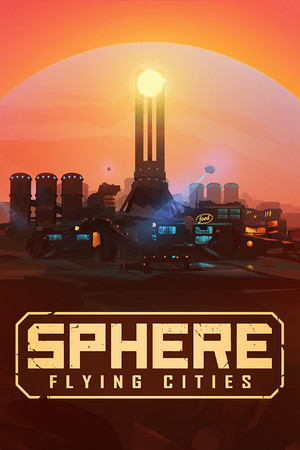
Sphere - Flying Cities
Frostpunk's floating cousin, stripped of moral weight and shipped with a clunky UI. Worth a look on deep discount if you need a breezy city-builder with a genuinely novel anti-grav hook.
GamerScout Verdict
A surface-level city-builder with a fresh anti-grav premise that runs out of depth well before genre fans run out of patience.
Compare Prices(0 stores)
Loading prices...
We may earn a commission when you buy games through links on this page — at no extra cost to you. It never affects our rankings or verdicts.
Price History
Screenshots & Media
About Sphere - Flying Cities
My spreadsheet instincts told me to be cautious the moment I saw that Steam review score sitting at 44 percent mixed. That number has a story behind it: Sphere - Flying Cities launched into Early Access in October 2021 with a difficulty curve that punished new players before they could even read the feedback their city was sending them, and the 1.0 release in October 2022 did not fully close that gap. Post-launch patches addressed some of the worst friction points, but the underlying structural problems remain visible once you know where to look. The central hook is genuinely clever. Your city floats on an anti-gravity field generated by the AG device at its core. That field doubles as a shield boundary, meaning every building you place outside its radius takes constant environmental damage from particle storms and meteor debris. Expanding the shield costs power, which means building more power plants, which means more space consumed, which means the shield needs to grow again. It is a tight feedback loop that should reward dense, optimized layouts, and for a while it does. You pilot the city across a globe map, scout resource nodes with drones before committing to a flight, then weigh whether staying in a hazardous zone long enough to finish mining is worth the repair bill. Those are real decisions, and they land with some weight early on. The problem is that the decision tree never deepens the way genre fans will expect. The loyalty mechanic, which is supposed to represent population morale, is effectively inert unless you actively neglect housing. The research tree is small, and community reviewers have noted that most loyalty-boosting buildings are unlocked by default, removing any meaningful long-term hook to that system. Robots handle all construction, mining, and maintenance, so the population feels more like a resource counter than a society. The narrative cutscenes gesture at a story but the game systems do not reinforce any of it. A campaign structure exists with difficulty settings ranging from Easy through Very Hard, and the developers did add Easy mode for the first eight missions after early feedback flagged the intro as overwhelming, which is a thoughtful response. But the thin research tree and the repetitive exploration loop mean that experienced city-builder players will feel the ceiling arrive faster than they would like. For newcomers to the genre, the calculus is different. The mechanics are comparatively accessible, the atmospheric presentation is strong, and the core loop of expand-shield, manage-power, fly-to-resources is taught through play rather than dense tooltips. Reviewers who updated their assessments after post-launch patches generally landed on "solid and enjoyable" rather than enthusiastic. The UI remains a weak point: building connections to roads are not always clearly communicated, shield strength controls are largely manual with limited automation options, and the default camera angle at startup makes orientation harder than it needs to be. These are not dealbreakers but they are friction that a strategy-and-sim audience trained on Anno or Frostpunk will feel immediately. No mod ecosystem exists here, AI is not a factor in a traditional sense since the game has no competitors, and the depth ceiling means this is unlikely to absorb the three-digit hours that grand-strategy players budget for a title. At its current deep-discount pricing this is a reasonable one-session-a-night city-builder for someone who wants something lighter after a brutal Frostpunk run, not a replacement for it.

Strategy & simulation
Tags
System Requirements
Minimum
- OS
- Windows 7/8/10 64-bit
- Memory
- 4 GB RAM
- DirectX
- Version 12
- Storage
- 3 GB available space
- Graphics
- GeForce GTX 660, Radeon R7 370 (or equivalent), 2 GB video RAM
- Processor
- 3.2 GHz Dual Core Processor
- Sound Card
- DirectX compatible
Recommended
- OS
- Windows 7/8/10 64-bit
- Memory
- 8 GB RAM
- DirectX
- Version 12
- Storage
- 3 GB available space
- Graphics
- GeForce 970, Radeon RX 580 (or equivalent), 4GB video RAM
- Processor
- 3.2 GHz Quad Core Processor
- Sound Card
- DirectX compatible
Keep exploring
Community Discussion
Be the first to comment on Sphere - Flying Cities.
Reviews & Ratings
No ratings available
Game Info
- Developer
- mañana studios
- Publisher
- Assemble Entertainment
- Release Date
- Oct 13, 2022