
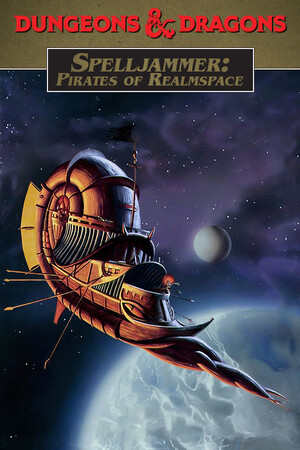
Spelljammer: Pirates of Realmspace
A 1992 DOS relic that blends AD&D 2E tactical combat with space-trading loops - worthwhile if your tolerance for old-school jank matches your love of the Forgotten Realms setting.
GamerScout Verdict
Best for SSI catalogue completionists and Spelljammer lore fans who can stomach DOSBox-era jank and a thin content loop.
Compare Prices(3 stores)
Every store in this table quotes us in euros, so the EUR figure is the price the seller actually set, not our arithmetic — which is why EUR is also the currency we rank in. We only list an offer here when the store gives us its price in euros, so nothing in this table is a number we invented.
Pick USD, PLN, GBP, CAD or AUD in the header and we convert from EUR at the European Central Bank reference rate — converted amounts are prefixed with ~. Your bank or the store may apply a different rate at checkout. We never hide offers based on where you are: everyone sees this whole table.
We may earn a commission when you buy games through links on this page — at no extra cost to you. It never affects our rankings or verdicts.
Price History
Screenshots & Media
About Spelljammer: Pirates of Realmspace
My spreadsheet instincts told me to expect a layered resource-management sim when I loaded this one up - Spelljammer tabletop lore is dense, the crystal-sphere cosmology is genuinely fascinating, and the three-pillar structure of docked trade, real-time space combat, and turn-based boarding actions sounded like a recipe for something special. The reality is more complicated than that, and knowing what you are actually getting into is the whole point of this write-up. The core loop works like this: you pick a class from the AD&D 2E roster - Fighter, Mage, Cleric, Paladin, Ranger, or Thief - and start at level 5 with a ship and a skeleton crew. From there you dock at planets to buy and sell cargo, repair your hull, upgrade weapons, and pick up missions ranging from guarding the space lanes to hunting pirates. Reputation points accumulate and eventually unlock the game's thin main quest. The trade system is rudimentary by any standard, but there is genuine freedom in whether you play as an aggressive privateer or a cautious merchant working cargo routes. The problem is that the game's reputation system does not reward the pacifist route - players who avoided combat found themselves branded as infamous despite never losing a crew member, which is a clumsy design decision that has not aged well. Combat is split into two phases. Ship-to-ship fights use a first-person view with real-time ballista and catapult fire - you steer to aim, dodge incoming shots, and try to close distance for a grapple. Once you board, the perspective flips to a top-down isometric map for phased tactical combat. Here you directly command your officers, casting spells and swinging weapons across a wide monster roster, while the AI handles your regular crew. The boarding combat is the part that holds up best - it resembles Gold Box tactical fights enough to feel familiar, and capturing an enemy vessel and swapping ships adds a light progression hook. The space-combat portion is less satisfying: the 3D view is a scaling trick rather than true three-dimensional movement, and contemporary DOS titles did it better. The bigger strategic critique is that the planets feel identical from a gameplay loop perspective. Eight worlds sounds like scope; in practice, planet docking is a text-menu system and none of the locations offer dungeon exploration or local quests beyond the mission board. The nonlinearity before the main quest kicks in is real, but the content filling that open space is thin. Bugs documented at original release - including sound-setting crashes and the infamous doorway collision - carried through to the Steam re-release via SNEG, which is essentially a DOSBox wrapper with cloud saves. There is no mod ecosystem, no updated UI, and no tutorial beyond the manual. That manual is actually worth reading if you plan to play; it explains the spelljamming-helm mechanics and the Crystal Sphere cosmology in more detail than the game itself ever surfaces. Who is this for, then? If you are working through the SSI AD&D catalogue chronologically, it sits in a specific gap between the Gold Box series and the Infinity Engine era and documents a quirky design experiment that almost worked. Spelljammer fans who want to see Toril, Coliar, and the Rock of Bral rendered in pixel form will find enough recognisable lore to justify a session or two. Anyone else expecting a deep strategy game or a polished retro RPG will find that the parts never quite add up to the sum they promised.

Strategy & simulation
Tags
System Requirements
Minimum
- OS
- Windows 7 or later
- Memory
- 512 MB RAM
- DirectX
- Version 7.0
- Storage
- 2 GB available space
- Graphics
- 3D graphics card compatible with DirectX 7
- Processor
- 1.8 GHz
Recommended
- OS
- Windows 10 / 11
- Memory
- 512 MB RAM
- DirectX
- Version 9.0
- Storage
- 2 GB available space
- Graphics
- 3D graphics card compatible with DirectX 9
- Processor
- 1.8 GHz
Keep exploring
Community Discussion
Be the first to comment on Spelljammer: Pirates of Realmspace.
Reviews & Ratings
No ratings available
Game Info
- Developer
- Cybertech
- Publisher
- SNEG
- Release Date
- Mar 27, 2023