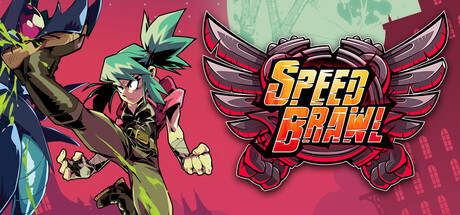
Speed Brawl
If your standard brawler bores you before the first screen clears, Speed Brawl fixes that by making momentum the actual damage stat, stop moving and you stop mattering.
GamerScout Verdict
Best for brawler fans who want their movement speed to mean something and have a couch co-op partner to share the chaos with.
Compare Prices(5 stores)
Every store in this table quotes us in euros, so the EUR figure is the price the seller actually set, not our arithmetic — which is why EUR is also the currency we rank in. We only list an offer here when the store gives us its price in euros, so nothing in this table is a number we invented.
Pick USD, PLN, GBP, CAD or AUD in the header and we convert from EUR at the European Central Bank reference rate — converted amounts are prefixed with ~. Your bank or the store may apply a different rate at checkout. We never hide offers based on where you are: everyone sees this whole table.
We may earn a commission when you buy games through links on this page — at no extra cost to you. It never affects our rankings or verdicts.
Price History
Screenshots & Media
About Speed Brawl
I came into Speed Brawl expecting the usual left-to-right cleanup loop and got something that actually punishes coasting. The core mechanic here is that your movement speed directly feeds your attack power, the faster you are moving when a hit lands, the harder it hits. That single design decision changes everything. You are not waiting for enemies to cluster so you can trade blows; you are sprinting into them, bouncing off poles, using wrecking balls and explosive barrels mid-dash, and tagging your second character the moment your stamina dips. It turns a genre that usually rewards patience into something that rewards aggression and route optimisation, which is a genuinely interesting pivot. The roster gives you six brawlers split into speed and power archetypes, and you always pick two to bring into a stage. The tag system is not just a health buffer, switching mid-combo with a character that has different specials and focus attacks opens up genuine team synergy. Each brawler has three gear slots (gloves, boots, trinket), a fame-based levelling system across power, defense, and technique skill branches, and an elemental equipment layer that reviewers and players consistently flag as the weakest part of the package. Honest answer: the elemental system barely registers in practice. You can largely ignore it and still clear events. The RPG wrapper around the combat is light enough to be welcoming but thin enough that dedicated build-crafters will feel underfed by the end. The event variety is the other thing worth flagging. Not every stage is a straight race to the finish. Some require you to hit every checkpoint in sequence inside a brutal time window; others drop an invulnerable enemy that you have to wail on to reach a damage threshold before the clock zeros out. There are 50-plus events spread across four leagues, and going back to beat your gold time on stages you already cleared is where the real replayability lives. The online leaderboards give that loop a competitive backbone, though finding open lobbies at launch was already dicey and the player count has not grown since 2018, so your mileage on async competition versus your friends list will vary. Co-op works both locally and online, and the couch version in particular is where the game shines brightest. Controlling your own two-person team while a friend controls theirs turns the already-hectic screen into something genuinely chaotic in the best way. The story mode runs roughly 10 to 11 hours to complete, and the narrative framing, a steampunk Victorian London where alien insectoids called Selenites serve as gladiatorial fodder for a spectator sport, is fun world-building largely wasted on forgettable villain dialogue. Do not come for the writing. Come for the sensation of swinging off a pole at full sprint and watching the hit connect for double the damage it would have at a standstill. The real friction is that the momentum loop can be interrupted in ways that feel cheap rather than challenging. Certain combo-count events throw so many enemies at you simultaneously that sustaining a streak becomes arbitrary rather than skilful, and some stage layouts grind your run to a halt right when you had built a clean rhythm. Loading screens between short stages also break the flow more than they should. These are not dealbreakers but they are noticeable enough that casual brawler fans who do not care about pushing for gold times may bounce off before the game clicks. For anyone who does care about leaderboard positions and optimising character pairings, the ceiling is high enough to keep you busy.
Shooters
Tags
System Requirements
Minimum
- OS
- Windows 7
- Memory
- 2 GB RAM
- Network
- Broadband Internet connection
- Storage
- 5420 MB available space
- Graphics
- NVIDIA GeForce GTX 650 or equivalent
- Processor
- Intel Core i3 or equivalent
Recommended
- OS
- Windows 10
- Memory
- 4 GB RAM
- Network
- Broadband Internet connection
- Storage
- 5420 MB available space
- Graphics
- NVIDIA GeForce GTX 960 or equivalent
- Processor
- Intel Core i5 or equivalent
Keep exploring
Community Discussion
Be the first to comment on Speed Brawl.
Reviews & Ratings
No ratings available
Game Info
- Developer
- Double Stallion
- Publisher
- Double Stallion
- Release Date
- Sep 18, 2018