Spacelines from the Far Out
Overcooked-in-space with actual stakes: your run ends, your unbanked cash evaporates, and three laughing friends suddenly become very serious crew members.
GamerScout Verdict
Best for groups of two to four who want co-op chaos with actual consequences, not just a party game reset button.
Compare Prices(0 stores)
Loading prices...
We may earn a commission when you buy games through links on this page — at no extra cost to you. It never affects our rankings or verdicts.
Price History
Screenshots & Media
About Spacelines from the Far Out
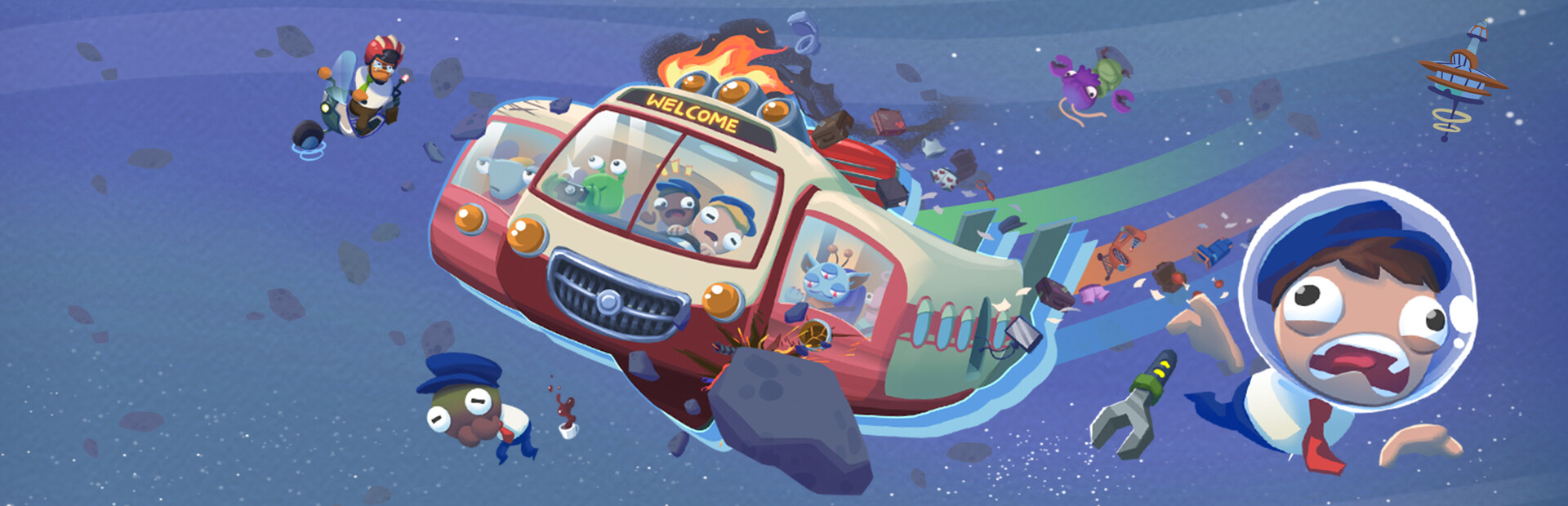
I spent a couple of runs in Spacelines from the Far Out convinced it was a breezy party game I could recommend to anyone with a couch and a controller. Then fuel ran out two stops from Gambulon V, the hull integrity hit zero, and I lost every coin I had not yet deposited at the checkpoint bank. That is the real game, and it is more interesting than the cheerful 1960s jazz aesthetic lets on. At its core this is a rogue-lite co-op management title where one to four players run an intergalactic passenger airline across a randomly generated route. Each leg of the trip layers on more pressure: passengers need feeding via laser cooker, entertaining through a dance mini-game, and mopping up after when they get sick. Meanwhile the ship's 15 upgradeable systems deteriorate as you go, asteroids show up on the radar and need dodging (the oversized "fat" ones are one-hit kills to hull integrity), and fuel burns down whether you are having a good run or a catastrophic one. The Trip Generator means no two campaigns share the same route, passenger mix, or obstacle layout, so repeat attempts genuinely feel different rather than just punishing. You can bank cash at certain checkpoints and even insure your ship so that upgrades survive a wreck, a mechanic that starts feeling less optional and more essential the deeper into a campaign you get. The comparison to Overcooked is accurate but incomplete. Where Overcooked resets failure in seconds with zero consequence, Spacelines carries permanent weight. A bad run costs real in-game progress. That tension is what separates it from the casual tier it superficially occupies. Solo play is genuinely hard, and multiple reviewers flagged it as the game's clearest weakness: one person simply cannot pilot, cook, repair, mop, and dodge asteroids at the same time without something critical failing. With two to four players the workload splits naturally, one on the helm, one on passenger care, and the chaos becomes cooperative comedy rather than frustrating overload. The absence of open public lobbies is worth noting: you need to bring your own crew, which is a real limitation if your friend group is not reliably online. On the production side, the 60s retro-futurist aesthetic is genuinely well executed. The lounge jazz shifts to more urgent arrangements when the hull starts taking damage, which is a small but effective tension tool. The UI is clean enough that newcomers can read the situation quickly, and the tutorial, also available as a standalone free demo called Flight School, does a solid job of easing players into the systems before the full campaign's difficulty curve kicks in. Ship and character customizations unlock through successful flights, giving you cosmetic goals even in runs that end early. The criticism that there is not quite enough variety in ships and upgrades has some merit: by the time you have learned the optimal build order, late runs can start to feel mechanical. For the strategy-minded player, the decision layer is thinner than something like FTL but the real-time execution pressure is higher. This is not a game where you optimize a spreadsheet between turns. You make split-second calls about whether to stop for fuel now or push to the next station, whether to spend cash on ship insurance or a new service module. Those calls compound. Get them right consistently across a two-hour campaign and arriving at Gambulon V feels earned. Get them wrong and the rogue-lite loop pulls you back to try a different approach. The Steam community sits at a Mostly Positive rating across several hundred reviews, which is an honest reflection of a game that works well in its intended context and has real rough edges outside of it.

Strategy & simulation
Tags
System Requirements
Minimum
- OS
- Windows 7 SP1, Windows 8.1 or Windows 10
- Memory
- 4 GB RAM
- Network
- Broadband Internet connection
- Storage
- 10 GB available space
- Graphics
- NVIDIA GeForce® GTX 650 equivalent or better
- Processor
- Intel® i3-3220, AMD FX 6300 equivalent or better
Recommended
- OS
- Windows 7 SP1, Windows 8.1 or Windows 10
- Memory
- 8 GB RAM
- Network
- Broadband Internet connection
- Storage
- 10 GB available space
- Graphics
- NVIDIA GeForce® GTX 960 equivalent or better
- Processor
- Intel® i5-4590, AMD FX 8350 equivalent or better
Keep exploring
Community Discussion
Be the first to comment on Spacelines from the Far Out.
Reviews & Ratings
No ratings available
Game Info
- Developer
- Coffeenauts
- Publisher
- Skystone Games
- Release Date
- Jun 9, 2022