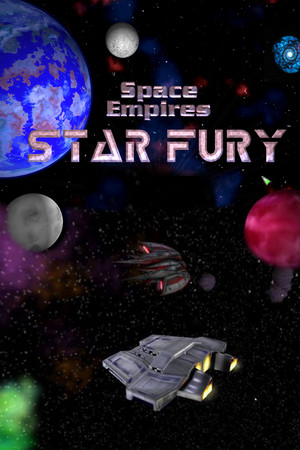
Space Empires: Starfury
A 2003 space-sim oddity that swaps empire management for lone-wolf ship combat, Starfury is strictly for players who want the Space Empires universe at ground level and can forgive a flat, mission-repetitive loop.
GamerScout Verdict
Worth it only for Space Empires series fans who want ground-level ship combat; newcomers should start with SE IV or SE V instead.
Compare Prices(0 stores)
Loading prices...
We may earn a commission when you buy games through links on this page — at no extra cost to you. It never affects our rankings or verdicts.
Price History
Screenshots & Media
About Space Empires: Starfury
My spreadsheet instincts told me to expect a stripped-down 4X, but Starfury is something more awkward and more interesting than that. Where the mainline Space Empires titles put you in charge of entire civilizations across turn-based star maps, this one shrinks the scope to a single hull and asks you to care about tonnage limits, weapon hard points, and firing arcs rather than fleet orders and diplomatic treaties. That pivot is genuinely surprising coming from Malfador Machinations, and understanding it up front will save you the frustration of loading this up expecting Space Empires V in miniature. The mechanical core is real-time ship combat built around a component-slot system that fans of the mainline series will recognize immediately. You purchase hulls from various races, each with its own hard-point layout, then fill the available tonnage with weapons, shields, armor, engines, ECM, combat sensors, and life-support modules. The ceiling on total tonnage is the one genuine design constraint that keeps the build decisions meaningful. Combat itself plays out as a drawn-out dance of weapon charge cycles and armor angling rather than a reflexes-first shooter, which suits the audience. Particle beams, torpedoes, and layered shields make engagements feel like the tactical puzzles SE veterans expect, though the entirely 2D movement plane removes a full axis of maneuvering and makes some fights feel more like face-to-face slugging matches than proper dogfights. Your commander also levels up between missions, with attribute points allocated by the player, giving a light RPG layer on top of the hardware customization. The campaign structure gives you three interconnected storylines following a TCN undercover agent investigation into pirate escalation, but the game is non-restrictive enough that you can shelve the plot entirely, join a trading guild, take mercenary contracts, or work toward pirate faction membership at significant credit cost. The open-ended freedom is real, but the mission pool underneath it gets repetitive faster than the sandbox framing implies. Timed delivery and escort jobs form the bulk of available work, and the tight time windows mean a single pirate interception en route can flip a passing run into a failed one with no recourse. There is no mid-mission surrender or loot recovery from defeated pirates, which cuts off some of the friction-filling side activity you might expect from the Elite-adjacent design pitch. Reviewers at launch noted the loop felt familiar to the point of staleness for anyone who had played space-sims in the decade prior. What partially rescues it is the mod architecture. The game was built with modability as a first-class design goal, and the community around the broader Space Empires franchise has historically taken that seriously. The data files are accessible enough that hull layouts, weapon stats, race setups, and mission parameters can all be adjusted without deep technical knowledge. For a niche title with a small but loyal playerbase, that open structure has extended the shelf life considerably beyond what the base content alone would support. Steam's handful of user reviews sit at a modest 70 percent positive across a very small sample, which tells you more about who still seeks this game out than about its objective quality ceiling. For strategy players who have never touched the Space Empires series, the honest recommendation is to start with Space Empires IV or V instead. This title was literally built from a combat engine prototype that was judged not deep enough for SE V, and that origin story shows in places. But if you already know the lore, the factions, and the ship component logic, dropping into a single-ship perspective inside that universe has a distinct appeal that no other game in the series replicates. Manage your expectations around the mission variety, accept the 2D plane, and treat the component build screen as the actual game. On those terms it holds up as a functional, mod-friendly curio.

Strategy & simulation
Tags
System Requirements
Minimum
- OS
- Windows 7 / 8.1 / 10
- Memory
- 1024 MB RAM
- Storage
- 1024 MB available space
- Graphics
- Video card with 128MB RAM
- Processor
- 1 gigahertz (GHz) or faster
Keep exploring
Community Discussion
Be the first to comment on Space Empires: Starfury.
Reviews & Ratings
No ratings available
Game Info
- Developer
- Malfador Machinations
- Publisher
- Strategy First
- Release Date
- Aug 3, 2020