Something Ate My Alien
A hand-painted two-person passion project that smuggles a surprisingly meaty puzzle game inside a cheerful alien digging adventure. If you liked SteamWorld Dig but wanted block puzzles and boss wyrms, this scratches that itch.
GamerScout Verdict
Best for patient players who love methodical digging loops and satisfying block puzzles wrapped in a cheerful hand-painted sci-fi package.
Compare Prices(5 stores)
Every store in this table quotes us in euros, so the EUR figure is the price the seller actually set, not our arithmetic — which is why EUR is also the currency we rank in. We only list an offer here when the store gives us its price in euros, so nothing in this table is a number we invented.
Pick USD, PLN, GBP, CAD or AUD in the header and we convert from EUR at the European Central Bank reference rate — converted amounts are prefixed with ~. Your bank or the store may apply a different rate at checkout. We never hide offers based on where you are: everyone sees this whole table.
We may earn a commission when you buy games through links on this page — at no extra cost to you. It never affects our rankings or verdicts.
Price History
Screenshots & Media
About Something Ate My Alien
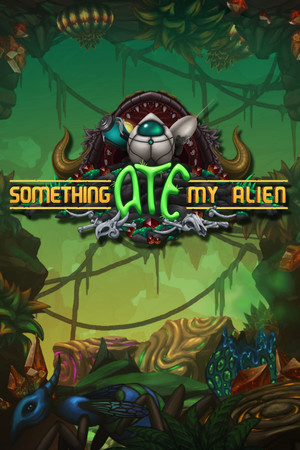
I have a soft spot for games where you can feel the handprint of the people who made them, and Something Ate My Alien has that quality all over it. Rob and Kat of RoKabium Games spent roughly four years building this in Unity, and that care shows in every brushstroke of the underground environments. Bright mineral veins glow against dark subterranean walls, acid splashes animate with a satisfying splat, and the goofy sci-fi soundtrack keeps the whole thing feeling buoyant rather than oppressive. This is not a dour spelunker. It is cheerful, a little absurd, and genuinely pleasant to spend time in. The structure blends three distinct activities, and the balance between them is the thing you need to understand before buying. You are playing as Antalasia, the AI of a hijacked mining ship, sending your blob-like alien crew down to four distinct planets to gather ransom materials for a mouthy space pirate. That framing gives the game its light ongoing comedy: the pirate taunts you for working too slowly, and your blobs bicker back. The actual digging loop is methodical. Levels are hand-crafted rather than procedurally generated, so your progress is saved each run. You carve paths through grid-based terrain, collect gems, fossils, minerals, and gases, manage a depleting oxygen bar topped up by recharge stations or by killing enemies, and navigate environmental hazards including corrosive pools, toxic gases, slippery ice, and falling rocks. Six weapons handle the combat side, from a pyroblaster suited for burning clustered spiders to a grenade launcher for clearing tight corridors. Excess resources go toward upgrades: faster mining speed, bigger oxygen tanks, longer jetpack burn, stronger weapons. The puzzle chambers are where the game earns its best moments. Scattered across each planet are locked rooms containing numbered block puzzles. The mechanic is clean: colored blocks must be pushed or pulled into matching slots, affected by gravity unless magnets are involved, and your alien can never lift them, only nudge them. Over 40 chambers across the four planets introduce new wrinkles like magnetic blocks and colorless wildcards at a steady pace. Solving a set of puzzles on a planet eventually summons a boss, a large wyrm-like creature called a Something, which is the source of the title and genuinely threatening during exploration before you are ready to fight it. The final stage escalates this into a back-to-back gauntlet with a dual-Something finale. That ending gets the pacing right in a way the middle occasionally does not. The honest caveat: the traversal connecting puzzle rooms can drag. Walking and digging your way through long stretches of terrain to reach the next chamber is less engaging than the chambers themselves, and enemy spawns in enclosed spaces can occasionally feel unfair rather than challenging. Dying mid-exploration means losing gathered resources until you retrieve them, which adds mild tension but mostly adds friction. Players who find the mining loop meditative will not mind. Players who want to skip straight to the puzzles may find the journey longer than it needs to be. For the right audience, though, there is a warmth here that bigger titles rarely manage. The hand-painted art style is genuinely distinctive, the controller support is solid (and the exclusive hold-position command makes mid-air mining noticeably easier), and the game runs on PC, Mac, and Linux with minimal system requirements. At roughly 10 or more hours depending on how thoroughly you explore, it respects your time without padding aggressively. This is a small game that knows what it is, made by two people who clearly loved making it.

Indie & narrative
Tags
System Requirements
Minimum
- OS
- Windows 7 or newer
- Memory
- 2 GB RAM
- Storage
- 3 GB available space
- Graphics
- Intel HD 4000 or better. 1GB VRAM
- Processor
- Intel Core i3 or similar
Recommended
- OS
- Windows 10 or newer
- Memory
- 4 GB RAM
- Storage
- 3 GB available space
- Graphics
- DirectX 11 Compatible card. 2GB VRAM
- Processor
- Intel i3 or newer
Keep exploring
Community Discussion
Be the first to comment on Something Ate My Alien.
Reviews & Ratings
No ratings available
Game Info
- Developer
- Rokabium Games
- Publisher
- Rokabium Games
- Release Date
- Jun 18, 2020