
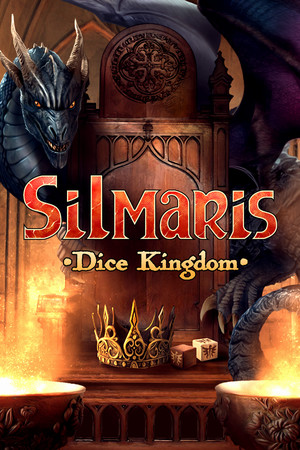
Silmaris: Dice Kingdom
Winning at Silmaris requires losing at Silmaris, repeatedly, until the brutal rhythm of five dice colors and Fate Points finally clicks. RNG-tolerant strategy players will find a compact, replayable kingdom sim with surprising narrative depth.
GamerScout Verdict
Worth the entry price for RNG-tolerant players who enjoy iterative strategy runs, but expect multiple losses before the system finally clicks.
Compare Prices(0 stores)
Loading prices...
We may earn a commission when you buy games through links on this page — at no extra cost to you. It never affects our rankings or verdicts.
Price History
Screenshots & Media
About Silmaris: Dice Kingdom
I went into Silmaris: Dice Kingdom expecting a light board-game-ish diversion, and came out genuinely humbled by how methodically it dismantles overconfident players. The core loop sits at the intersection of choose-your-own-adventure storytelling and opposed dice-roll resource management, and the two halves are in constant tension, for better and worse. You rebuild the fallen city of Thylla by subduing rival monarchs across the valley, and every action on the map, from military invasions to espionage runs to trade agreements, resolves through colored dice pools. There are five resource types (military, diplomacy, grain, espionage, and trade), each represented by a distinct dice color, and your adviser roster determines how many dice you accumulate each turn. Recruiting the right advisers and leveling their skills is the closest thing the game has to a build path, and losing one to a random event mid-run genuinely stings. The difficulty here is not artificial wall-of-numbers hard, it is information-asymmetry hard. Early runs will end with you having no real idea what killed you. Was it the ally conversion you prioritized, which turns out to be weaker economically than maintaining a trade-friendly neutral city? Was it banking eight espionage dice without understanding that a bad reroll only restores half your pool? The game does not hand you this knowledge. A brief tutorial covers the basics, but the meta-layer, which paths are viable, when to spend Fate Points on rerolls versus hoarding them for adviser recruitment, takes repeated losses to internalize. Players who accept that the first three to five runs are essentially paid tuition will find the system rewarding once the logic becomes readable. The narrative side is the stronger half. Story segments are procedurally arranged each run, so the sequencing of events changes, and the written content is well-crafted enough that discovering a new branch still feels like a payoff. Choices carry moderate consequence; angering a rival faction in a story beat can make your dice rolls against their city harder in subsequent turns, which is a nice bit of integration. The tone is straight medieval fantasy, closer to a grounded Dungeons and Dragons setting than the weird folk-horror of King of Dragon Pass or the sardonic wit of Reigns, which means it lacks those games' distinctive personality, but is also more immediately legible. Twenty hours in, players report still encountering story content they have not seen before, so the written pool is genuine. Where the game earns its Mixed Steam rating is the dice management layer between story beats. Watching rows of dice resolve identical opposed rolls for a war action and a smuggling action starts to feel mechanical and abstract after a while, like a spreadsheet expressed in physical objects rather than a simulation of actual kingdom-building. The randomness is also genuinely punishing in ways that can feel arbitrary rather than strategic, particularly in the early-mid run window before you have stabilized your dice economy. Players with low tolerance for variance will hit a wall and disengage well before the system reveals its depth. For the right audience, though, there is something here that larger, louder strategy games do not deliver. The run length is short enough to attempt multiple per session, the replayability is real given the branching story pool, and the adviser-and-dice-color build space gives you enough levers to try meaningfully different approaches across runs. It is not a grand strategy game and does not pretend to be. Think of it as a compact, punishing narrative-strategy hybrid with a low entry price and a steep but finite learning curve.

Strategy & simulation
Tags
System Requirements
Minimum
- OS
- Microsoft® Windows® 8/10 64 bits
- Memory
- 2 GB RAM
- Storage
- 2 GB available space
- Graphics
- 512 MB VRAM
- Processor
- Dual core
Recommended
- OS
- Microsoft® Windows® 8/10 64 bits
- Memory
- 4 GB RAM
- Storage
- 2 GB available space
- Graphics
- 1 GB VRAM
- Processor
- Quad core
Keep exploring
Community Discussion
Be the first to comment on Silmaris: Dice Kingdom.
Reviews & Ratings
No ratings available
Game Info
- Developer
- Pyrogen
- Publisher
- Mi-Clos Studio
- Release Date
- Dec 3, 2020