Shadowrun Trilogy
Three compact CRPGs that prove cyberpunk and high fantasy make a better couple than anyone had a right to expect. Read-heavy, tactics-light, story-first.
GamerScout Verdict
Best for CRPG fans who want tight, story-first tactical RPGs they can actually finish in a weekend or two.
Compare Prices(4 stores)
Every store in this table quotes us in euros, so the EUR figure is the price the seller actually set, not our arithmetic — which is why EUR is also the currency we rank in. We only list an offer here when the store gives us its price in euros, so nothing in this table is a number we invented.
Pick USD, PLN, GBP, CAD or AUD in the header and we convert from EUR at the European Central Bank reference rate — converted amounts are prefixed with ~. Your bank or the store may apply a different rate at checkout. We never hide offers based on where you are: everyone sees this whole table.
We may earn a commission when you buy games through links on this page — at no extra cost to you. It never affects our rankings or verdicts.
Price History
Screenshots & Media
About Shadowrun Trilogy
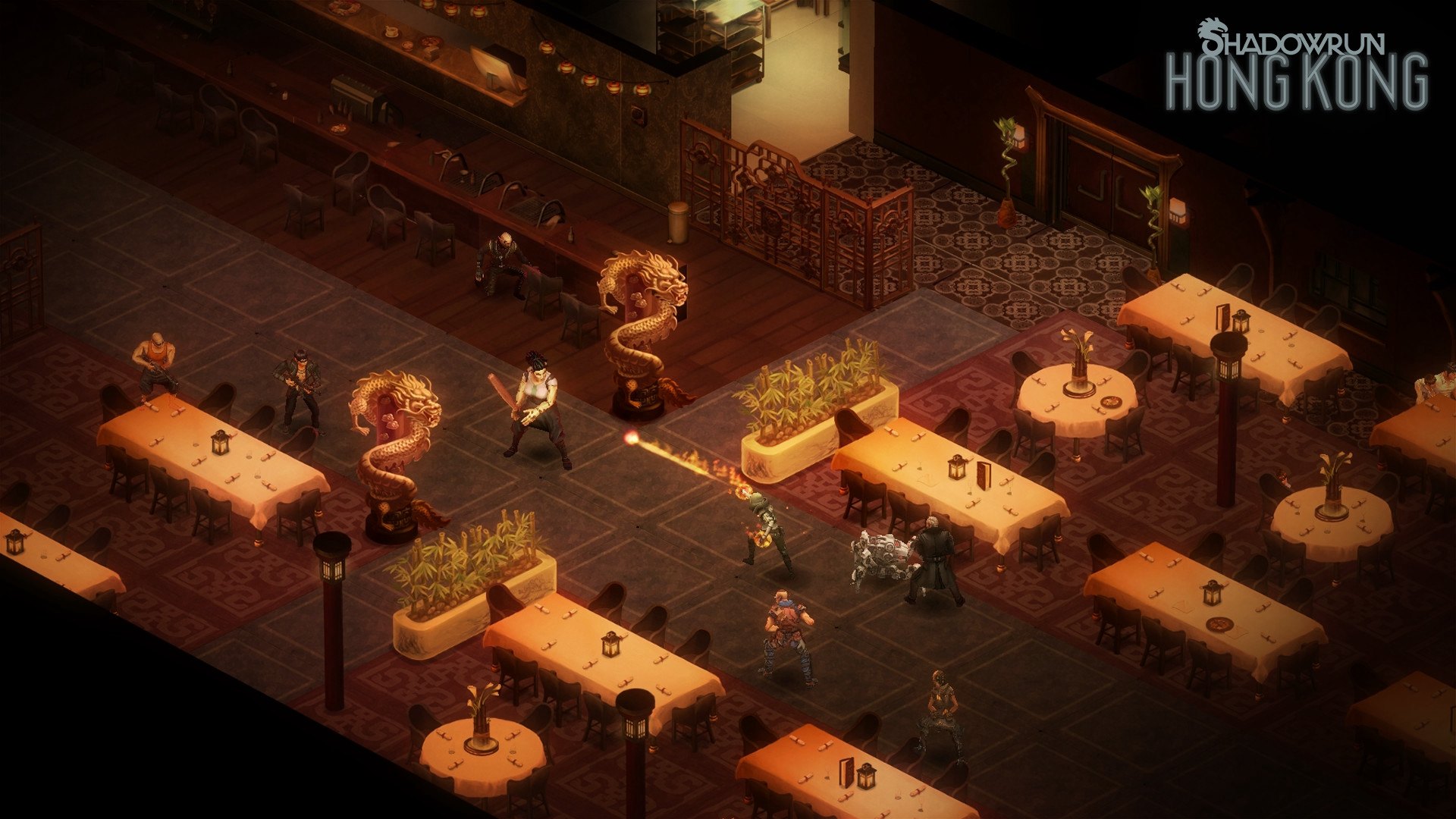
My first hours with Shadowrun Returns felt like stumbling into a noir detective novel that had been stapled to a Dungeons and Dragons sourcebook, and I mean that as a genuine compliment. The trilogy, developed by Harebrained Schemes and published by Paradox Interactive, bundles three isometric, turn-based tactical RPGs set in a world where magic returned to a near-future Earth, and elves with cyberware implants are just a Tuesday. It is one of the stranger genre fusions in PC gaming, and it works far more often than it should. Each game runs through three phases: dialogue, exploration, and turn-based combat. The combat borrows the broad strokes of XCOM-style action-point mechanics, where every character acts on a pool of AP per turn, spending it to move, shoot, reload, or cast. Shadowrun Returns, the opener, kicks off with a noir murder investigation in Seattle and is the shortest entry at around ten to twelve hours. Shadowrun: Dragonfall, set in an anarchist Berlin, is widely considered the high point of the trilogy for its tighter structure and more memorable companion writing. Shadowrun: Hong Kong refines the mechanics further still, particularly the Matrix hacking sequences, and adds a full permanent crew including Gobbet (an orc street-shaman), Is0bel (a dwarf decker), and Racter (a Russian rigger who travels with his self-built drone, Koschei). Dragonfall and Hong Kong both run around twenty hours each, so together you are looking at fifty-plus hours of content across very different settings. Character building is the mechanical core, and it rewards patience. The six archetypes, Street Samurai, Mage, Decker, Rigger, Physical Adept, and Shaman, each shift how you interact with encounters. A Decker can jack into the Matrix to disable security grids or cut off enemy reinforcements. A Rigger floods a room with drones. A Mage tosses area spells from cover, though positioning carefully matters since Mages make easy targets if caught in the open. The classless Karma system means you can push any character in almost any direction, though the community broadly agrees that mixing magic and cybernetics tends to undercut both sides since cyberware drains Essence, which weakens magical ability. Some archetypes, notably the Shaman, polarize players: spirit summoning is situationally strong but feels inconsistent compared to just shooting things with an assault rifle. The imbalance is real, though rarely game-breaking. What holds up best is the writing. Each game leans hard into its setting without explaining itself to death, and the branching dialogue trees include stat- and skill-gated options that let a silver-tongued Street Samurai talk her way past checkpoints a Mage would have to blast through. The stories deal with corporate overreach, inequality, and people with no institutional power fighting to reclaim some agency, themes that land with more weight now than they did at original release. Where the trilogy stumbles is in visual presentation, which was modest at launch and has not been updated. The isometric environments are functional rather than impressive, and Shadowrun Returns in particular shows its age in the save system, which originally only checkpointed at area transitions. Dragonfall fixed that with anywhere-saves, a quality-of-life upgrade that carries forward into Hong Kong. This is a trilogy for players who like reading, who enjoy deliberate turn-based tactics over spectacle combat, and who want a setting that does not feel like every other cyberpunk game on the shelf. If you bounce off walls of text or need modern production values to stay engaged, the rough exterior will push you out before the story pulls you in. For everyone else, especially players who bounced off heavier CRPGs like Pillars of Eternity and wanted something more compact, each entry finishes in a single weekend. The ceiling on value here is high.

Catch-all
Tags
System Requirements
Minimum
- Processor
- x86-compatible 1.4GHz or faster processor
- Memory
- 2 GB RAM
- Graphics
- DirectX compatible 3D graphics card with at least 256MB of addressable memory DirectX®:9.0 Hard Drive:2 G…
Keep exploring
Community Discussion
Be the first to comment on Shadowrun Trilogy.
Reviews & Ratings
Game Info
- Developer
- Paradox Interactive
- Publisher
- Paradox Interactive
- Release Date
- Jun 23, 2016