Scorchlands
A hex-grid logistics puzzler disguised as a cozy builder: laser-routing your supply chains across a volcanic moon is more satisfying than it has any right to be, but the depth ceiling arrives faster than hardcore sim fans will want.
GamerScout Verdict
Best for logistics-puzzle fans who want a chill, two-playthrough colony builder with a genuinely clever transport mechanic.
Compare Prices(5 stores)
Every store in this table quotes us in euros, so the EUR figure is the price the seller actually set, not our arithmetic — which is why EUR is also the currency we rank in. We only list an offer here when the store gives us its price in euros, so nothing in this table is a number we invented.
Pick USD, PLN, GBP, CAD or AUD in the header and we convert from EUR at the European Central Bank reference rate — converted amounts are prefixed with ~. Your bank or the store may apply a different rate at checkout. We never hide offers based on where you are: everyone sees this whole table.
We may earn a commission when you buy games through links on this page — at no extra cost to you. It never affects our rankings or verdicts.
Price History
Screenshots & Media
About Scorchlands
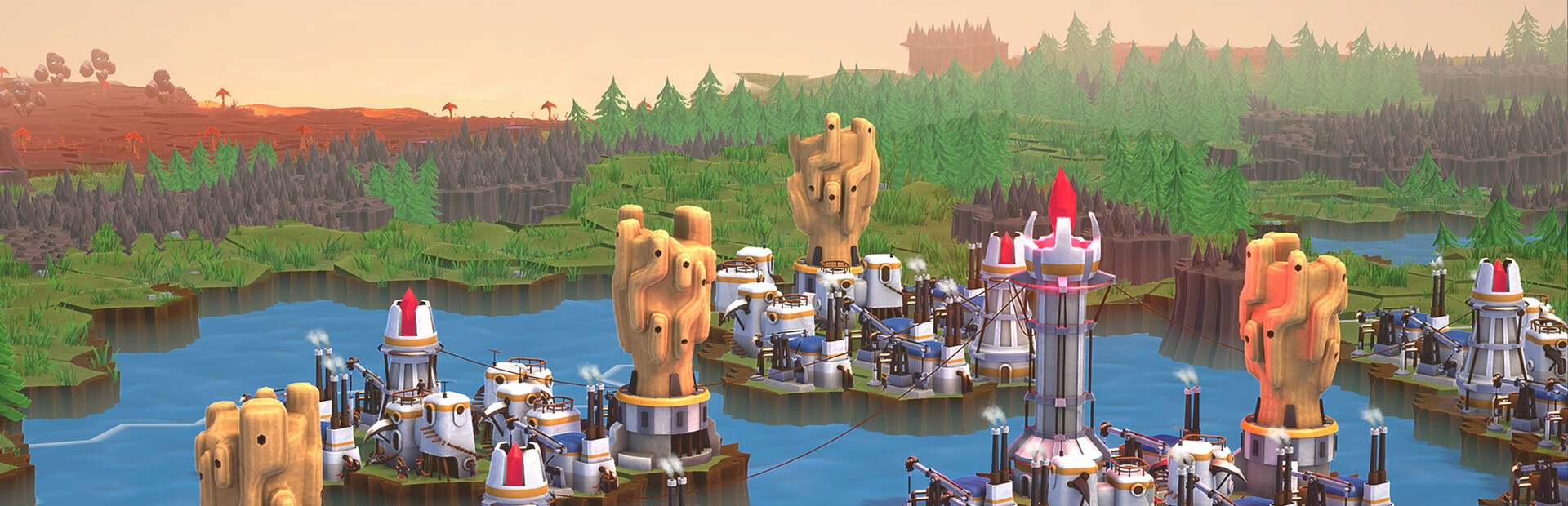
My first instinct when I loaded Scorchlands was to reach for a spreadsheet, and then I realized the game had already made one irrelevant. Unlike every factory-builder I've lost months to, this one strips away the time pressure entirely. Resource production here has no tick rate: a quarry outputs stone instantly, and the colony either has what it needs or it doesn't. That sounds like it removes all the tension, and for the first hour it genuinely does. Stick with it past that initial friction and a different kind of challenge surfaces, one built around spatial planning and logistics routing rather than throughput racing. The core loop is colony placement on a hex grid, building adjacency optimization, and inter-colony resource transfer via a system of transfer lasers and mirrors that you physically aim across the map. The laser-mirror mechanic is the game's signature and its most discussed feature for good reason: routing a beam through tight terrain, bouncing it off two or three mirrors to feed a distant Nexus with processed compounds, produces a puzzle-box satisfaction that no conveyor belt has matched for me recently. Catapults offer a shorter-range alternative, but they eat space and have hard line-of-sight limits, so the laser network becomes your real infrastructure problem to solve. Building adjacency adds another layer: productivity scales based on what neighbors a structure, so colony layouts are genuine optimization problems rather than aesthetic choices. Each colony also runs on a workforce cap that gates how many buildings you can place, which forces you to think about density and tech-tree investment at the same time. The technology tree and biome terraforming system give the mid-game its momentum. You funnel refined resources into the Nexus to unlock new biomes, each carrying unique raw materials that open higher-tier processing chains. Procedurally generated maps mean your laser routing problem is never quite the same twice, and that gives the game real replay value for a first and second run. A GOG reviewer put a number on it: two full playthroughs lands somewhere around 30 hours, and the third run is where diminishing returns set in. That matches my read. The tech tree is wide enough to feel meaningful but not so dense that a new player will drown. The prologue tutorial is brief and light on hand-holding, which will frustrate some, but the mechanics are simple enough that trial-and-error costs nothing given the zero-timer design. The places Scorchlands falls short are worth naming. The combat system is minimalistic by the developer's own admission: you maneuver your avatar and a small Giwi squad around a hex grid, using positioning and flanking to reduce enemy influence zones until you can destroy a guarding crystal. It works as a palate cleanser between logistics sessions, and the synergy rules for adjacent units add a mild puzzle dimension, but anyone coming in expecting even Wargroove-level tactical depth will be disappointed. Building visual variety is also limited; colonies can start to look homogeneous as they scale, and the UI has some readability friction that earlier versions carried and that the 1.0 release only partly resolved. A minor frame-rate slowdown on large maps is reported by multiple players and worth noting if you run a lower-spec machine. For strategy and sim players who find Anno too punishing and Factorio too mechanical, Scorchlands sits in a useful gap. It is a solo project from a single developer at Ringlab, and the craft shows in the coherence of the design even if the content volume reflects that constraint. The Steam user base landed at 92% positive across roughly 106 reviews, which is a reliable signal for an indie at this scale. If you want a thinky, pressure-free logistics game with a genuinely novel transport mechanic, it earns your time. If you need a 200-hour endgame grind or a modding scene to keep you busy, look elsewhere.

Strategy & simulation
Tags
System Requirements
Minimum
- OS
- Windows 7 / 8 / 10 / 11 x64
- Memory
- 8 GB RAM
- Storage
- 1 GB available space
- Graphics
- GeForce GTX 1050Ti 4GB
- Processor
- Intel(R) Core(TM) i5-6400 CPU @ 2.70GHz
Recommended
Requires a 64-bit processor and operating system
Keep exploring
Community Discussion
Be the first to comment on Scorchlands.
Reviews & Ratings
No ratings available
Game Info
- Developer
- Ringlab
- Publisher
- Star Drifters
- Release Date
- Jul 25, 2024