
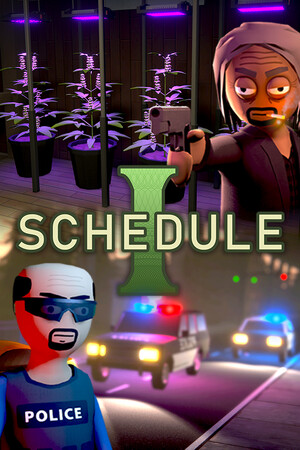
Schedule I
Ignore the premise for a second: this is one of the tightest supply-chain management games released in years, wrapped in a satirical crime skin that somehow makes automation feel genuinely exciting.
GamerScout Verdict
Best for sim and strategy players who want a deep supply-chain loop and can tolerate an Early Access ceiling on the endgame.
Compare Prices(6 stores)
Every store in this table quotes us in euros, so the EUR figure is the price the seller actually set, not our arithmetic — which is why EUR is also the currency we rank in. We only list an offer here when the store gives us its price in euros, so nothing in this table is a number we invented.
Pick USD, PLN, GBP, CAD or AUD in the header and we convert from EUR at the European Central Bank reference rate — converted amounts are prefixed with ~. Your bank or the store may apply a different rate at checkout. We never hide offers based on where you are: everyone sees this whole table.
We may earn a commission when you buy games through links on this page — at no extra cost to you. It never affects our rankings or verdicts.
Price History
Screenshots & Media
About Schedule I
I keep a running list of Early Access titles that actually respect the player's intelligence, and Schedule I landed near the top inside the first hour. Solo developer TVGS has shipped what is, beneath its deliberately scruffy exterior, a layered empire-management sim with a progression curve that strategy players will recognise immediately: constrained early resources, mounting operational complexity, and a late-game where the bottleneck shifts from cash to logistics and attention management. The production loop is the core hook. You start by hand-crafting product in a rented motel room, physically running deliveries on foot or skateboard to unlock your first clients. As your rank climbs across 74 tiered levels, new regions of Hyland Point open up, new substances become available (weed, meth, cocaine, shrooms, with more on the roadmap), and the chemistry system lets you experiment with mixing ingredients to hit different quality tiers and customer-preference profiles. Lab setup requires real planning: grow tents, burners, mixers, drying racks, and environmental controls like AC units all feed into production output. That detail is not decoration. Each step in the chain has failure modes, and losing a batch to a raid or mismanaged heat meter is a genuine setback. The police AI runs per-territory heat tracking, so pushing too hard in one district forces you to rotate operations or lay low rather than just absorbing a fine and continuing as normal. The business layer is where Schedule I earns serious strategy credentials. Money laundering through purchased storefronts is not optional flavour; it is a mechanical requirement to keep dirty cash usable. Hiring and assigning dealers means managing their customer pools, arming them against cartel interference, and understanding that rival cartel influence actively erodes your territory if left unchecked. Customer addiction mechanics feed directly into word-of-mouth referrals or police reports depending on satisfaction levels. There is a genuine supply-demand loop here, with pricing, product quality, and delivery consistency all feeding back into long-term revenue. The co-op mode supports up to four players and lets groups divide the labour across production, distribution, and defence roles, which is the fastest way to stress-test whether your operation is actually efficient or just held together by your own micromanagement. The criticisms worth noting are real. The current endgame has a repetitive restocking cycle that some players find grindy once full automation is nearly achieved but not quite complete. Early Access bugs have appeared, though the developer ships patches consistently and has published a multi-year roadmap that includes map expansions, cartel systems, a weather layer, bribery mechanics with police, and custom product packaging. The art style is deliberately cartoonish, which works tonally but will not impress anyone looking for visual fidelity. And yes, the subject matter is not for everyone; the game does not pretend otherwise. For strategy and sim players specifically: the depth-to-jank ratio here is surprisingly good for a one-person Early Access project. The progression feels designed rather than accidental, the crafting avoids busywork through genuinely interactive minigames, and the territory and cartel systems give the mid-to-late game real strategic texture. Approach it as a crime-themed Offworld Trading Company crossed with a light factory-automation game and you will not be disappointed.

Strategy & simulation
Tags
System Requirements
Minimum
- OS
- Windows 10 (64-bit)
- Memory
- 8 GB RAM
- DirectX
- Version 11
- Storage
- 8 GB available space
- Graphics
- GeForce GTX 1060 6GB or Radeon RX 580
- Processor
- 3GHz 4-Core or similar
Recommended
- OS
- Windows 10 (64-bit)
- Memory
- 16 GB RAM
- DirectX
- Version 11
- Storage
- 10 GB available space
- Graphics
- GeForce RTX 3060 or Radeon RX 6700
- Processor
- 3.5GHz 6-Core or similar
Keep exploring
Community Discussion
Be the first to comment on Schedule I.
Reviews & Ratings
Game Info
- Developer
- TVGS
- Publisher
- TVGS
- Release Date
- Mar 24, 2025


